Why is the sky blue?
Short answer
The sky appears blue because of Rayleigh scattering. As sunlight enters Earth’s atmosphere, it collides with gas molecules and scatters in all directions. Shorter, blue wavelengths of light scatter more strongly than longer, red wavelengths. Consequently, when you look up, your eyes detect this scattered blue light coming from every part of the sky.
On this page
Why the sky is blue
Sunlight may look white, but it is actually composed of the entire visible spectrum of colors, ranging from red to violet. Each color corresponds to a specific wavelength, with red light having the longest wavelengths and blue or violet light having the shortest. When this light reaches Earth, it encounters the atmosphere, which is filled with nitrogen and oxygen molecules.
Because these gas molecules are much smaller than the wavelengths of visible light, they cause a phenomenon known as Rayleigh scattering. Named after the British physicist Lord Rayleigh, who described the effect in 1871, this process dictates how light interacts with particles. Shorter wavelengths, specifically blue and violet, are scattered much more efficiently than longer wavelengths like red or yellow. As a result, the blue light is dispersed across the sky, creating the azure appearance we observe during the day.
How light interacts with the atmosphere
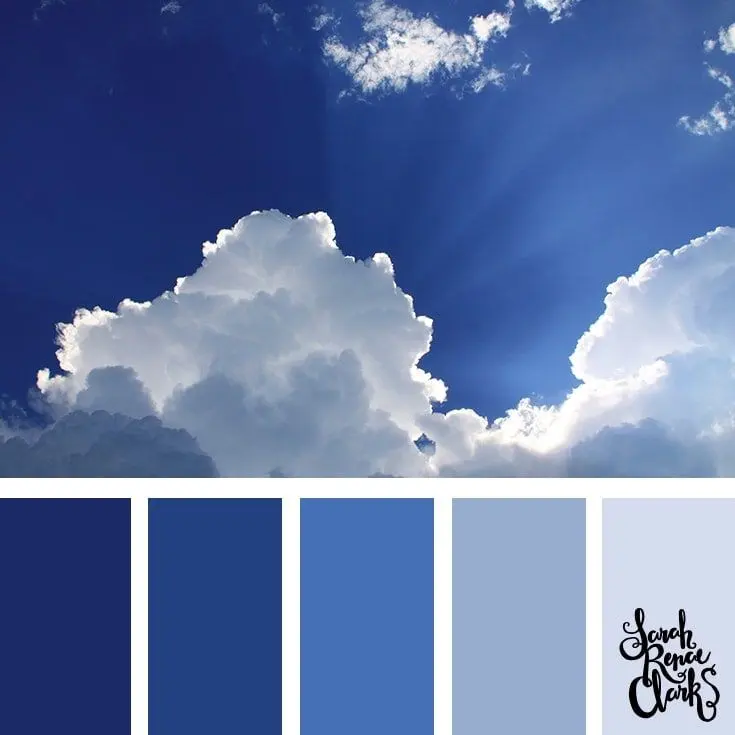
The atmosphere acts as a complex filter for solar radiation. While the scattering process is consistent, the specific path of the light changes depending on the angle of the sun. When the sun is high in the sky, the light travels through a relatively thin layer of the atmosphere to reach your eyes. This allows the scattered blue light to dominate the visual field.
Several factors influence the intensity and hue of the sky:
- Atmospheric density: Denser air at lower altitudes increases the frequency of scattering events.
- Particle size: Larger particles, such as dust or water droplets, scatter all wavelengths equally, which can make the sky look hazy or white.
- Solar elevation: The distance light travels through the atmosphere changes the color composition reaching the ground.
Why sunsets are red
Sunsets and sunrises occur because the sun is positioned near the horizon. During these times, sunlight must travel through a significantly thicker portion of the Earth’s atmosphere to reach an observer. By the time the light arrives, most of the blue light has been scattered away completely, leaving only the longer wavelengths to pass through.
This shift in color is a direct consequence of the increased distance the solar rays must cover. As the blue light is stripped away, the remaining light is dominated by the red, orange, and pink ends of the spectrum. You can observe this effect by noting the following progression:
- High noon: The sun appears white or yellow because light takes the shortest path.
- Late afternoon: The sky begins to shift toward orange as the path length increases.
- Sunset: The blue light is almost entirely scattered, leaving deep reds and purples.

Common misconceptions about sky color
A frequent error is the belief that the sky is blue because it reflects the color of the ocean. In reality, the ocean appears blue largely because it reflects the sky, though water also absorbs red light. The two phenomena are linked by reflection, but the sky’s color is an independent result of atmospheric physics rather than a reflection of the Earth's surface.
Another common mistake is assuming that violet light should make the sky look violet. While violet light has an even shorter wavelength than blue and scatters more intensely, the human eye is significantly more sensitive to blue light. Furthermore, the sun emits less violet light than blue light, and the upper atmosphere absorbs some of the violet spectrum. These biological and physical factors combine to ensure that the sky appears blue rather than violet to the average human observer.
How to observe atmospheric light effects
To better understand these principles, you can conduct simple observations of the sky throughout the day. By tracking the color changes from dawn to dusk, you will see the scattering process in action. Use a camera with manual white balance settings to capture these shifts, as automatic settings often attempt to color-correct the image, which can mask the natural changes in light quality.
When observing the sky, avoid these common errors:
- Ignoring the influence of clouds, which scatter all light and appear white or gray.
- Attempting to observe the sun directly, which can cause permanent retinal damage.
- Misinterpreting pollution, which can cause the sky to look brownish or milky due to larger particulate matter scattering light differently than gas molecules.
By paying attention to the clarity of the air and the position of the sun, you can accurately predict how the sky will appear. High-pressure systems often result in a deeper, more vibrant blue because they contain fewer aerosols to interfere with the natural Rayleigh scattering process. Understanding these variables allows you to appreciate the atmosphere as a dynamic filter that constantly transforms the white light of the sun into the diverse palette of colors we see above us each day.
Key facts
- Sunlight is composed of all the colors of the visible spectrum, which appear white when combined.
- Rayleigh scattering is the physical phenomenon that causes shorter blue light waves to scatter more than longer red waves.
- The Earth’s atmosphere is filled with gases like nitrogen and oxygen that act as obstacles for incoming sunlight.
- Blue light travels in shorter, smaller waves, making it collide with atmospheric molecules more frequently than red light.
- During sunrise and sunset, sunlight travels through a thicker layer of the atmosphere, scattering away blue light and leaving reds and oranges.
- To observe light scattering at home, mix a drop of milk into a glass of water and shine a flashlight through it to see a bluish tint.
The bottom line
The blue color of the sky is a result of Rayleigh scattering, where Earth's atmospheric gases disperse shorter blue light waves more effectively than longer red ones. While sunlight contains all colors, our eyes perceive the scattered blue light as the sky's color. This natural phenomenon shifts during sunrise and sunset, demonstrating how atmospheric density and the angle of sunlight dictate the colors we see daily.
People also ask
Why is the sky red at sunset?
When the sun is low on the horizon, its light must pass through a much thicker portion of the atmosphere. This distance causes the blue light to scatter away completely, allowing only the longer wavelengths like red and orange to reach your eyes.
Is the sky actually blue or does it just look that way?
The sky does not have an inherent color, as it is simply the appearance of sunlight interacting with our atmosphere. If the Earth had no atmosphere, the sky would appear black even during the day, as seen by astronauts in space.
Do other planets have blue skies?
The color of a sky depends entirely on the composition of a planet's atmosphere and its distance from a star. For example, Mars often has a reddish or butterscotch-colored sky due to suspended dust particles that scatter light differently than Earth's gases.
Does air pollution change the color of the sky?
Yes, high levels of pollution or volcanic ash can introduce larger particles into the air that scatter light in unique ways. This often results in hazier skies or more intense, vibrant red sunsets due to the increased density of particles.
Why isn't the sky violet, since violet light has an even shorter wavelength than blue?
While violet light scatters more than blue, our eyes are significantly more sensitive to blue light than violet. Additionally, the sun emits much more blue light than violet light, which dominates our visual perception of the sky.
Does the sky color change based on altitude?
As you move to higher altitudes, the atmosphere becomes thinner and contains fewer molecules to scatter sunlight. Consequently, the sky appears a much darker, deeper blue at high elevations and transitions toward black as you approach the edge of space.
This answer was created with the help of AI research tools and reference sources. Spotted an error? Let us know — we correct mistakes quickly. See our editorial policy.