How do you draw light?
Short answer
Drawing light is the process of manipulating value—the relative lightness or darkness of an area—to create the illusion of three-dimensional form on a flat surface. By identifying the light source and mapping shadows, artists define volume, texture, and depth, effectively "carving" objects out of the surrounding space using graphite, charcoal, or digital pigments.
On this page
How to identify light sources in drawing
To draw light effectively, you must first establish a consistent light source. This source dictates where highlights, midtones, and shadows fall across your subject. Without a clear direction of light, an object will appear flat and disconnected from its environment. Begin by observing the brightest point on your subject, known as the highlight, and the darkest point, often called the core shadow.
Once you have identified the primary light source, visualize it as a vector or a beam hitting the object. Everything facing toward this beam will be lighter, while areas facing away will fall into shadow. You can practice this by placing a simple sphere under a desk lamp and observing how the light wraps around the curve. Note these specific zones:
- Highlight: The point where the light hits directly.
- Midtone: The true color or local value of the object.
- Core Shadow: The darkest area on the object itself.
- Reflected Light: Subtle illumination bouncing back into the shadow.
- Cast Shadow: The dark shape projected onto the surface beneath the object.
How to use values to create depth
Value is the artist's tool for simulating the intensity of light. A full range of values, from pure white to deep black, is necessary to make an object look solid. Beginners often make the mistake of using only mid-tones, which results in "muddy" or washed-out drawings. To avoid this, push your darks as dark as possible and keep your highlights clean and bright.
You can organize your values using a scale of 1 to 10, where 1 is white paper and 10 is the darkest graphite or charcoal mark. When drawing, squint at your subject to blur the details; this helps you see the broad shapes of light and dark rather than the distracting textures. Assign a number to each area you see and apply your medium accordingly.
- Map out the darkest shadows first to establish the contrast range.
- Fill in the midtones to connect the light and shadow areas.
- Preserve the white of the paper for the brightest highlights.
- Refine the edges where light transitions into shadow to create a smooth, realistic gradient.
Why light behaves differently on surfaces
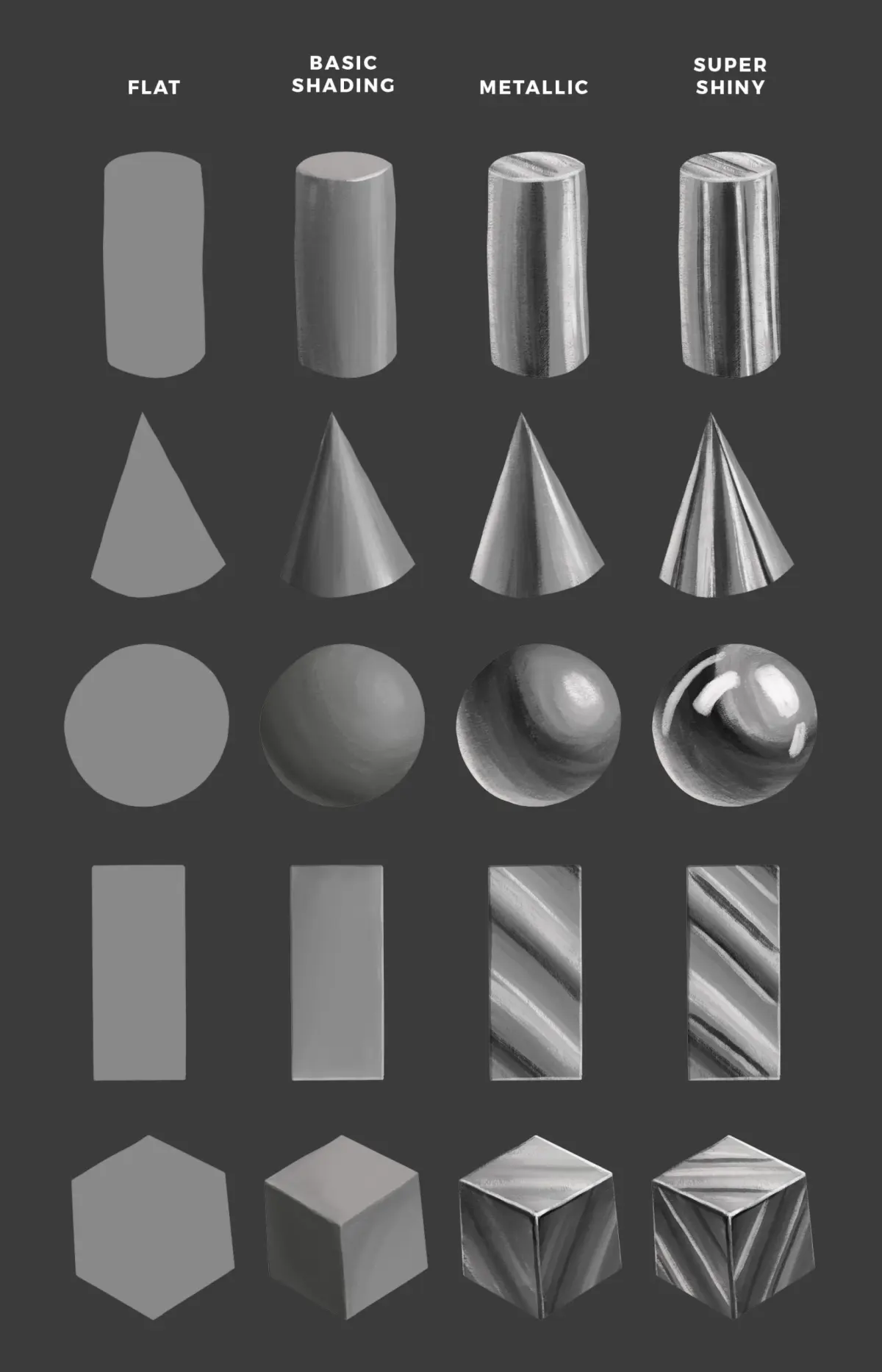
The way light interacts with an object depends entirely on its material properties. A polished metal sphere reflects light sharply, creating high-contrast, crisp edges. In contrast, a matte object like a piece of felt absorbs light, resulting in soft, diffused transitions between light and shadow. Understanding these material behaviors is essential for rendering convincing textures.
Reflected light is a common point of confusion for students. It occurs when light hits a nearby surface and bounces back into the shadow side of your object. If you ignore reflected light, your drawing will look like a cutout silhouette rather than a three-dimensional form. Always look for that faint glow on the edge of a shadow; it is the key to making an object feel like it occupies real space. If your drawing looks too heavy or "stuck" to the page, adding a touch of reflected light will often provide the necessary lift and realism.
Common mistakes when drawing light
One of the most frequent errors is "outlining" light. Beginners often draw a hard line around a highlight, which creates a cartoonish look rather than a natural glow. Light is a transition, not a shape with a boundary. Instead of drawing a circle for a highlight, gently lift the graphite with a kneaded eraser to soften the edges until the light appears to bloom naturally from the surface.
Another mistake is failing to connect the cast shadow to the object. The cast shadow should be darkest right where it meets the base of the object, as this is where the least amount of ambient light can reach. As the shadow moves further away from the object, it should gradually become lighter and softer. If your cast shadow is the same darkness throughout, the object will look like it is floating. Remember that the cast shadow is a reflection of the object's form and should follow the contours of the surface it rests upon.
Best tools for drawing light and shadow
Choosing the right tools can significantly improve your ability to render light. For graphite artists, a range of pencils from 2H (hard, light) to 6B (soft, dark) is essential. Hard pencils are ideal for delicate highlights and light mapping, while soft pencils allow you to achieve the deep, velvety blacks needed for core shadows. Experimenting with different pressures will allow you to master the transition between these extremes.
Charcoal is often considered superior for learning light because it is highly erasable and allows for dramatic, high-contrast marks. A kneaded eraser is your most important tool for drawing light; it acts like a drawing instrument itself, allowing you to "subtract" light from dark areas to create highlights. By molding the eraser into a fine point, you can create sharp, brilliant reflections on eyes or metallic surfaces. Regardless of the medium, the principle remains constant: you are not just drawing objects, but rather the way light reveals their existence to the human eye.
Key facts
- Light is defined by its relationship to shadow; you cannot draw light without simultaneously defining the darkness around it.
- Use the "squint test" to simplify complex scenes into basic shapes of light and shadow, ignoring fine details.
- Highlights are the brightest points on an object and should be reserved for the final stage of a drawing.
- A full range of values, from pure white to deep black, is necessary to create the illusion of three-dimensional volume.
- Reflected light occurs when light bounces off a surface and illuminates the shadowed side of an object, adding realism.
- The "core shadow" is the darkest area on an object, located just before the transition into reflected light.
The bottom line
Drawing light is essentially the art of managing contrast. By focusing on the interplay between deep shadows, mid-tones, and sharp highlights, you create the illusion of physical form on a flat surface. Always identify your light source early, maintain a consistent value range, and use your eraser as an active drawing tool. With practice, these techniques will transform simple outlines into convincing, three-dimensional representations of reality.
People also ask
What is the best tool for creating bright highlights?
A kneaded eraser is the most effective tool because it can be molded into a sharp point to lift graphite or charcoal from the paper. Alternatively, a white gel pen or opaque white gouache paint can be applied over dark areas for intense, crisp highlights.
How do I know where to place the light source?
Choose a single, consistent direction for your light source before you begin drawing. If you imagine the light coming from the upper right, every shadow on every object in the scene must fall toward the lower left.
Why do my drawings look flat despite using shading?
Flatness usually occurs when the transition between light and shadow is too uniform. Ensure you have a clear "terminator line" where the light stops hitting the object, and use a dark core shadow to give the form weight and depth.
Should I use my fingers to smudge shadows?
Avoid using your fingers, as the natural oils on your skin can damage the paper and create uneven, muddy textures. Instead, use a paper blending stump or a soft brush to move the pigment smoothly across the surface.
How does the surface texture affect how I draw light?
Smooth, shiny surfaces like metal or glass have very sharp, high-contrast transitions between light and dark. Rough or matte surfaces, such as fabric or wood, have softer, more gradual transitions that require subtle blending.
What is the purpose of a cast shadow?
A cast shadow is the dark shape projected onto a surface by an object blocking the light. It anchors the object to the ground and provides essential context about the distance and intensity of the light source.
This answer was created with the help of AI research tools and reference sources. Spotted an error? Let us know — we correct mistakes quickly. See our editorial policy.