What is an equinox?
Short answer
An equinox is a biannual astronomical event where the Sun crosses the celestial equator, causing day and night to be approximately equal in length across the globe. Occurring in March and September, it marks the precise moment the Earth's axis is tilted neither toward nor away from the Sun.
On this page
Why an equinox happens
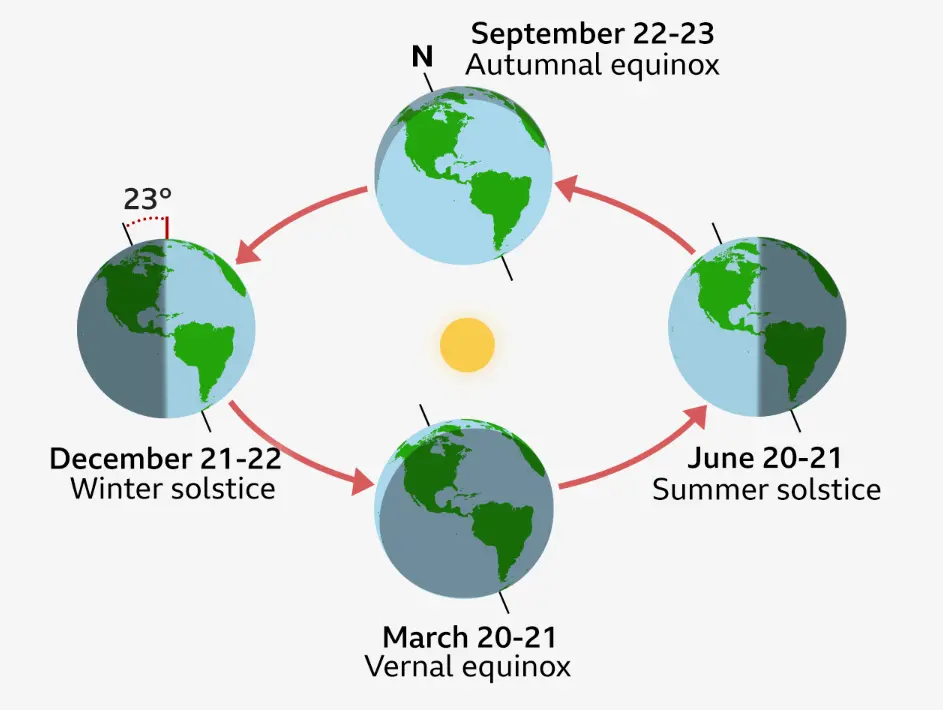
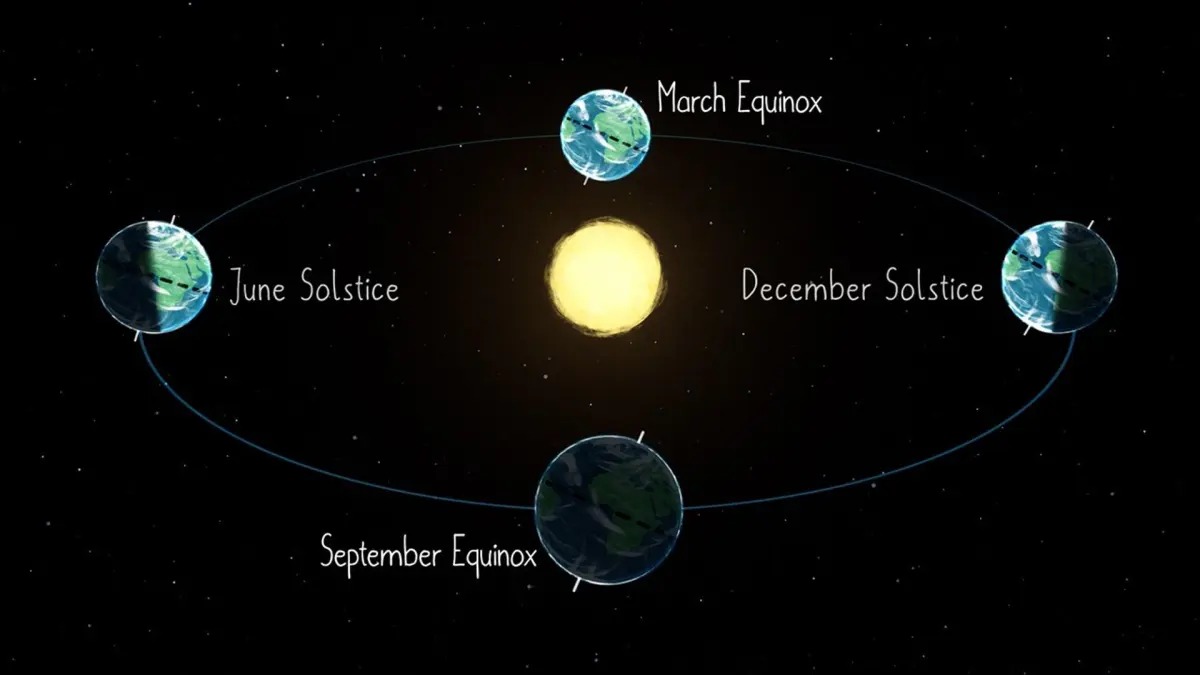
The phenomenon of the equinox is a direct result of Earth's axial tilt. Our planet rotates on an axis that is tilted at an angle of approximately 23.5 degrees relative to its orbital plane around the Sun. As Earth journeys through its year-long orbit, different hemispheres receive varying amounts of direct sunlight, which creates the seasonal cycle.
During an equinox, the Earth's tilt is perfectly perpendicular to the Sun's rays. At this specific moment, the center of the Sun is positioned directly above the Earth's equator. This alignment ensures that the terminator line—the shadow line separating day from night—connects the North and South Poles exactly. Consequently, the distribution of sunlight is balanced between the northern and southern hemispheres, resulting in nearly equal periods of daylight and darkness worldwide.
When do equinoxes occur
Equinoxes happen twice every year, signaling the transition between astronomical seasons. The vernal equinox, or spring equinox, typically occurs around March 20 or 21 in the Northern Hemisphere. The autumnal equinox follows six months later, usually falling on September 22 or 23. These dates are not fixed to a single calendar day because the Gregorian calendar year is 365 days long, while the solar year—the time it takes for Earth to complete one orbit—is approximately 365.24 days.
To account for this discrepancy, the timing of the equinox shifts slightly each year. Leap years are utilized to realign the calendar with the Earth's position in its orbit. Because of these adjustments, the exact time of an equinox can fluctuate by several hours, meaning it might occur on different dates depending on your specific time zone.
- March Equinox: Signals the start of spring in the Northern Hemisphere and autumn in the Southern Hemisphere.
- September Equinox: Signals the start of autumn in the Northern Hemisphere and spring in the Southern Hemisphere.
How to observe an equinox
Observing an equinox does not require specialized equipment, though it does require a bit of patience and a clear view of the horizon. Because the Sun rises due east and sets due west on the days of the equinox, these events offer a perfect opportunity to calibrate your sense of direction. You can use this natural alignment to identify true cardinal directions in your own backyard or local park.
- Find a flat, open space with a clear view of the eastern or western horizon.
- Arrive at your location shortly before sunrise or sunset on the day of the equinox.
- Use a compass or a smartphone app to mark the exact point where the Sun breaks the horizon.
- Compare this point to your local cardinal directions to confirm the true east-west alignment.
Common mistakes when tracking equinoxes
A frequent misconception is the belief that day and night are exactly 12 hours long everywhere on Earth during the equinox. In reality, the duration of daylight is slightly longer than 12 hours on these days. This occurs because the atmosphere refracts, or bends, sunlight. As the Sun approaches the horizon, the atmosphere lifts the image of the Sun upward, allowing us to see it before it has technically crossed the horizon line.
Another common error is assuming the equinox lasts for the entire day. While we refer to the "day of the equinox," the event itself is a specific moment in time when the Sun crosses the celestial equator. This moment can happen at any hour of the day or night, depending on your longitude. People often forget to convert the Universal Time (UTC) listed in astronomical charts to their local time zone, leading them to miss the precise moment of the event.
Why equinoxes matter for culture
Equinoxes have played a vital role in human history, serving as essential markers for agricultural, religious, and social planning. Ancient civilizations relied on these events to determine the timing of planting and harvesting cycles. Many cultures built sophisticated monuments to track the Sun's movement, ensuring their societies remained in sync with the changing seasons.
- Stonehenge in England: Aligned to mark the sunrise on the solstices, but also serves as a reference for the solar cycle.
- Chichén Itzá in Mexico: The pyramid of El Castillo creates a shadow effect resembling a serpent descending the stairs during the equinoxes.
- Nowruz: The Iranian New Year, which is timed to coincide with the vernal equinox to celebrate the renewal of nature.
Today, these events continue to hold cultural significance, reminding us of our planet's place in the solar system. By understanding the mechanics of the equinox, we gain a deeper appreciation for the predictable, rhythmic nature of our world and the celestial dance that sustains our environment.
Key facts
- An equinox occurs twice a year when the Sun crosses the celestial equator, making day and night approximately equal in length globally.
- The vernal equinox typically falls on March 20 or 21, marking the start of spring in the Northern Hemisphere.
- The autumnal equinox usually occurs on September 22 or 23, signaling the beginning of autumn in the Northern Hemisphere.
- During an equinox, the Sun rises exactly due east and sets exactly due west for every location on Earth.
- You can find true east or west by observing the sunrise or sunset on the day of the equinox.
- Avoid the common mistake of assuming day and night are exactly 12 hours long everywhere; atmospheric refraction often makes the day slightly longer than the night.
The bottom line
An equinox is a precise astronomical event marking the moment the Sun crosses the celestial equator. By balancing light and dark across the globe, it serves as a reliable marker for the changing seasons. Whether you are tracking the Sun's path across the horizon or simply observing the shift in daylight, the equinox remains a fundamental point of reference for understanding Earth's orbit and seasonal cycles.
People also ask
Why is the date of the equinox not always the same?
The calendar year is 365 days, but the solar year is approximately 365.24 days long. This discrepancy causes the equinox to shift slightly each year until a leap year resets the cycle.
Does the equinox happen at the same time for everyone?
Yes, the equinox is a specific moment in time when the Sun is positioned directly over the Earth's equator. Because it is a global event, it occurs simultaneously for everyone regardless of their time zone.
Is the Sun directly overhead during an equinox?
The Sun is only directly overhead at noon for observers located exactly on the equator. For people at other latitudes, the Sun will appear at an angle in the sky.
Do equinoxes cause changes in weather?
While they mark the transition between astronomical seasons, equinoxes do not directly cause weather patterns. Seasonal temperature changes are primarily driven by the tilt of the Earth’s axis relative to the Sun.
Can you balance an egg on its end during an equinox?
This is a popular myth that suggests the gravitational pull of the Sun and Earth makes balancing an egg easier during an equinox. In reality, you can balance an egg on its end any day of the year with enough patience and a steady hand.
What is the difference between an equinox and a solstice?
An equinox occurs when the Sun is over the equator, resulting in nearly equal day and night. A solstice occurs when the Sun reaches its northernmost or southernmost point, resulting in the longest or shortest day of the year.
This answer was created with the help of AI research tools and reference sources. Spotted an error? Let us know — we correct mistakes quickly. See our editorial policy.