Who invented the wheel?
Short answer
The wheel was not invented by a single individual but emerged through gradual technological evolution in Mesopotamia around 3500 BCE. Originally developed as a potter’s wheel, the concept was later adapted for transportation. Because this innovation predates written records, the specific names of the prehistoric inventors remain lost to history.
On this page
When was the wheel invented?
Archaeological evidence points to the invention of the wheel occurring during the late Neolithic or early Chalcolithic period, roughly 5,500 years ago. Excavations in Mesopotamia, modern-day Iraq, have unearthed the earliest known examples of potter’s wheels dating to approximately 3500 BCE. These devices allowed artisans to spin clay more efficiently, revolutionizing the production of ceramics.
It took several centuries for this technology to transition from the workshop to the road. While the potter’s wheel was a stationary tool, the concept of a rotating disc on an axle eventually inspired the creation of wheeled vehicles. By 3200 BCE, pictographic tablets from the Uruk period depict sledges mounted on rollers, which served as the primitive precursors to true wheeled carts.
How did the wheel evolve for transport?
The transition from a stationary potter’s wheel to a transport vehicle required two critical engineering breakthroughs: the axle and the wheel-axle fit. A wheel must rotate freely around a fixed axle, or the axle must rotate within a frame. If the fit is too tight, friction halts movement; if it is too loose, the wheel wobbles and collapses.
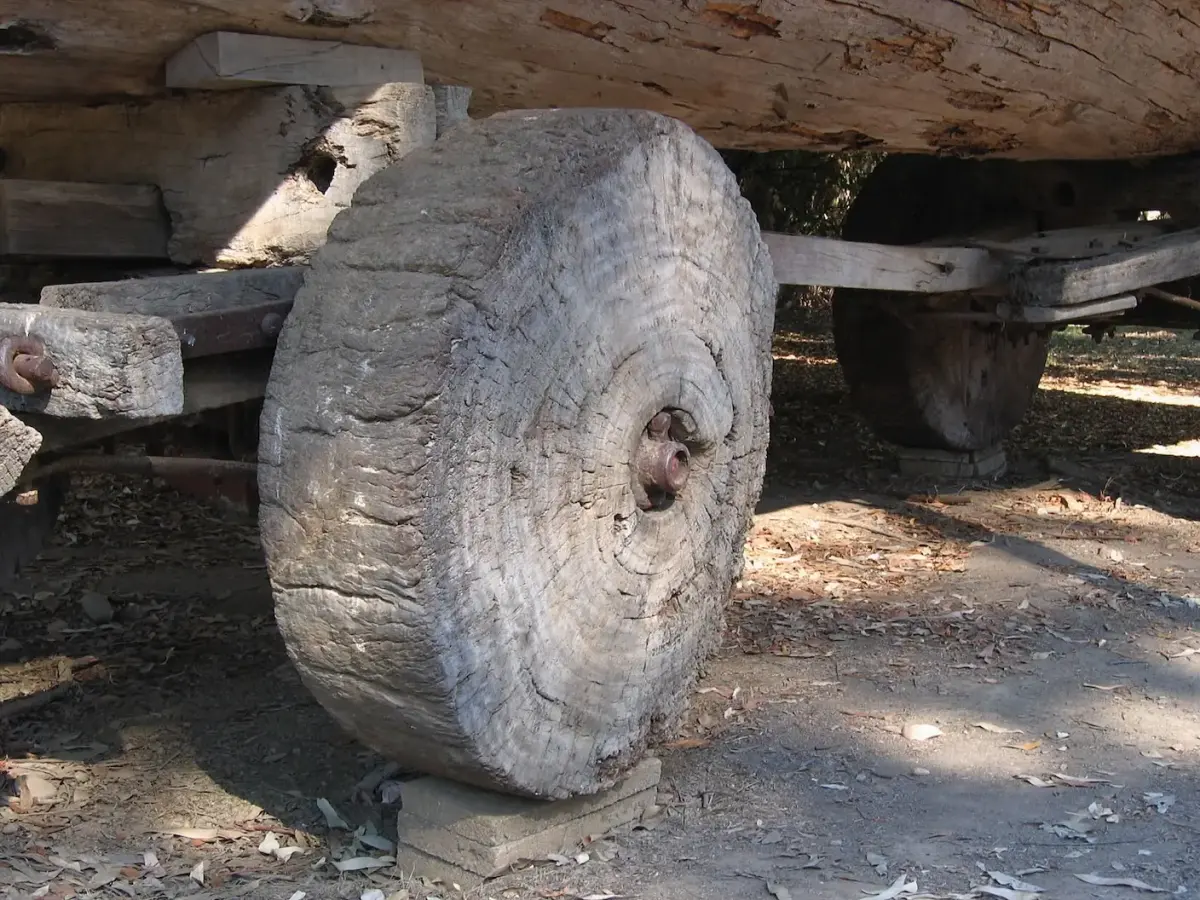
Early transport wheels were solid discs carved from thick wooden planks. These were heavy and inefficient for long-distance travel, yet they provided the foundation for trade and warfare. By 2000 BCE, engineers introduced the spoked wheel, which significantly reduced weight and increased speed. This advancement allowed for the development of light, maneuverable chariots that changed the nature of ancient military conflict.
- Solid wooden discs were carved from tree trunks.
- A central hole was bored to accommodate a wooden axle.
- Lubricants like animal fat were applied to reduce friction.
- Frames were constructed to hold the axle securely in place.
Why did the wheel spread so quickly?
The rapid adoption of the wheel across Eurasia was driven by the immense economic advantages it offered. Before the wheel, humans relied on pack animals or human porters to move heavy goods. Wheeled carts allowed for the transport of significantly larger loads, such as grain harvests and stone for building, which stimulated the growth of early urban centers.
The spread of this technology followed established trade routes, moving from Mesopotamia into the Caucasus, Europe, and the Indus Valley. Cultural exchange played a vital role, as neighboring civilizations observed the efficiency of wheeled transport and adapted the design to suit their specific terrain and resources. The wheel became a symbol of status and administrative power, as only wealthy societies could afford the specialized labor and materials required to maintain carts and draft animals.
- Increased agricultural output due to easier transport of fertilizer and crops.
- Enhanced military mobility through the use of horse-drawn chariots.
- Expansion of trade networks as goods could travel further distances.
- Improved urban planning through the ability to move heavy construction materials.

Common mistakes when researching the wheel
A frequent error in understanding the history of the wheel is the assumption that it was invented for transportation first. Many people mistakenly believe that early humans saw a rolling log and immediately created a cart. In reality, the potter’s wheel was a complex piece of machinery that existed for hundreds of years before anyone thought to attach it to a vehicle.
Another common misconception is that the wheel was invented simultaneously worldwide. In the Americas, for example, the wheel was used in toys and ritual objects but was not utilized for large-scale transportation until the arrival of Europeans. This was likely due to the lack of large draft animals like horses or oxen, which were necessary to pull heavy wheeled loads across the diverse American landscapes.
How to identify early wheel technology
When examining ancient artifacts, archaeologists look for specific signs of wheel use. The most prominent indicator is the presence of axle holes in circular wooden discs. Researchers also analyze the wear patterns on the central hubs, which reveal whether the wheel rotated on a fixed axle or if the axle itself turned with the wheels.
If you are studying ancient transport, keep these technical details in mind:
- Look for evidence of "dishing," where the wheel is slightly concave to handle stress.
- Examine the wood grain; cross-sections of tree trunks were prone to cracking under weight.
- Check for evidence of metal tires, which were added in later periods to protect the wood.
- Assess the terrain; wheels were largely useless in mountainous or swampy regions, which explains why some societies rejected the technology.
By focusing on these physical markers, historians can distinguish between simple rollers and true wheels. Understanding these nuances helps clarify why the wheel was a revolutionary, albeit geographically limited, innovation in the ancient world. The development of the wheel remains one of the most significant milestones in human engineering, setting the stage for all future mechanical progress.
Key facts
- The wheel was not invented by a single person, but emerged through gradual technological evolution in the 4th millennium BCE.
- Evidence suggests wheels appeared nearly simultaneously in Mesopotamia, the North Caucasus, and Central Europe around 3500 BCE.
- Early wheels were solid wooden disks made from planks joined together, rather than the spoked wheels seen in later chariots.
- The primary initial use of the wheel was for pottery production, known as the potter's wheel, before it was adapted for transport.
- A common mistake is assuming the wheel was immediately used for travel; it took centuries to develop durable axles and hubs for carts.
- To replicate a primitive wheel, ensure the center hole is perfectly perpendicular to the grain to prevent the wood from splitting under pressure.
The bottom line
The wheel represents a pinnacle of human ingenuity, evolving from stationary potter’s tools into a transformative technology for global transport. It was not the product of one inventor, but a collective breakthrough across Eurasia. By mastering the mechanics of rotation and friction, ancient societies fundamentally altered trade, warfare, and urban development, proving that simple circular geometry remains the most powerful tool in the history of human engineering.
People also ask
Why did it take so long for humans to invent the wheel?
Humans had already developed complex tools and agriculture, but the wheel required advanced carpentry skills to create a circular shape that could rotate on a fixed axle. Without metal tools, shaping wood into a perfectly balanced circle was extremely labor-intensive and difficult to achieve.
Was the wheel invented for transportation purposes?
No, archaeological evidence suggests the earliest wheels were used as potter's wheels to spin clay. It was only after this technology became established that inventors realized the same rotational principle could be applied to heavy loads.
What was the biggest challenge in early wheel design?
The main hurdle was the friction between the axle and the wheel hub. Early inventors had to figure out how to lubricate these parts and ensure the axle remained straight, otherwise the wheel would wobble and break under weight.
Did every ancient civilization use the wheel?
Not immediately, as many cultures in the Americas and sub-Saharan Africa did not adopt the wheel for transport until much later. These societies often relied on rugged terrain or different social structures where pack animals or human porters were more practical than wheeled carts.
When were spoked wheels introduced?
Spoked wheels appeared around 2000 BCE, significantly lighter and faster than solid wooden disks. This innovation was crucial for the development of chariots, which revolutionized ancient warfare and travel.
How did the wheel change human society?
The wheel allowed for the transport of heavy goods over long distances, which facilitated trade and the growth of cities. It also enabled more efficient farming and the construction of massive architectural projects by moving materials that were previously impossible to shift.
This answer was created with the help of AI research tools and reference sources. Spotted an error? Let us know — we correct mistakes quickly. See our editorial policy.