Who invented eyeglasses?
Short answer
Eyeglasses were invented in Italy between 1286 and 1290 by an unknown craftsman. While historians cannot name a single inventor, the technology emerged in the Pisa or Venice regions. These early devices were simple convex lenses held by hand or balanced on the nose to assist monks and scholars with reading.
On this page
Who actually invented eyeglasses?
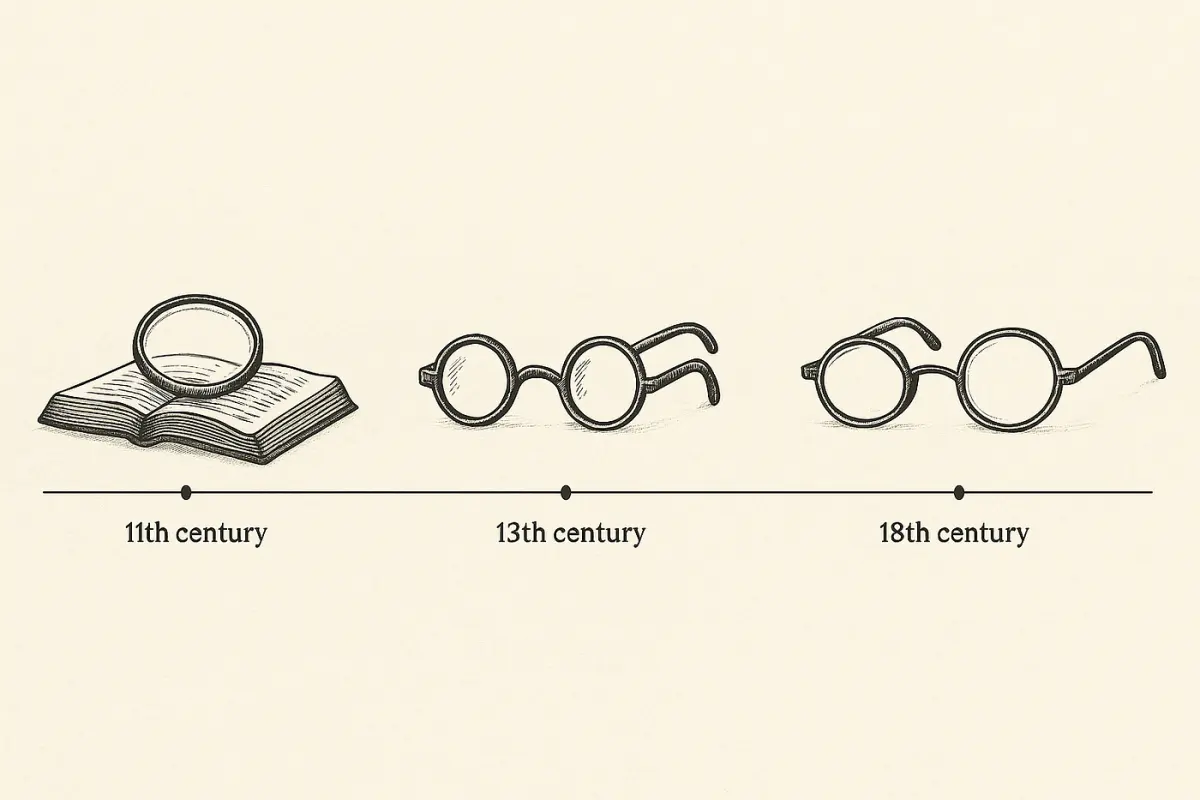
The invention of eyeglasses remains one of the great mysteries of medieval technology. No single patent exists, as the concept evolved from earlier optical tools like "reading stones," which were polished segments of quartz or glass placed over text to magnify letters. By the late 13th century, Italian glassmakers in the Venice region began experimenting with thinner, more refined lenses.
Historical records point to a sermon delivered in 1306 by the Dominican friar Giordano da Pisa, who explicitly mentioned that eyeglasses had been invented less than 20 years prior. Another candidate, Salvino D’Armate, was often credited in later centuries, but modern research suggests this was a fabrication by a 17th-century scholar. The invention was likely a collaborative effort among skilled glassblowers who mastered the art of creating clear, curved glass.
How did early eyeglasses work?
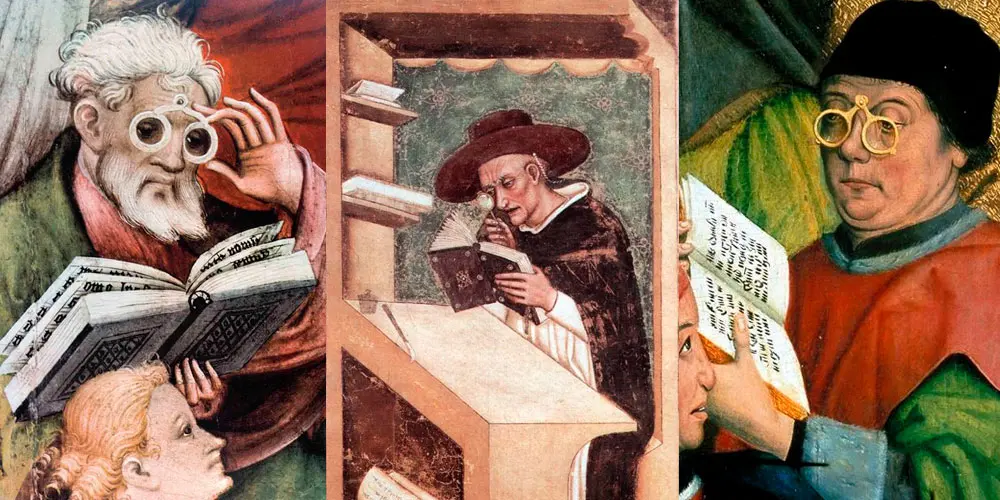
Early eyeglasses, known as "rivet spectacles," consisted of two convex lenses held together by a metal or bone frame that pivoted on a central rivet. These lenses were designed specifically for farsightedness, helping older individuals who struggled to read small manuscripts. Because the frames lacked temples to hook over the ears, they had to be held by hand or pinched firmly onto the nose.
The technology was limited by the quality of glass available at the time. Because glassblowing was still developing, lenses often contained bubbles or impurities that distorted vision. Despite these flaws, they were revolutionary for the intellectual class. The ability to correct vision allowed scholars, scribes, and monks to continue working well into their later years, effectively extending the productive lifespan of the era's most educated population.
Why did eyeglasses spread so quickly?
The rapid adoption of eyeglasses was fueled by the invention of the printing press in the 15th century. As books became more accessible and literacy rates climbed, the demand for visual aids skyrocketed. Eyeglasses transitioned from a luxury item for the wealthy elite to a practical necessity for merchants, artisans, and professionals who needed to read ledgers and documents daily.
Several factors contributed to this widespread adoption:
- The rise of the guild system in Italy, which protected optical trade secrets.
- Increased trade routes that allowed lenses to be exported across Europe.
- The development of concave lenses in the 16th century, which finally allowed nearsighted people to see clearly at a distance.
- The introduction of more comfortable frame materials like leather, horn, and eventually wire.

Common mistakes when using historical glasses
If you were to handle original antique spectacles, you would quickly realize they were not designed for the modern face. One common mistake people make is assuming these early frames were intended for constant wear. In reality, they were "task-specific" tools meant only for reading, and they were often removed immediately after the work was completed.
To maintain historical eyewear, collectors must avoid these common errors:
- Cleaning lenses with modern chemical sprays, which can strip the delicate surface of antique glass.
- Forcing the rivet pivot, which is often brittle and prone to snapping after centuries of oxidation.
- Storing frames in high-humidity areas, which causes corrosion in metal components.
- Attempting to wear them for extended periods, as the lack of proper fit can cause significant discomfort and nose bridge irritation.
How did glasses evolve into modern frames?
The transition to the glasses we recognize today took several centuries of experimentation. For most of history, the primary struggle was stability; the frames simply would not stay on the face. In the 1700s, designers began adding rigid side arms, known as temples, which rested on the ears. This innovation finally allowed users to move around while wearing their glasses.
The 19th and 20th centuries brought further refinements, including the invention of bifocals by Benjamin Franklin and the introduction of lightweight plastics. Today, the focus has shifted from basic magnification to complex prescription grinding and advanced lens coatings. While the fundamental principle of using curved glass to bend light remains identical to the 13th-century invention, modern manufacturing ensures that every pair of glasses is precisely tailored to the unique curvature of the user's eye and the specific requirements of their daily life.
Key facts
- Eyeglasses were invented in Italy, likely in the region of Pisa or Venice, between 1286 and 1290.
- The earliest spectacles consisted of two convex lenses mounted in bone, metal, or leather rims and held by hand or balanced on the nose.
- Salvino D'Armate is often cited in popular lore as the inventor, though no historical evidence confirms his existence or contribution.
- Early glasses were designed exclusively for farsightedness, helping elderly monks and scholars read manuscripts.
- Concave lenses for nearsightedness were not developed and widely used until the early 15th century.
- To clean lenses safely, use a microfiber cloth and mild soap; avoid paper towels or clothing, which can scratch the surface.
The bottom line
While the exact inventor of eyeglasses remains lost to history, the innovation emerged in late 13th-century Italy to assist aging scholars. What began as simple, handheld convex lenses evolved over centuries into the sophisticated optical tools we use today. This transition from basic magnifying aids to essential medical devices revolutionized literacy and productivity, proving that clear vision is a fundamental component of human progress and learning.
People also ask
Why were early eyeglasses held by hand?
The first spectacles lacked side arms, known as temples, to hook over the ears. Users had to hold them against their face or balance them precariously on the bridge of their nose.
When were temples added to eyeglasses?
Side arms were not added until the early 18th century. Before this, inventors experimented with ribbons or leather straps tied around the head to keep the frames in place.
What materials were used for the first lenses?
The earliest lenses were crafted from beryl or quartz, which were ground into convex shapes. Glass technology eventually improved, allowing for clearer and more affordable lenses.
Did the invention of the printing press affect eyeglasses?
Yes, the 15th-century invention of the printing press increased the demand for reading materials. This created a surge in the need for vision correction, turning spectacles into a mass-produced commodity.
How did people determine their prescription in the Middle Ages?
There were no standardized eye exams. Customers would visit a spectacle maker and try on various pairs of glasses until they found a set that made text appear clearer.
Why are modern frames made of plastic or metal?
Modern materials are chosen for durability, weight, and flexibility. Metal alloys like titanium are preferred for strength, while acetate plastics allow for a wide range of styles and comfort.
This answer was created with the help of AI research tools and reference sources. Spotted an error? Let us know — we correct mistakes quickly. See our editorial policy.