Who invented the movie camera?
Short answer
No single individual invented the movie camera. Instead, it evolved through the work of several pioneers in the late 19th century. Thomas Edison and his assistant William Kennedy Dickson created the Kinetograph in 1891, while the Lumière brothers, Auguste and Louis, developed the more portable Cinématographe in 1895, which truly launched cinema.
On this page
Who actually invented the movie camera?
The invention of the movie camera was a collaborative and iterative process rather than a singular "eureka" moment. During the 1880s and 1890s, inventors across the globe were racing to capture motion on film. Étienne-Jules Marey, a French physiologist, created a "chronophotographic gun" in 1882 that could take 12 consecutive frames per second, providing a crucial foundation for later mechanical developments.
In the United States, Thomas Edison tasked his employee William Kennedy Dickson with developing a device to record moving images. By 1891, they had produced the Kinetograph, a large, bulky camera that utilized celluloid film. While revolutionary, it was not a projector; it required viewers to peer into a box called a Kinetoscope to see the moving images. The invention was a commercial success, but it lacked the communal experience of watching a film on a screen.
How did the Lumière brothers change cinema?
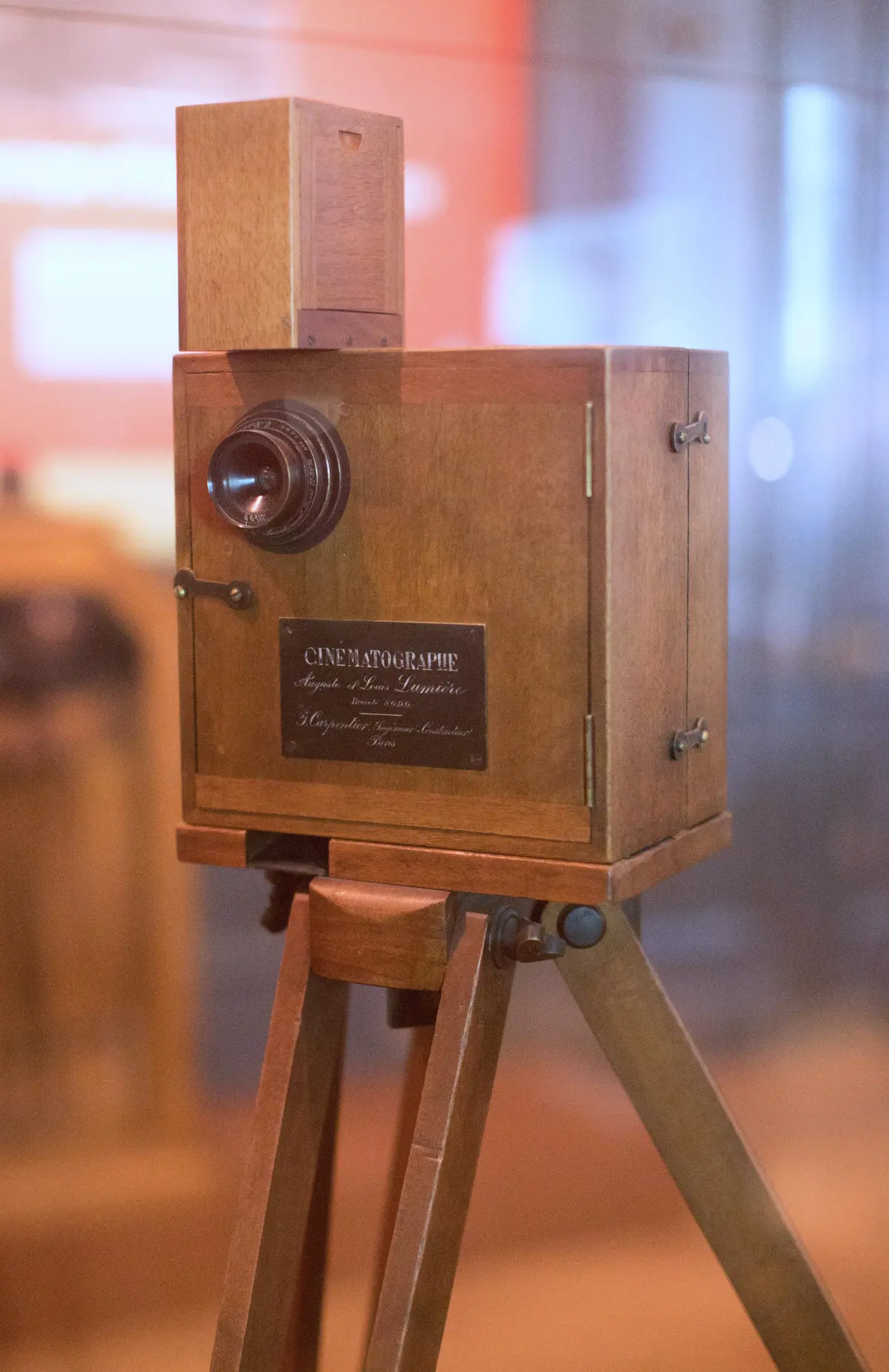
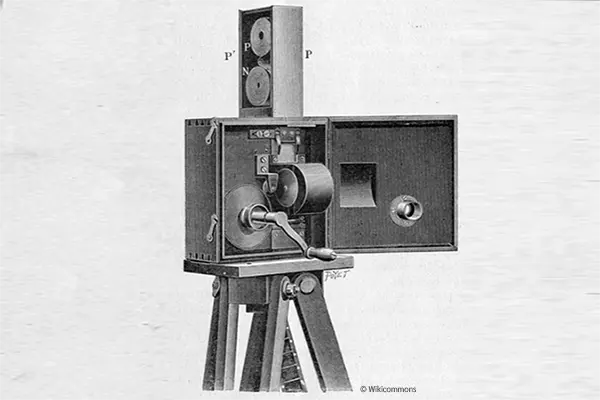
In France, Auguste and Louis Lumière took the technology a step further by creating the Cinématographe. Patented in 1895, this device was significantly more practical than Edison’s version because it functioned as a camera, a printer, and a projector all in one. It was lightweight and hand-cranked, allowing filmmakers to move outside the studio to capture "actualities," or short clips of everyday life.
The Lumière brothers held the first commercial public screening in Paris on December 28, 1895. This event is widely considered the birth of modern cinema because it allowed an audience to watch a projected image together. Their technical approach differed from Edison’s in several key ways:
- They used a claw mechanism to move the film, which became the standard for decades.
- Their camera was portable, weighing only about 16 pounds.
- They prioritized high-quality projection over the individual viewing experience.
What were the early technical challenges?
Early inventors faced immense hurdles regarding film stability and light sensitivity. The primary challenge was the "intermittent movement" of the film strip. To create the illusion of motion, the film had to stop briefly behind the lens to be exposed, then move forward to the next frame. If the movement was not perfectly synchronized, the resulting image would flicker or blur beyond recognition.
Another significant obstacle was the chemical composition of the film itself. Early celluloid was highly flammable and prone to jamming within the camera’s gears. Inventors had to balance the speed of the shutter with the sensitivity of the film emulsion to avoid overexposing the footage. These technical limitations dictated the length of early films, which were usually limited to less than one minute of continuous recording.
- Develop a reliable mechanism to advance film one frame at a time.
- Ensure the shutter remains closed while the film is in motion.
- Synchronize the frame rate to match the projection speed.
- Protect the light-sensitive film from accidental exposure during loading.
How to identify early motion picture devices?
When studying the history of cinema, it is helpful to distinguish between a camera and a projector. Many early devices were designed for only one purpose, while later models combined both. If you are researching these machines, look for the specific patent dates and the intended method of viewing. Edison’s Kinetoscope, for instance, is often mistaken for a camera, but it was strictly for individual viewing.
Common mistakes when identifying these historical artifacts include:
- Assuming that all early film devices recorded sound simultaneously (sound-on-film did not become standard until the late 1920s).
- Confusing the "flicker" of early silent films with a technical defect, when it was actually a byproduct of the low frame rates used at the time.
- Attributing the entire invention to a single person, ignoring the contribution of assistants and independent researchers.
Why did these inventions evolve so quickly?
The rapid evolution of the movie camera was driven by intense competition and the desire for entertainment. Once the public saw the potential of moving images, there was a massive demand for longer, more complex stories. Inventors quickly realized that the camera was not just a scientific tool for studying movement, but a powerful medium for storytelling. By the early 1900s, cameras began to include features like adjustable lenses and tripods.
This era of innovation shifted from purely mechanical experimentation to artistic application. Filmmakers like Georges Méliès began using the camera to perform "tricks," such as stop-motion animation and double exposures, proving that the device could manipulate reality. This transition from capturing simple reality to creating cinematic fiction transformed the camera from a laboratory curiosity into the most influential cultural tool of the 20th century. By the time the industry matured, the basic principles established by these early pioneers remained the core of filmmaking for over a hundred years.
Key facts
- Thomas Edison and his assistant William Kennedy Dickson developed the Kinetograph, the first motion-picture camera, in 1891.
- Louis and Auguste Lumière patented the Cinématographe in 1895, a portable device that functioned as both a camera and a projector.
- Early movie cameras relied on a hand-cranked mechanism to move film through the gate at a consistent speed.
- The standard frame rate for early silent films was often inconsistent, typically ranging between 16 and 18 frames per second.
- A common mistake for early inventors was failing to synchronize the shutter speed with the film advancement mechanism, causing blurred images.
- To achieve smooth motion, the film must be stopped momentarily behind the lens for each exposure, a process known as intermittent motion.
The bottom line
The invention of the movie camera was not a single moment but a collective evolution of mechanical engineering. While Thomas Edison’s Kinetograph established the foundation for motion capture, the Lumière brothers revolutionized the medium by creating a portable device for public projection. Understanding these pioneers highlights how the transition from static photography to moving images required precise synchronization of mechanical movement and light-sensitive film technology.
People also ask
What was the first motion picture ever filmed?
The first motion picture is widely considered to be Roundhay Garden Scene, filmed by Louis Le Prince in 1888. It captures a few seconds of people walking in a garden and remains the oldest surviving film footage.
Did the Lumière brothers invent the first projector?
While they did not invent the very first projector, their Cinématographe was the first to successfully project films to a paying public audience. This event in Paris in 1895 is often cited as the birth of modern cinema.
Why were early movies silent?
Early movie cameras were purely visual recording devices and lacked the technology to synchronize audio directly onto the film strip. Sound was typically provided by live musicians or narrators accompanying the screening in the theater.
What material was used for early film strips?
Early filmmakers utilized flexible celluloid film, which was durable enough to withstand the mechanical stress of the camera's internal gears. This material allowed for the development of long, continuous rolls of film.
How did early cameras handle lighting?
Because early film stock had very low sensitivity to light, filmmakers relied heavily on bright, natural sunlight. Indoor filming required massive glass-roofed studios or intense artificial lighting setups to produce a clear image.
What is the difference between a camera and a projector?
A camera uses a lens to capture light onto a photosensitive medium, while a projector uses a light source and a lens to cast that recorded image onto a screen. The Lumière brothers' innovation was combining these functions into one portable unit.
This answer was created with the help of AI research tools and reference sources. Spotted an error? Let us know — we correct mistakes quickly. See our editorial policy.