Who invented chess?
Short answer
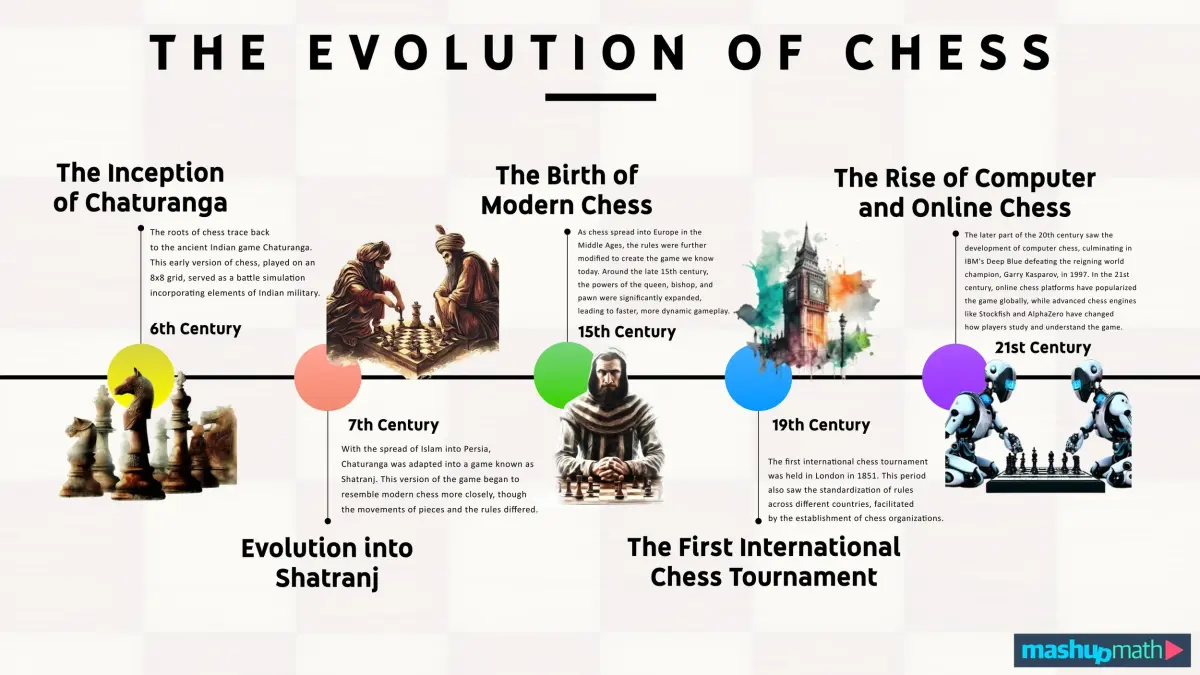
Chess does not have a single inventor. It evolved from a 6th-century Indian game called chaturanga. This early version spread along trade routes to Persia, where it became shatranj, and eventually reached Europe by the 10th century. Modern rules, including the powerful Queen, were standardized in Europe during the late 15th century.
On this page
Where did chess originate?
The earliest ancestor of chess is widely considered to be the Indian game of chaturanga, which emerged during the Gupta Empire around 600 CE. This game featured four divisions of the military: infantry, cavalry, elephants, and chariotry, which later evolved into the pawn, knight, bishop, and rook. While legends often attribute the game to a single wise advisor or king, historians agree it was a gradual development of ancient board games.
From India, the game traveled to Sassanid Persia, where it was renamed shatranj. The Persian version introduced the concept of "Shah" (King) and "Shah Mat" (the King is helpless), which forms the basis of the modern term "checkmate." By the time it reached the Islamic world, the game had become a popular pastime for scholars and nobility alike. Its movement across borders was facilitated by the extensive Silk Road trade networks, allowing it to adapt to different cultures while maintaining its core strategic structure.
How did chess evolve into the modern game?
When chess arrived in Europe via the Islamic conquests of Spain and Sicily, it underwent significant modifications. By the late 1400s, European players sought to speed up the game, which had previously been quite slow due to the limited movement of the pieces. The most dramatic change occurred with the queen, which evolved from a weak advisor into the most powerful piece on the board, capable of moving any number of squares in any direction.
These changes, often referred to as "mad queen chess," were solidified by the invention of the printing press, which allowed rulebooks to spread rapidly across the continent. By the 16th century, the game had largely stabilized into the form recognized today. The introduction of standardized boards, clock-based time controls, and formal tournament structures in the 19th century further refined the game into the competitive sport played globally today.
What are the basic rules for beginners?
Learning to play chess requires understanding the unique movement of each piece and the objective of the game. The primary goal is to trap the opponent's king, a state known as checkmate, where the king is under attack and has no legal move to escape.
- Set up the board so that each player has a light-colored square in their bottom right corner.
- Place the rooks in the corners, knights next to them, then bishops, with the queen on her own color and the king on the remaining square.
- Arrange the eight pawns in the row directly in front of the major pieces.
- Move pieces according to their specific patterns, ensuring you never move into a position that leaves your king in check.
Common mistakes when learning chess
Many beginners focus too heavily on capturing pieces rather than controlling the center of the board. This often leads to a disorganized position where your pieces are trapped behind your own pawns. Another frequent error is moving the same piece multiple times during the opening phase, which wastes valuable time and allows your opponent to develop their forces more efficiently.
- Neglecting king safety by delaying castling.
- Leaving pieces undefended, allowing for easy captures by the opponent.
- Failing to look for "forks," where one piece attacks two of your pieces simultaneously.
- Overextending pawns, which creates weaknesses that your opponent can easily exploit.
- Ignoring the importance of the endgame, where king activity becomes crucial for securing a win.
How to improve your chess strategy
Improving at chess requires a balance of tactical practice and strategic study. A practical approach is to solve daily puzzles, which help you recognize patterns and combinations that occur in real games. Furthermore, studying classic games played by grandmasters can provide insight into how to coordinate pieces effectively and build a solid position.
Consistency is key to progress, so try to play games with longer time controls rather than "blitz" games. Longer games allow you to practice the decision-making process and avoid impulsive blunders. After each session, take a few minutes to review your moves, specifically looking for the moment your position began to decline. By identifying these critical errors, you can adjust your planning for future matches and gradually develop a deeper understanding of the game's complex geometry and logic.
Key facts
- Chess evolved from an ancient Indian game called chaturanga, which dates back to the 6th century CE.
- The game spread along the Silk Road to Persia, where it was known as shatranj.
- By the 10th century, the game reached Europe, where it underwent significant rule changes to increase the speed of play.
- The modern version of chess, with the powerful queen and bishop, was standardized in Europe during the late 15th century.
- To improve your game, focus on controlling the center of the board with your pawns early in the match.
- A common mistake for beginners is moving the same piece multiple times during the opening phase instead of developing different pieces.
The bottom line
Chess does not have a single inventor but evolved over centuries from the Indian game chaturanga. It traveled through Persia and the Islamic world before arriving in Europe, where it reached its modern form by the 15th century. Today, it remains a globally recognized game of strategy that balances historical tradition with complex tactical play, offering endless intellectual challenges for players of all skill levels worldwide.
People also ask
Is chess considered a sport?
The International Olympic Committee recognizes chess as a sport. While it lacks physical exertion, it requires high levels of mental stamina, strategy, and competitive skill.
Why did the queen become the most powerful piece?
In the original shatranj, the queen was a weak piece that could only move one square diagonally. European players strengthened the piece in the 1400s to make the game more dynamic and faster.
How many possible games of chess are there?
The Shannon number estimates that there are at least 10^120 possible variations of a chess game. This complexity ensures that no two games are ever truly identical.
What is the goal of the game?
The objective is to checkmate the opponent's king, which means the king is under attack and has no legal move to escape. If neither player can force a win, the game ends in a draw.
Can anyone learn to play chess?
Yes, chess is accessible to all ages. Learning the basic movement of the six pieces takes only minutes, though mastering the strategic nuances can take a lifetime.
Why is chess often used in schools?
Educators use chess to help students develop critical thinking, pattern recognition, and patience. It provides a structured environment for children to practice decision-making and accountability for their actions.
This answer was created with the help of AI research tools and reference sources. Spotted an error? Let us know — we correct mistakes quickly. See our editorial policy.