Why is Iceland called Iceland?
Short answer
Iceland was named by the Norse settler Flóki Vilgerðarson in the 9th century. After a harsh winter killed his livestock, he climbed a mountain and spotted a fjord filled with drift ice. Disappointed by the unforgiving climate, he disparagingly dubbed the land "Iceland," a name that persisted despite the island's actual volcanic warmth.
On this page
Who first named Iceland?
The naming of Iceland is attributed to the Viking explorer Flóki Vilgerðarson, often called Hrafna-Flóki or "Raven-Flóki." According to the Landnámabók, or Book of Settlements, Flóki set sail from Norway in the late 9th century to find the newly discovered land in the North Atlantic. He brought his family and livestock, intending to establish a permanent homestead.
However, the expedition proved disastrous. Flóki failed to prepare adequately for the harsh Icelandic winter, and his livestock perished due to a lack of fodder. Frustrated and disillusioned by the unforgiving conditions, he climbed a high mountain to survey the landscape. Upon seeing a fjord choked with sea ice, he decided to abandon the settlement. He reportedly gave the country its bleak name out of spite, hoping to discourage others from following in his footsteps.
Why is Iceland not actually icy?
Despite its chilly name, Iceland is not a land of perpetual ice. The country benefits significantly from the North Atlantic Current, a warm ocean current that keeps temperatures much milder than those in other regions at similar latitudes, such as parts of Canada or Russia. While glaciers do cover about 11 percent of the landmass, the coastal lowlands often experience relatively temperate winters.
The country’s internal heat provides a striking contrast to its name. Iceland is situated directly over the Mid-Atlantic Ridge, a tectonic boundary that makes it one of the most volcanically active places on Earth. This geothermal energy is a defining feature of the landscape, manifesting in:
- Numerous natural hot springs and geothermal spas.
- Widespread use of volcanic steam for heating homes and greenhouses.
- Frequent volcanic eruptions that constantly reshape the island's surface.
- Extensive geyser activity, including the famous Great Geysir.
How did early settlers describe the land?
Before Flóki’s arrival, other Norse explorers had different impressions of the island. The first permanent settler, Ingólfur Arnarson, arrived around 874 CE and established his farm in what is now Reykjavík. Unlike Flóki, Ingólfur and his contemporaries viewed the island as a land of opportunity, rich in fishing grounds and pastureland.
Some historical accounts suggest that earlier explorers gave the island more appealing names to attract settlers. One explorer, Garðar Svavarsson, called it Garðarshólmi, or "Garðar’s Islet," while another, Naddoddur, referred to it as Snæland, or "Snowland." These names reflected the seasonal appearance of the terrain rather than a permanent state of frozen desolation. The name "Iceland" eventually stuck, likely because it was the most distinctive and memorable of the early monikers, even if it was intended as a warning rather than a description.
Common mistakes when researching Icelandic history
Many people mistakenly believe that Iceland is covered entirely by ice or that it is a polar desert. This misconception is fueled by the name itself and the popularity of films that emphasize the island's glaciers. When studying the history of the region, it is important to avoid these common errors:
- Assuming the name was meant to be a literal geographical description.
- Overlooking the influence of the Gulf Stream on the country's climate.
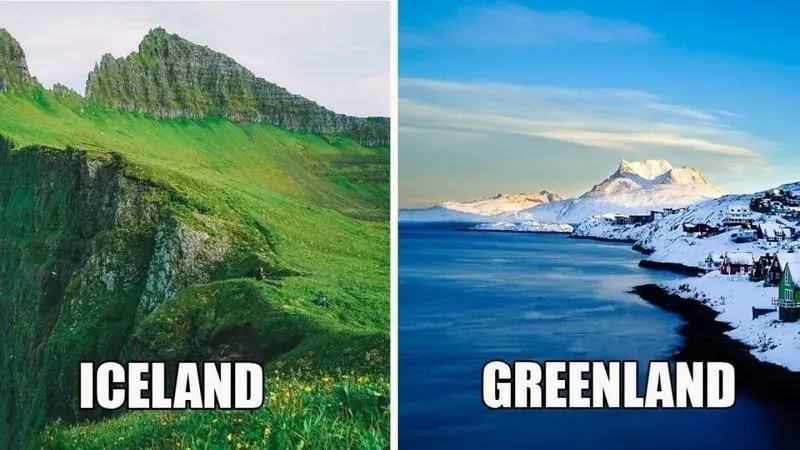
- Confusing the naming of Iceland with the naming of Greenland, which was intentionally marketed as a "green" land to lure settlers.
- Ignoring the role of geothermal activity in making the island habitable for early Norse settlers.
By understanding that the name is a relic of a disgruntled explorer’s bad experience, you can better appreciate the actual diversity of the Icelandic climate and landscape.
Best ways to explore Icelandic geography
If you are planning to visit Iceland to experience its unique terrain, you should focus on the contrast between its volcanic and glacial features. The best way to understand the name is to witness the "ice" and "fire" simultaneously by visiting areas where glaciers sit atop active volcanoes.
To have a successful and safe trip, follow these essential steps:
- Research the "Golden Circle" route, which showcases geysers and tectonic rifts.
- Pack layers of clothing, as the weather can change from sunny to snowy in minutes.
- Rent a four-wheel-drive vehicle if you plan to travel outside of the main urban centers.
- Respect local warnings regarding volcanic activity and weather alerts, as the environment remains unpredictable.
- Visit during the summer months if you prefer milder temperatures and the midnight sun, or winter if you hope to see the Northern Lights.
By focusing on the geological reality rather than the historical name, you will gain a much clearer understanding of why this island continues to fascinate travelers from around the world.
Key facts
- The name "Iceland" was reportedly coined by the Viking settler Flóki Vilgerðarson in the 9th century after he saw sea ice in a fjord.
- Despite its name, Iceland is not covered in ice; about 11 percent of the country is covered by glaciers, while the rest is volcanic rock and moss.
- The island was originally called "Snæland" (Snowland) by the first Norse explorer, Garðar Svavarsson, who circumnavigated it around 860 CE.
- Iceland experiences a relatively mild climate due to the North Atlantic Current, which brings warm water from the Gulf Stream to its shores.
- A common myth suggests the name was a deceptive marketing ploy to discourage settlers from the lush, green island, but historians generally dismiss this.
- When visiting, do not assume the name reflects the year-round temperature; always pack layers, as weather conditions can shift from sun to snow in minutes.
The bottom line
Iceland’s name is a historical relic from the 9th century, reflecting the sea ice encountered by early Norse settlers rather than the country's overall climate. While the name suggests a frozen wasteland, the island is actually a geologically diverse landscape shaped by volcanic activity and tempered by the Gulf Stream. Understanding this distinction helps travelers appreciate the country's unique mix of fire, ice, and lush greenery.
People also ask
Is Greenland actually greener than Iceland?
No, Greenland is significantly more glaciated than Iceland, with roughly 80 percent of its landmass covered by an ice sheet. The naming of the two countries is often cited as a historical irony or a deliberate misnomer used by early explorers.
Did the Vikings intentionally choose the name to keep people away?
There is no historical evidence that the name was a strategic attempt to deter settlers. Most scholars agree the name simply reflected the immediate environmental conditions encountered by the first Norse explorers.
What is the average temperature in Iceland during winter?
Coastal temperatures usually hover around freezing, between 0°C and 2°C (32°F to 35°F). While it is cold, it is rarely as extreme as the name "Iceland" implies to those living in similar northern latitudes.
Are there more trees in Iceland today than in the past?
Yes, reforestation efforts have been a priority for the Icelandic government since the early 20th century. Centuries of deforestation for fuel and grazing left the island largely barren, but millions of trees are now planted annually.
Is it safe to hike on Icelandic glaciers?
It is only safe to hike on glaciers with a professional guide and proper safety equipment like crampons and ice axes. Glaciers contain hidden crevasses that can be fatal, so never venture onto the ice alone.
Does Iceland have active volcanoes?
Iceland is one of the most volcanically active places on Earth, sitting atop the Mid-Atlantic Ridge. There are roughly 30 active volcanic systems, and eruptions occur periodically, significantly shaping the island's landscape.
This answer was created with the help of AI research tools and reference sources. Spotted an error? Let us know — we correct mistakes quickly. See our editorial policy.