Who invented the submarine?
Short answer
The submarine was not invented by a single individual but evolved through centuries of experimentation. Cornelius Drebbel, a Dutch engineer, built the first navigable submarine in 1620. Later innovators, including David Bushnell and Robert Fulton, refined the technology, transforming the vessel from a scientific curiosity into a functional weapon for naval warfare.
On this page
Who built the first submarine?
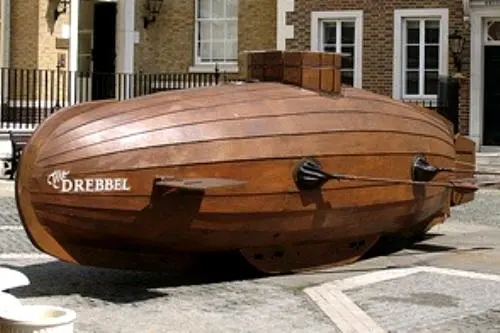
Cornelius Drebbel is widely credited with creating the first successful submersible in 1620. Working for the British Royal Navy, he constructed a vessel covered in greased leather that was powered by oars. Drebbel successfully demonstrated his craft in the River Thames, remaining submerged for several hours at a depth of 12 to 15 feet. While his design was rudimentary, it proved that a vessel could be controlled underwater.
Before Drebbel, inventors like William Bourne had sketched conceptual designs for underwater boats, but these remained theoretical. Drebbel’s achievement marked the transition from abstract engineering ideas to physical reality. His submarine relied on manual propulsion and lacked the sophisticated ballast systems found in modern vessels. Despite its success, the invention did not see immediate military use, as the technology was too fragile and limited for open-sea combat.
How did early submarines work?
Early submarines relied on basic physics to achieve buoyancy and depth control. Inventors utilized primitive ballast tanks, often made of animal bladders or simple wooden chambers, to take on or expel water. By adjusting the weight of the vessel, the pilot could sink or rise. Navigation was generally performed using compasses and external visual cues, which became impossible once the vessel descended into murky or deep waters.
The evolution of these vessels followed a distinct path of mechanical refinement:
- 1776: David Bushnell’s Turtle introduced the first screw propeller and a hand-cranked system.
- 1800: Robert Fulton’s Nautilus utilized a folding mast for sailing on the surface and a hand-cranked propeller for underwater travel.
- 1863: The Plongeur became the first submarine to use compressed air for propulsion, moving away from manual labor.
- 1888: The Peral submarine, designed by Isaac Peral, introduced the first fully electric battery-powered system.
Why did military interest in submarines grow?
The military potential of the submarine became clear during the American Revolutionary War. David Bushnell designed the Turtle, a small, egg-shaped craft intended to attach explosive charges to the hulls of British warships. Although the mission failed to sink a target, it demonstrated that a small, hidden vessel could threaten a massive ship. This shifted naval strategy, forcing larger fleets to consider the danger lurking beneath the surface.
During the American Civil War, the H.L. Hunley proved the lethal capability of the submarine by sinking the USS Housatonic in 1864. This was the first time in history a submarine successfully destroyed an enemy warship in combat. However, the mission was a pyrrhic victory, as the Hunley and its entire crew were lost in the process. These events accelerated global investment in submarine research, leading to the development of more stable and reliable designs by the late 19th century.
What are common mistakes when studying submarine history?
A frequent error is assuming that the submarine was invented as a single, sudden breakthrough. Many enthusiasts mistakenly attribute the invention solely to later figures like John Philip Holland or Simon Lake. In reality, these men were the architects of the modern, engine-powered submarine, not the pioneers of the concept itself. Ignoring the centuries of trial and error leads to a misunderstanding of how naval technology actually progresses.
Another common mistake involves ignoring the limitations of early propulsion systems. Beginners often assume that early submarines could travel long distances or stay submerged for days. In practice, these vessels were restricted by:
- Limited oxygen supplies for the crew.
- The lack of reliable underwater navigation tools.
- Extreme vulnerability to surface weather and currents.
- The physical exhaustion of crews operating manual hand-cranks.
Understanding these constraints is essential to evaluating why it took nearly 300 years for the submarine to become a dominant naval force.
How did submarines become modern warships?
The transition to the modern submarine required the integration of the internal combustion engine and electric motors. In the early 1900s, inventors realized that diesel engines could be used to charge batteries on the surface, while electric motors allowed for silent, emission-free travel underwater. This "diesel-electric" configuration became the standard for decades, allowing submarines to patrol vast areas of the ocean and remain submerged for significantly longer periods than their predecessors.
The invention of nuclear propulsion in the mid-20th century finally removed the need for surface air intake. The USS Nautilus, launched in 1954, was the first submarine to be powered by a nuclear reactor. This allowed the vessel to remain underwater indefinitely, limited only by the food supply and the psychological endurance of the crew. From Drebbel’s leather-covered rowboat to the nuclear-powered giants of today, the submarine remains one of the most complex and significant inventions in the history of maritime engineering.
Key facts
- Cornelis Drebbel, a Dutch inventor, built the first navigable submarine in 1620 for the British Royal Navy.
- Drebbel’s vessel was a wooden rowboat covered in greased leather to make it watertight.
- David Bushnell created the Turtle in 1775, the first submarine used in combat during the American Revolutionary War.
- Robert Fulton designed the Nautilus in 1800, which introduced the concept of dual propulsion using sails for surface travel and a hand-cranked propeller underwater.
- The USS Holland, launched in 1898, was the first submarine commissioned by the U.S. Navy to use a gasoline engine and electric motor combination.
- Modern submarines use nuclear reactors to generate power, allowing them to remain submerged for months without refueling.
The bottom line
The invention of the submarine was not the work of one individual, but an evolutionary process spanning centuries. From Drebbel’s rudimentary leather-covered rowboat to the sophisticated nuclear-powered vessels of today, engineering advancements have transformed submarines into essential naval assets. By mastering buoyancy, propulsion, and life-support systems, inventors successfully transitioned underwater travel from a dangerous experimental concept into a reliable, world-changing technology for exploration and defense.
People also ask
How did early submarines stay underwater?
Early submarines used ballast tanks that could be filled with water to increase the vessel's weight, causing it to sink. To surface, the crew used hand pumps or compressed air to expel the water and restore buoyancy.
What was the first submarine to sink an enemy ship?
The H.L. Hunley, a Confederate submarine, successfully sank the USS Housatonic in 1864 using a spar torpedo. However, the Hunley itself sank shortly after the attack, killing its entire crew.
Why are submarines shaped like a teardrop?
The teardrop shape, or "Albacore" hull, is designed to minimize drag and turbulence while moving through water. This hydrodynamic efficiency allows submarines to travel faster and more quietly than traditional boat-shaped hulls.
How do crews breathe inside a submarine?
Modern submarines generate oxygen through electrolysis, which splits water molecules into hydrogen and oxygen. They also use scrubbers to remove excess carbon dioxide from the air to maintain a breathable atmosphere.
What is the difference between a submarine and a submersible?
A submarine is an independent vessel capable of launching from a port and returning under its own power. A submersible has limited power and range, usually requiring a support ship to transport and launch it.
Can submarines see outside without windows?
Submarines rely on sonar, which uses sound waves to map the surroundings and detect objects. They also use periscopes or high-resolution digital cameras to observe the surface when at shallow depths.
This answer was created with the help of AI research tools and reference sources. Spotted an error? Let us know — we correct mistakes quickly. See our editorial policy.