Who invented the video game?
Short answer
There is no single inventor of the video game, as the technology evolved through the contributions of several engineers. Physicist William Higinbotham created Tennis for Two in 1958, while Ralph Baer developed the first home console prototype in 1966. These pioneers transformed simple electronic signals into the interactive entertainment industry we know today.

On this page
Who actually invented the first video game?
The origins of video games trace back to academic research rather than commercial gaming. In 1958, William Higinbotham, a scientist at Brookhaven National Laboratory, designed Tennis for Two to entertain visitors during an open house. He used an oscilloscope to display a side-view of a tennis court, allowing players to hit a ball over a net using handheld controllers. While rudimentary, it is widely considered the first true video game because it featured real-time interaction and a visual display.
Before this, in 1952, A.S. Douglas created OXO, a digital version of Tic-Tac-Toe, for the EDSAC computer at Cambridge University. However, OXO functioned more as a static display of logic rather than a dynamic game. These early experiments proved that cathode ray tubes could be repurposed for leisure. The transition from scientific curiosity to public entertainment required the vision of engineers like Ralph Baer, who later sought to bring these experiences into the living room.
How did home video game consoles start?
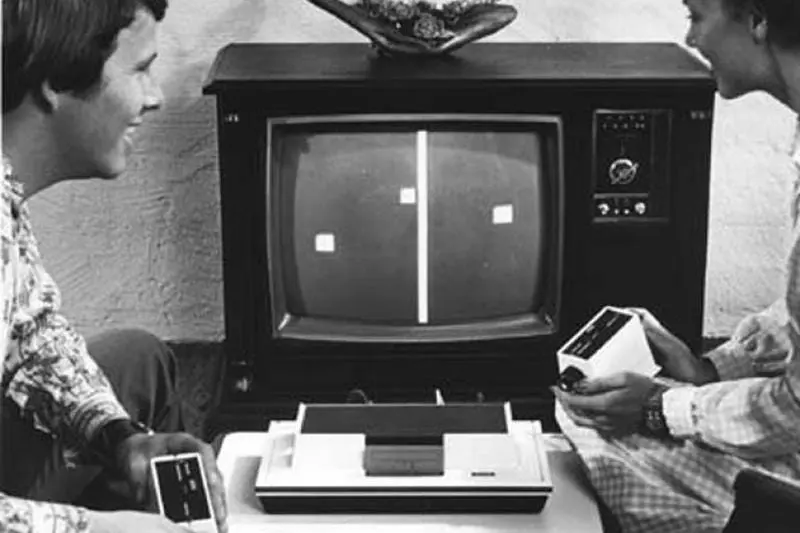
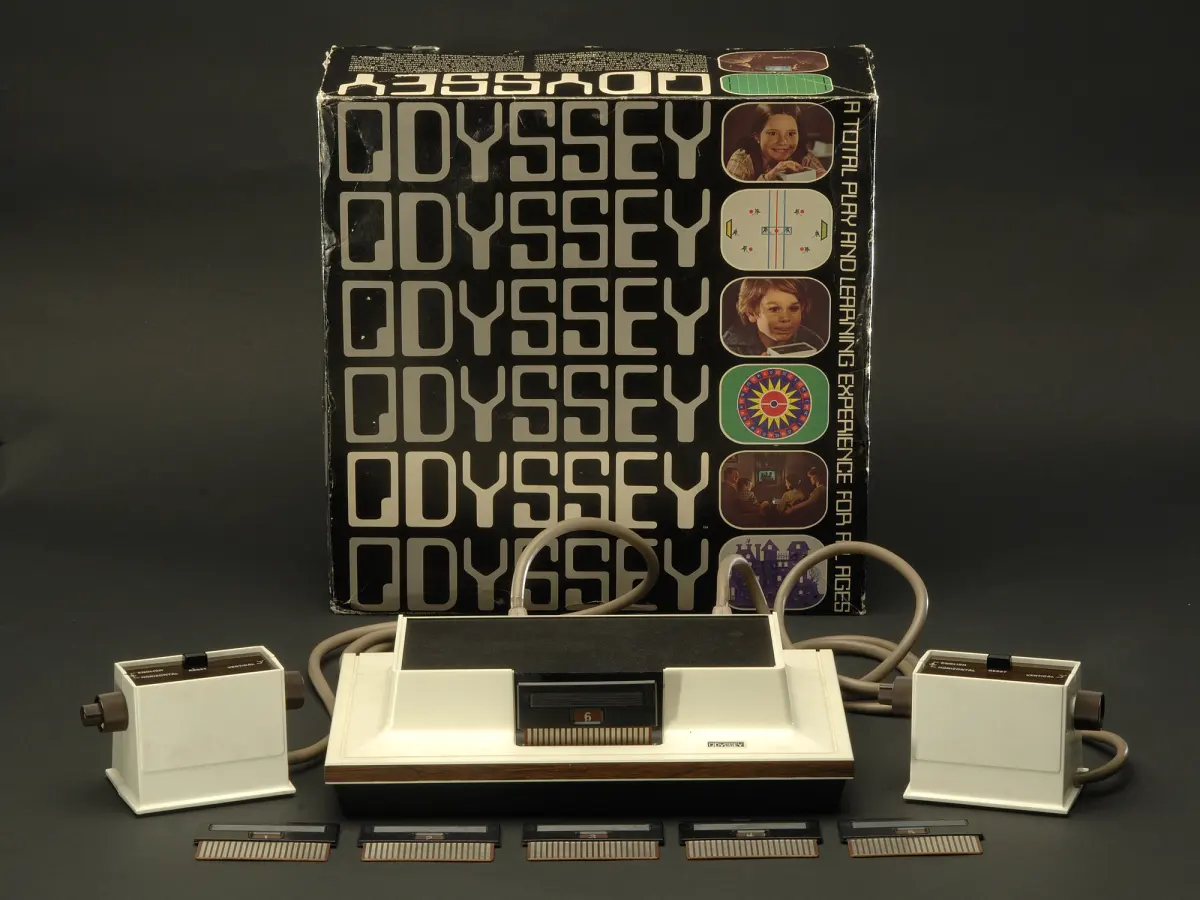
Ralph Baer, often called the "Father of Video Games," began his work in 1966 while working for the defense contractor Sanders Associates. He envisioned a device that could turn a standard television set into an interactive gaming machine. By 1968, he and his team developed the "Brown Box," a prototype that featured several games, including a chase game and a light gun shooter. This invention laid the technical foundation for the Magnavox Odyssey, released in 1972 as the first commercial home console.
The development of the Magnavox Odyssey established several critical standards for the industry. It utilized plastic overlays to simulate color graphics on black-and-white screens, a clever workaround for the hardware limitations of the era. The console's success demonstrated that consumers were eager to engage with their televisions interactively. Following this, the industry expanded rapidly through the following milestones:
- 1972: Nolan Bushnell founds Atari and releases Pong.
- 1975: Atari releases a home version of Pong, driving mass-market adoption.
- 1977: The Atari 2600 introduces interchangeable game cartridges, changing the business model forever.
Why did arcade games become so popular?
The commercialization of video games truly ignited with the success of arcade cabinets in the 1970s. Following the release of Pong, companies like Atari, Midway, and Namco began producing dedicated machines for bars, bowling alleys, and shopping malls. These games were designed to be simple to learn but difficult to master, encouraging repeat play to achieve higher scores. The social aspect of standing around a cabinet, waiting for a turn, created a vibrant community culture that defined the decade.
The arcade era also introduced the concept of the "high score," which provided a clear objective for players. As technology improved, developers added more complex mechanics, such as multiple levels and increasing difficulty. This period saw the rise of iconic titles that remain culturally significant today:
- Space Invaders (1978): Introduced the concept of the escalating challenge.
- Pac-Man (1980): Created a recognizable mascot and character-driven gameplay.
- Donkey Kong (1981): Established the platforming genre and introduced Mario.
Common mistakes when researching video game history
Many people mistakenly credit Pong as the absolute first video game. While Pong was the first massive commercial success that brought gaming into the public consciousness, it was preceded by nearly two decades of academic and prototype development. Another common error is assuming that early games were created by large corporations. In reality, most foundational work occurred in university laboratories or small, independent engineering firms that were trying to solve problems in computer science and display technology.
Researchers often overlook the hardware limitations that dictated early game design. Developers had to work within the constraints of extremely limited memory and processing power, which forced them to prioritize gameplay mechanics over visual fidelity. When studying this history, avoid these common pitfalls:
- Assuming that modern software development practices applied to the 1950s or 1960s.
- Ignoring the role of analog circuitry in early prototypes.
- Failing to distinguish between mainframe computer games and dedicated hardware consoles.
How to learn more about early game development
If you are interested in the technical evolution of gaming, start by exploring the archives of the Strong National Museum of Play or the Computer History Museum. These institutions house original prototypes, schematics, and interviews with the engineers who built the first systems. Understanding the transition from vacuum tubes to transistors and eventually integrated circuits is essential for grasping how games evolved from simple blips on a screen to the complex digital worlds we see today.
To gain a practical understanding of how these games functioned, you can try these steps:
- Research the schematics of the Magnavox Odyssey to understand how it used analog logic.
- Play emulated versions of early games to experience the original constraints firsthand.
- Read technical biographies of pioneers like Ralph Baer and Nolan Bushnell to understand the business challenges they faced.
By examining the intersection of engineering constraints and human creativity, you will gain a profound appreciation for the ingenuity that launched the global video game industry.
Key facts
- Ralph Baer, known as the "Father of Video Games," developed the first home console prototype, the "Brown Box," in 1966.
- William Higinbotham created Tennis for Two in 1958, an early electronic game displayed on an oscilloscope at Brookhaven National Laboratory.
- Nolan Bushnell and Ted Dabney founded Atari in 1972 and released Pong, the first commercially successful arcade video game.
- Steve Russell programmed Spacewar! in 1962, which is widely considered the first game to be played on multiple computer installations.
- Avoid the mistake of naming a single inventor; the industry evolved through decades of collaborative engineering and academic research.
- When researching early game history, distinguish between "video games" (which require a video signal) and earlier electromechanical games.
The bottom line
The invention of the video game was not a singular event but a gradual evolution of electronic engineering. From academic experiments in the 1950s to the commercial arcade hits of the 1970s, many pioneers contributed to the medium. Ralph Baer and Nolan Bushnell remain the most influential figures, yet the industry’s birth relied on the collective efforts of researchers, programmers, and entrepreneurs across several decades.
People also ask
What was the first home video game console?
The Magnavox Odyssey, released in 1972, was the first commercial home video game console. It was based on Ralph Baer’s original "Brown Box" prototype and used plastic overlays on television screens to provide graphics.
Did Atari invent the video game?
No, Atari did not invent the video game, but they popularized the medium. Their 1972 release of Pong turned video gaming into a profitable global industry and a cultural phenomenon.
Was Pong the first arcade game?
Pong was the first commercially successful arcade game, but it was preceded by Computer Space in 1971. Computer Space was also created by Nolan Bushnell and Ted Dabney but proved too difficult for the general public to play.
What role did universities play in early gaming?
Universities were the primary hubs for early game development because they held the only available mainframe computers. Students and researchers at institutions like MIT created games like Spacewar! as experiments in computing power and human-computer interaction.
How do I identify a true video game?
A true video game must feature a visual display, typically a cathode-ray tube or screen, and a mechanism for player input. If the game relies solely on mechanical gears or physical moving parts, it is classified as an electromechanical game rather than a video game.
Why are there conflicting claims about who invented video games?
Claims vary because early developments occurred simultaneously across different research labs and companies. Some early games were never patented or commercialized, leading to disputes over who achieved specific technical milestones first in the history of interactive entertainment.
This answer was created with the help of AI research tools and reference sources. Spotted an error? Let us know — we correct mistakes quickly. See our editorial policy.