What is a halo around the moon?
Short answer
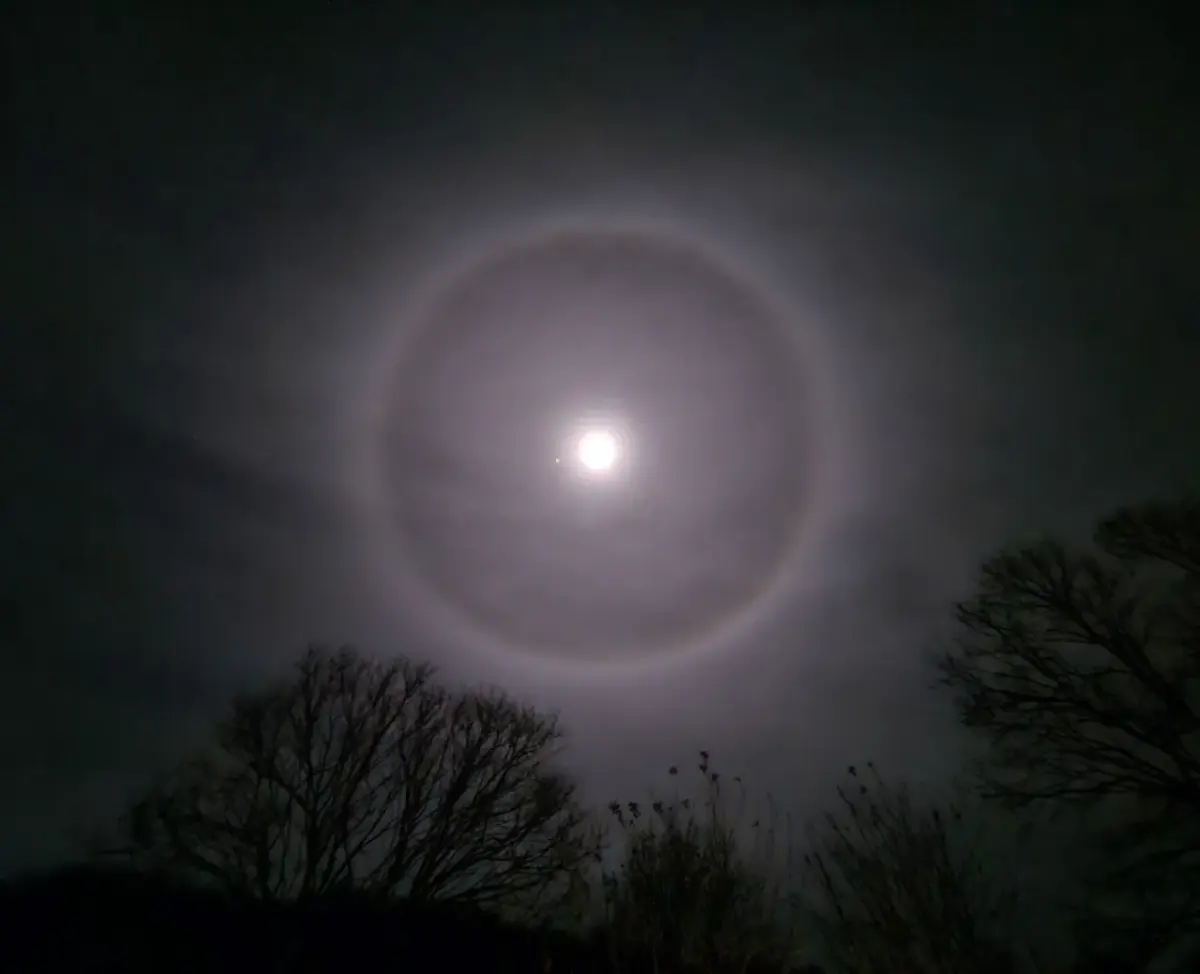
A lunar halo is an optical phenomenon appearing as a bright, luminous ring surrounding the Moon. It occurs when moonlight refracts and reflects through millions of hexagonal ice crystals suspended in high-altitude cirrus clouds. These crystals act like tiny prisms, bending the light at a specific 22-degree angle to create the circle.
On this page
Why does a lunar halo happen?
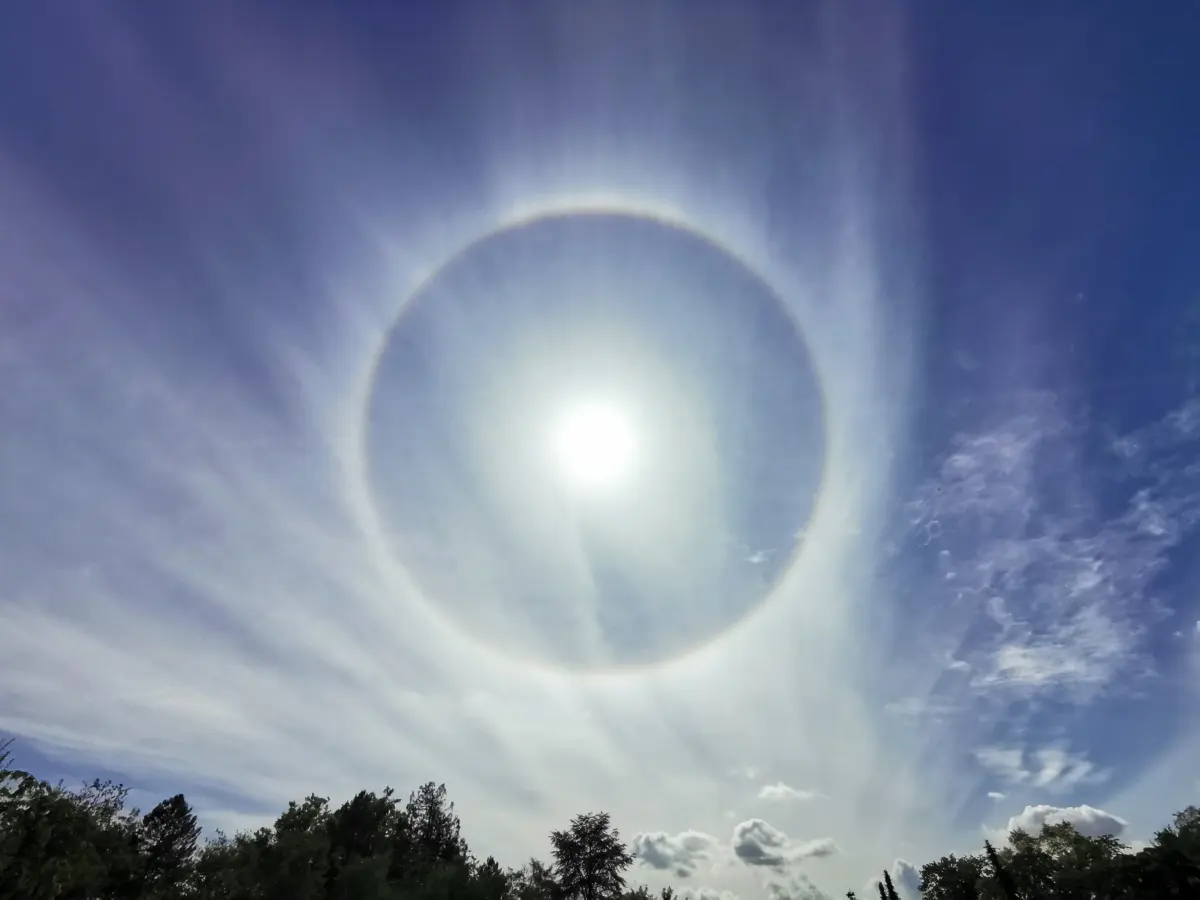
A lunar halo, often called a 22-degree halo, is a result of light interacting with ice. When moonlight passes through cirrus or cirrostratus clouds located 20,000 feet or higher in the atmosphere, it encounters ice crystals shaped like hexagonal prisms. As light enters one face of the crystal and exits through another, it is bent or refracted by exactly 22 degrees.
This consistent angle of refraction is what creates the distinct, circular shape of the halo. Because the crystals are randomly oriented in the sky, they form a complete ring around the Moon rather than a single point of light. While the ring often appears white, it can sometimes display faint colors, with a reddish hue on the inner edge and a bluish tint on the outer edge.
How to identify a lunar halo
Observing a lunar halo is relatively straightforward if you know what to look for in the night sky. The halo appears as a large, pale ring centered on the Moon, spanning about the width of your outstretched hand held at arm's length. Unlike a corona, which is a smaller, multicolored glow immediately hugging the Moon, a halo is much larger and more distant.
To confirm you are seeing a halo, consider these visual cues:
- The ring is perfectly circular and maintains a constant distance from the Moon.
- The area inside the ring appears slightly darker than the sky outside the ring.
- The phenomenon is most visible when the Moon is bright, particularly during the full or gibbous phases.
- The ring may only be partially visible if the cloud cover is thin or patchy.
Does a halo predict the weather?
Folklore often suggests that a lunar halo is a reliable omen of approaching rain or snow. Meteorologically speaking, this is grounded in fact because the cirrostratus clouds required for a halo are frequently the leading edge of a warm front. These high-altitude clouds often arrive 12 to 24 hours before a significant change in weather conditions.
While a halo is not a guarantee of a storm, it is a strong indicator of moisture increasing in the upper atmosphere. If you see a halo, you can expect the following atmospheric progression:
- High-altitude cirrus clouds thicken and lower into cirrostratus clouds.
- The barometric pressure begins to drop as the front approaches.
- Mid-level clouds move in, eventually leading to precipitation within the next day.
- The sky becomes overcast, obscuring the Moon and the halo entirely.
Common mistakes when viewing lunar halos
One frequent error is confusing a lunar halo with a lunar corona. A corona is caused by the diffraction of light through water droplets in lower, thinner clouds rather than ice crystals. Coronas are much smaller, often appearing as a tight, iridescent disk immediately surrounding the lunar surface, whereas halos are expansive rings that dominate the sky.
Another mistake is assuming that the halo is an atmospheric disturbance located near the Moon itself. In reality, the phenomenon is entirely local to Earth's atmosphere, existing only a few miles above your head. Observers also often fail to shield their eyes from the Moon's direct glare, which makes the faint light of the halo harder to perceive. To improve your view, stand in a shadow or block the Moon with a building or tree to allow your eyes to adjust to the dim light of the ring.
How to photograph a lunar halo
Capturing a clear image of a lunar halo requires a camera capable of long-exposure settings and a stable tripod. Because the ring is quite dim compared to the bright Moon, a standard smartphone camera often struggles to balance the exposure. Using a manual mode allows you to control the shutter speed and ISO to bring out the subtle details of the ring.
Follow these steps to capture the best image:
- Mount your camera on a tripod to prevent motion blur during long exposures.
- Set your lens to a wide-angle focal length to capture the entire diameter of the halo.
- Use a manual exposure setting, starting with an ISO of 800 and a shutter speed of 5 to 10 seconds.
- Adjust your focus to manual and focus on a distant star or the edge of the Moon to ensure sharpness.
- Use a remote shutter release or a self-timer to avoid shaking the camera when you press the button.
Key facts
- A lunar halo is an optical phenomenon caused by the refraction and reflection of moonlight through ice crystals.
- These ice crystals are suspended in high-altitude cirrus or cirrostratus clouds, typically 20,000 feet or higher.
- The halo appears as a large, faint ring of light with a radius of approximately 22 degrees around the moon.
- The inner edge of the ring often appears reddish, while the outer edge fades into a white or bluish glow.
- You can easily measure the 22-degree radius by holding your hand at arm's length; the halo spans about the width of your spread-out hand.
- Folklore suggests that a lunar halo often precedes a change in weather, such as an approaching warm front or storm.
The bottom line
A lunar halo is a beautiful display of atmospheric optics created when moonlight interacts with high-altitude ice crystals. By forming a 22-degree ring around the moon, these halos serve as natural indicators of moisture in the upper atmosphere. While they are often harbingers of approaching weather changes, they remain harmless to observe, providing a serene and memorable experience for anyone looking up at the night sky.
People also ask
Are lunar halos dangerous to look at?
No, looking at a lunar halo is perfectly safe for your eyes. Unlike a solar eclipse, the moonlight is not intense enough to cause retinal damage.
Why are lunar halos sometimes called "moon dogs"?
While a lunar halo is a complete ring, "moon dogs"—or paraselenae—are bright spots that appear on either side of the moon. They are caused by the same hexagonal ice crystals but are less common than the full halo.
Can you see colors in a lunar halo?
Yes, the ring often displays a faint spectrum of color. The light is refracted by ice crystals much like a prism, causing the inner edge to appear reddish and the outer edge to appear bluish.
Do lunar halos only happen at night?
The phenomenon is specifically associated with the moon, but the exact same process creates a solar halo during the day. Solar halos are often brighter and easier to observe, though they require eye protection to view safely.
How can I photograph a lunar halo?
Use a tripod to keep your camera steady and set a long exposure time, typically between 5 and 15 seconds. Avoid using your flash, as it will wash out the faint light of the halo and illuminate nearby dust instead.
Does a halo around the moon mean it will rain?
It is a strong indicator that high-altitude moisture is present in the atmosphere. While it does not guarantee immediate rain, it frequently signals that a storm system is moving into the area within the next 24 to 48 hours.
This answer was created with the help of AI research tools and reference sources. Spotted an error? Let us know — we correct mistakes quickly. See our editorial policy.