What is a blood moon?
Short answer
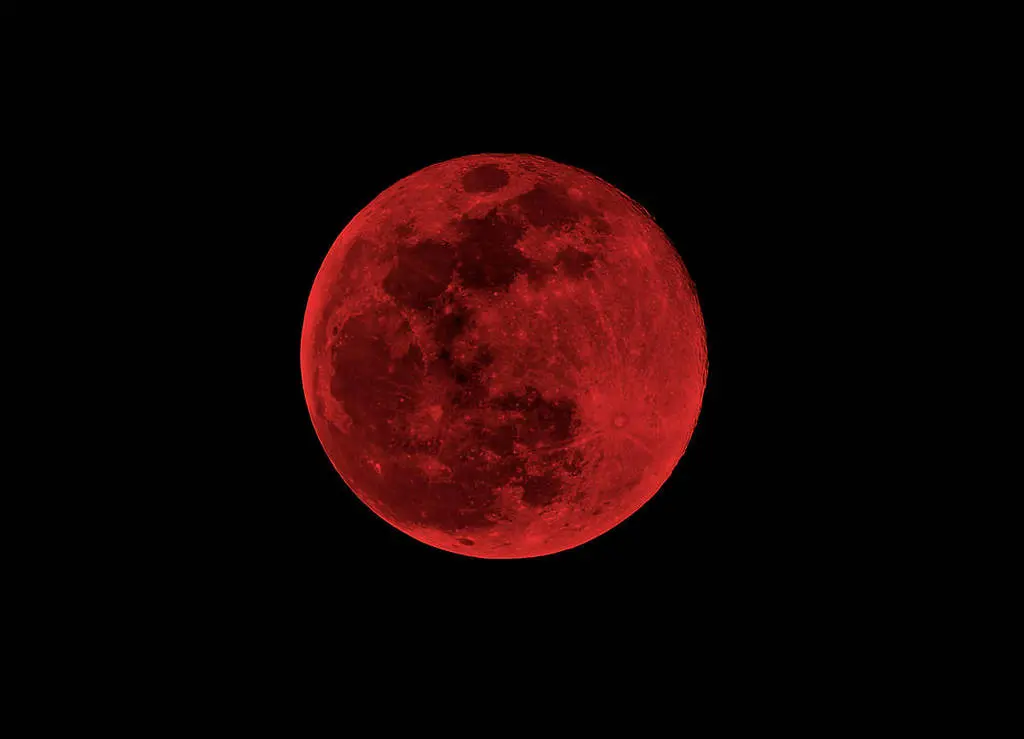
A blood moon is a total lunar eclipse that occurs when the Earth passes directly between the Sun and the Moon. During this alignment, the Earth blocks direct sunlight, but atmospheric scattering allows red light to reach the Moon’s surface, giving it a distinct, deep reddish-orange hue for several hours.
On this page
Why does a blood moon happen?
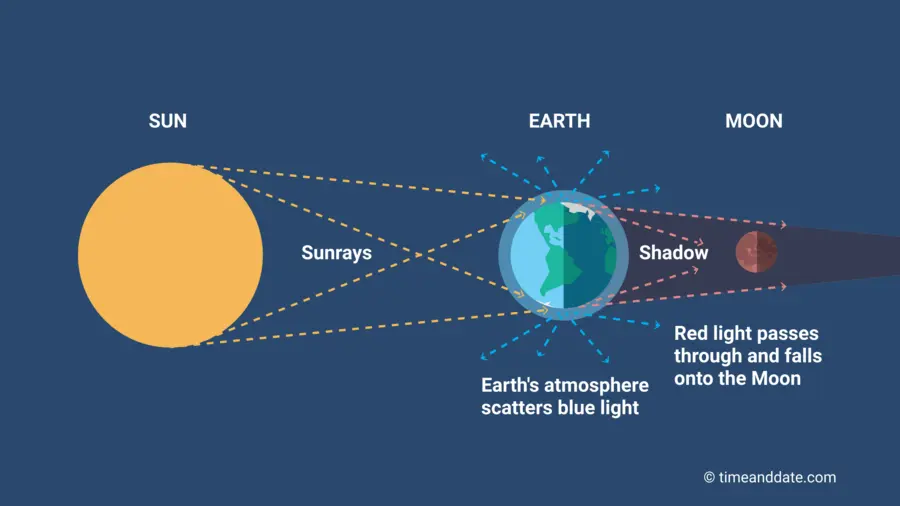
A blood moon occurs exclusively during a total lunar eclipse. This celestial event requires a syzygy, meaning the Sun, Earth, and Moon must align in a nearly perfect straight line. As the Earth moves between the Sun and the Moon, it casts a shadow known as the umbra across the lunar surface. If the Moon were to pass through the Earth's shadow without an atmosphere, it would turn completely black and disappear from view.
However, the Earth’s atmosphere acts like a lens, bending sunlight around the edges of the planet. This process, known as Rayleigh scattering, filters out the shorter blue wavelengths of light while allowing longer red wavelengths to pass through. These red rays are refracted toward the Moon, illuminating it with a copper or blood-red glow. The intensity of this color depends heavily on the amount of dust, volcanic ash, and water vapor present in the Earth’s atmosphere at the time of the eclipse.
How to view a blood moon safely
Unlike solar eclipses, which require specialized protective eyewear to prevent permanent eye damage, lunar eclipses are entirely safe to view with the naked eye. You do not need telescopes, binoculars, or filters to enjoy the spectacle. Because the Moon is dimmer than usual during the totality phase, your eyes will naturally adjust to the darkness, allowing you to see the red hue clearly.
If you want to enhance your viewing experience, consider these tips:
- Find a location away from city lights to maximize the contrast of the Moon against the dark sky.
- Use a pair of standard binoculars to get a closer look at the lunar craters during the partial phases of the eclipse.
- Check local weather reports in advance, as cloud cover is the primary factor that can obscure your view.
- Consult an online astronomy calendar to determine the exact timing of the eclipse for your specific geographic coordinates.
When is the next blood moon?
Total lunar eclipses occur at irregular intervals, typically happening about twice every three years on average. Because the Moon’s orbit is tilted about five degrees relative to the Earth’s orbit around the Sun, the three bodies do not align perfectly every month. When they do align, the eclipse is only visible from the half of the Earth facing the Moon at that moment.
To track upcoming lunar events, keep the following in mind:
- Visit reputable space agency websites that maintain updated ephemeris data for upcoming years.
- Note that the visibility of an eclipse is restricted to specific hemispheres, so a "blood moon" might be visible in North America but not in Europe.
- Be aware that lunar eclipses can happen during any season, provided the orbital nodes align correctly.
- Set reminders for the predicted peak of totality, as the most dramatic color changes occur during the middle portion of the event.
Common mistakes when watching a lunar eclipse
One of the most frequent errors observers make is failing to prepare for the duration of the event. A total lunar eclipse is a slow process that can take several hours from the moment the Moon enters the penumbra until it exits the shadow. Many people expect an instantaneous change and lose interest before the most impressive, deep-red phase begins. Patience is essential for the best experience.
Another mistake is assuming that every lunar eclipse results in a "blood moon." There are three types of lunar eclipses: penumbral, partial, and total. Only a total lunar eclipse produces the iconic red appearance. During a penumbral eclipse, the Moon only passes through the Earth’s faint outer shadow, which is often difficult to distinguish from a full moon. Similarly, a partial eclipse only covers a segment of the lunar disk, leaving the rest bright white. Always verify whether the upcoming event is classified as "total" if you are specifically hoping to see the red coloration.
What is the significance of the blood moon?
Historically, the blood moon has been viewed with both wonder and trepidation across various cultures. Ancient civilizations often interpreted the sudden darkening and reddening of the Moon as an omen of impending disaster, war, or divine judgment. These interpretations were born from a lack of scientific understanding, as the sudden shift in the night sky defied the expected predictability of the celestial bodies. Today, we understand these events as simple, beautiful consequences of orbital mechanics.
In modern times, the blood moon serves as a powerful tool for scientific education and public engagement with astronomy. It provides a unique opportunity for researchers to study the Earth’s atmosphere by measuring how much light is scattered during the eclipse. For the general public, it remains a moment of collective awe, encouraging people to look upward and appreciate the complex, clockwork nature of our solar system. Whether viewed from a backyard or a professional observatory, the blood moon remains one of the most accessible and visually striking phenomena in the night sky.
Key facts
- A blood moon occurs only during a total lunar eclipse when the Earth passes directly between the Sun and the Moon.
- The moon appears reddish because Earth’s atmosphere scatters blue sunlight while bending red light toward the lunar surface.
- Unlike solar eclipses, blood moons are perfectly safe to view with the naked eye and require no special protective equipment.
- The deep red color intensity depends on the amount of dust, volcanic ash, and cloud cover present in Earth's atmosphere during the event.
- Total lunar eclipses happen on average about 1.5 times per year, though some years may have none while others feature multiple events.
- To photograph a blood moon, use a tripod and a long telephoto lens to compensate for the moon's dimness and distance.
The bottom line
A blood moon is a captivating astronomical event that occurs during a total lunar eclipse, turning the moon a deep, rusty red. This transformation is caused by Earth's atmosphere filtering sunlight, a process that is entirely safe to observe without special equipment. By understanding the timing and location of these celestial alignments, anyone can enjoy the unique experience of watching the moon change color in the night sky.
People also ask
Does a blood moon have any negative impact on human health or behavior?
There is no scientific evidence suggesting that a blood moon influences human physiology, mental health, or behavior. Claims linking the event to natural disasters or societal unrest are based on superstition rather than astronomical reality.
How long does the total phase of a blood moon last?
The duration of totality—the period when the moon is completely covered by Earth's shadow—varies depending on the moon's position in its orbit. It typically lasts between 30 minutes and over an hour, with the entire eclipse process taking several hours.
Can I see a blood moon from anywhere on Earth?
A blood moon is only visible from the side of the Earth currently experiencing nighttime during the eclipse. If the moon is below your horizon when the eclipse occurs, you will not be able to observe the phenomenon.
Why do some lunar eclipses not result in a blood moon?
A blood moon only occurs during a total lunar eclipse. If the moon passes through only the outer part of Earth's shadow, known as the penumbra, or only partially enters the dark umbra, it will not turn red.
Is a blood moon the same thing as a supermoon?
These are distinct events, though they can happen simultaneously. A supermoon occurs when the moon is at its closest point to Earth in its orbit, while a blood moon refers specifically to the reddish color during a total eclipse.
What is the best way to prepare for viewing a blood moon?
Check an online astronomical calendar to confirm the exact timing for your specific location. Find a spot with minimal light pollution and an unobstructed view of the sky, and dress warmly if the event occurs during colder months.
This answer was created with the help of AI research tools and reference sources. Spotted an error? Let us know — we correct mistakes quickly. See our editorial policy.