What is the difference between weather and climate?
Short answer
Weather describes the short-term state of the atmosphere, such as rain or sunshine occurring over minutes or days. Climate represents the long-term average of these weather patterns in a specific region, typically measured over 30 years or more. While weather tells you what to wear today, climate dictates what clothes you own.
On this page
What is the difference between weather and climate?
Weather refers to the immediate, localized conditions of the atmosphere. It encompasses phenomena like temperature, humidity, precipitation, cloudiness, visibility, and wind speed. Because the atmosphere is chaotic and dynamic, weather can change rapidly within hours or even minutes. For example, a sunny morning can quickly transition into a thunderstorm by the afternoon.
Climate, conversely, is the statistical average of weather patterns over an extended period. Meteorologists and climatologists generally use a 30-year baseline to define a region's climate. While weather is what you experience when you step outside, climate is the expectation based on historical data. If you live in a desert, the climate is arid, even if it happens to rain on a single day. Understanding this distinction is essential for interpreting environmental data and preparing for both daily activities and long-term regional shifts.
How do scientists measure weather and climate?
Meteorologists track weather using a dense network of ground stations, weather balloons, radar, and satellites. These instruments provide real-time data on atmospheric pressure, wind vectors, and moisture levels. This information is fed into complex numerical models that generate short-term forecasts, usually accurate for up to seven to ten days.
Climatologists analyze these same data points but aggregate them over decades to identify trends. They utilize proxy data to understand historical climate, including:
- Ice cores from glaciers that trap ancient air bubbles.
- Tree rings that reveal annual growth patterns and moisture history.
- Sediment layers from lake beds that indicate past temperatures.
- Coral reef structures that store chemical signatures of ocean heat.
By combining modern instrumental records with these natural archives, scientists can reconstruct the Earth's climate history. This long-term perspective allows them to distinguish between natural variability and systemic changes in the global environment.
Why does weather change so quickly?
Weather is driven by the uneven heating of the Earth's surface by the sun. As the equator receives more direct sunlight than the poles, the atmosphere attempts to balance these temperature differences through the movement of air masses. High-pressure and low-pressure systems circulate, carrying moisture and heat across the globe.
Several factors influence the speed of these changes:
- Topography: Mountains force air to rise, cool, and condense, often creating localized weather patterns.
- Proximity to water: Oceans act as heat reservoirs, stabilizing temperatures in coastal regions compared to inland areas.
- Jet streams: These fast-flowing air currents in the upper atmosphere steer weather systems and determine the path of storms.
When these variables interact, they create the complex, often unpredictable nature of daily weather. A slight shift in the position of a jet stream can move a storm system hundreds of miles, changing a forecast from clear skies to heavy rain overnight.
Common mistakes when discussing climate change
A frequent error is confusing a single cold weather event with the absence of global warming. Because climate is an average, a record-breaking blizzard in one city does not disprove the trend of rising global temperatures. Climate change refers to the shift in the statistical mean of global weather over time, not the elimination of cold days.
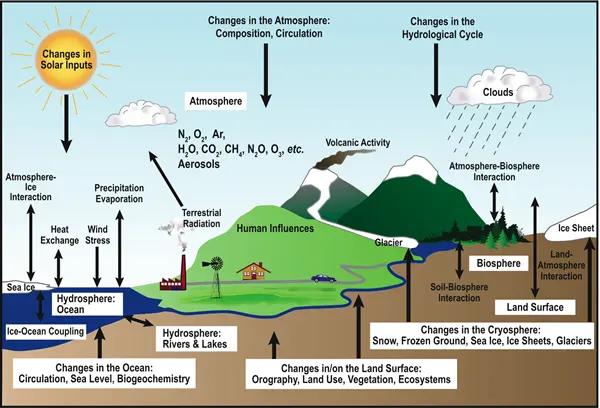
Another mistake is assuming that climate is static. Some people believe that because a region has been historically temperate, it will remain so indefinitely. However, climate is a dynamic system that responds to changes in greenhouse gas concentrations, volcanic activity, and solar output. Failing to distinguish between internal variability—like the El Niño Southern Oscillation—and long-term anthropogenic forcing often leads to misinterpretations of environmental reports. Always look for trends spanning multiple decades rather than focusing on the anomalies of a single season or year to understand the true trajectory of the climate.
Best ways to prepare for weather and climate
For daily life, preparation relies on checking reliable meteorological forecasts. Most national weather services provide hourly updates that help in planning commutes, outdoor events, or agricultural tasks. Keep an eye on alerts for severe weather, such as hurricanes or flash floods, which require immediate action to ensure safety.
Long-term climate preparation involves understanding the risks specific to your geographic location. If you are planning for the future, consider the following steps:
- Research historical climate data for your region to understand seasonal norms.
- Assess your vulnerability to extreme events like prolonged droughts or sea-level rise.
- Invest in infrastructure that is resilient to the projected climate trends of your area.
- Diversify your resources to account for potential shifts in agricultural or water availability.
By aligning your long-term planning with climate projections, you can mitigate risks associated with environmental changes. While you cannot control the weather, being informed about the climate allows you to adapt effectively to the changing world around you.
Key facts
- Weather describes the state of the atmosphere at a specific place and time, such as a rainy Tuesday afternoon.
- Climate represents the long-term average of weather patterns in a specific region, typically measured over 30 years or more.
- A common mistake is assuming a single cold day disproves global warming; weather is a momentary event, while climate is a trend.
- Meteorologists use tools like barometers and satellites to forecast weather, while climatologists analyze historical data to track climate shifts.
- The World Meteorological Organization defines the standard climate normal as a 30-year average to filter out short-term fluctuations.
- You can think of the difference using a simple analogy: weather is your mood today, while climate is your overall personality.
The bottom line
The fundamental distinction between weather and climate is time. Weather is the immediate, fluctuating state of the atmosphere that dictates your daily activities, while climate is the statistical average of those conditions over decades. Understanding this difference is essential for interpreting environmental data correctly. By focusing on long-term trends rather than daily variations, you can better grasp how our planet’s environment is evolving over time.
People also ask
How do scientists calculate climate averages?
Scientists calculate climate by averaging daily weather data, such as temperature and precipitation, over a period of at least 30 years. This long duration helps smooth out extreme anomalies, providing a stable baseline for a region's expected conditions.
Why is it difficult to predict weather more than two weeks in advance?
The atmosphere is a chaotic system where tiny changes in initial conditions can lead to vastly different outcomes, a concept known as the butterfly effect. Current computer models lose accuracy rapidly beyond 10 to 14 days because they cannot account for every variable.
Does climate change mean weather will disappear?
No, climate change refers to a shift in the long-term averages of weather patterns, not the elimination of weather itself. As the global climate warms, it often leads to more frequent or intense extreme weather events, such as heatwaves and heavy rainfall.
What is the difference between a weather watch and a weather warning?
A watch means that conditions are favorable for hazardous weather to develop in your area, so you should stay alert. A warning indicates that dangerous weather is already occurring or imminent, requiring immediate action to ensure your safety.
Can local weather be different from the regional climate?
Yes, local geography like mountains, lakes, or urban heat islands can create microclimates that differ significantly from the broader regional climate. A city center might be warmer than the surrounding countryside, even if they share the same general climate classification.
How do historical records help us understand climate?
Historical records, such as tree rings, ice cores, and early thermometer logs, allow scientists to reconstruct past climates. This data provides the necessary context to determine if current changes are part of natural cycles or driven by human activity.
This answer was created with the help of AI research tools and reference sources. Spotted an error? Let us know — we correct mistakes quickly. See our editorial policy.