Why is Greenland called Greenland?
Short answer
Greenland was named by the Norse explorer Erik the Red around 982 CE. After being exiled from Iceland for manslaughter, he discovered the island and gave it an appealing name to encourage Norse settlers to join him. He believed that people would be more eager to move if the land sounded inviting.
On this page
Who was Erik the Red?
Erik the Red, born Erik Thorvaldsson, was a Norse explorer known for his fiery temper and adventurous spirit. After his father was exiled from Norway for killing a man, the family settled in Iceland. Erik eventually followed in his father’s footsteps, getting himself banished from Iceland for three years following a series of violent feuds that resulted in multiple deaths.
During his period of exile, Erik sailed west into the North Atlantic to investigate rumors of land sightings. He reached the southwestern coast of Greenland, where he spent his years of banishment exploring the fjords and coastal areas. Upon returning to Iceland, he utilized his charisma to organize a fleet of ships to colonize the new territory. By branding the island "Greenland," he successfully convinced hundreds of settlers to depart their homes for the harsh Arctic climate.
Why was the name Greenland chosen?
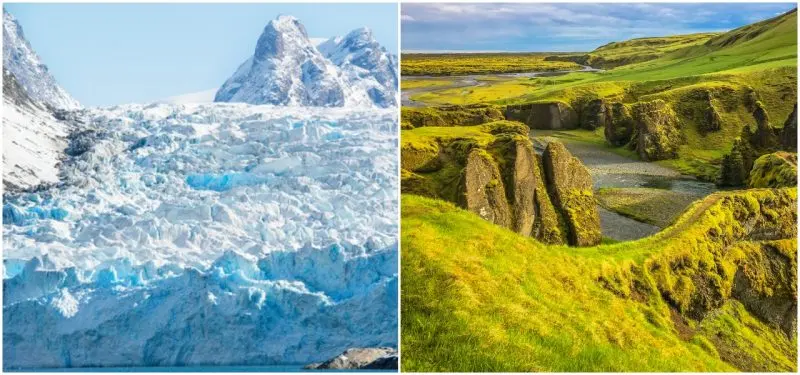
The name Greenland was a calculated marketing strategy designed to attract settlers to a land that was largely covered in ice. While the interior of the island is dominated by a massive ice sheet, the coastal regions where the Norse settled offered green pastures during the summer months. These areas provided sufficient grazing land for sheep, goats, and cattle, which were essential for the survival of the Norse colonies.
Historical accounts, specifically the Saga of Erik the Red, explicitly state that Erik chose the name to entice people to move there. He understood that the psychological appeal of a "green" land would outweigh the negative connotations of a cold, desolate island. This early form of branding proved effective, as thousands of Norse people eventually populated the Eastern and Western Settlements, establishing farms and churches that lasted for several centuries.
What was the climate like during the Norse settlement?
The Norse arrived in Greenland during the Medieval Warm Period, a time when global temperatures were notably higher than in previous centuries. This climatic shift allowed for more favorable conditions in the North Atlantic, making the sea routes safer and the coastal regions of Greenland more productive for agriculture. The settlers were able to maintain a lifestyle similar to what they had experienced in Iceland and Norway.
Several factors contributed to the relative success of these early settlements:
- The presence of sheltered fjords that protected livestock from harsh winds.
- Access to marine resources, such as seals and walruses, which provided food and valuable ivory.
- A temporary reduction in sea ice, which facilitated trade with Europe.
- The ability to grow hardy crops like barley in the most protected valleys.
How do historians verify this naming story?
Historians rely on a combination of archaeological evidence and medieval Icelandic sagas to verify the history of Greenland's naming. The sagas, while written down long after the events occurred, serve as the primary narrative source for the Viking Age. Archaeologists have confirmed these accounts by excavating Norse farmsteads, finding evidence of livestock bones and remnants of structures that align with the timeline provided in the texts.
When researching the origins of Greenland's name, avoid these common mistakes:
- Assuming the entire island was green; the name only applied to the habitable coastal strips.
- Believing the name was a simple mistake; it was a deliberate choice for colonization.
- Ignoring the role of the Medieval Warm Period in making the name seem accurate to the original settlers.
- Confusing the Norse naming with modern perceptions of the island's ice-covered interior.
What is the legacy of the name today?
Today, the name Greenland remains a historical curiosity that highlights the persuasive power of language. While the name is technically a misnomer for the vast majority of the island, it has become deeply embedded in global geography. The irony of the name is frequently discussed in modern culture, often serving as a cautionary tale about the importance of context when interpreting historical place names.
The island is now home to a majority Inuit population, who refer to their homeland as Kalaallit Nunaat. Despite the shift in demographics and the decline of the Norse colonies in the 15th century, the name Greenland persists on international maps. It serves as a reminder of the Norse explorers' ambition and their reliance on strategic communication to establish a foothold in one of the most challenging environments on Earth. The name survives not because it is descriptive of the landscape, but because it is a permanent marker of a significant chapter in human exploration.
Key facts
- Erik the Red, a Norse explorer, named the land "Greenland" around 982 CE.
- The name was likely a marketing tactic to attract settlers from Iceland to the harsh environment.
- Approximately 80 percent of Greenland's surface is covered by a permanent ice sheet.
- The name "Greenland" ignores the fact that only the coastal fringes are seasonally green.
- Norse settlers established two main colonies, the Eastern and Western Settlements, which lasted for several centuries.
- Avoid confusing the name with the actual climate, as the island is primarily an Arctic tundra and glacier landscape.
The bottom line
Greenland’s misleading name is a classic example of historical branding intended to lure settlers to a challenging frontier. While Erik the Red hoped to frame the icy landscape as an inviting prospect, the reality remains a vast, frozen expanse dominated by glaciers. Today, the island serves as a vital center for climate research, reminding us that its name reflects human ambition rather than its true, rugged Arctic geography.
People also ask
Was Greenland ever actually green?
During the Medieval Warm Period, some coastal areas experienced slightly milder temperatures than today. However, the island was never a lush, green territory, and the name remains largely a historical exaggeration.
Did the Norse settlers survive in Greenland?
The Norse colonies thrived for about 400 years before disappearing in the 15th century. Historians attribute their decline to a combination of climate cooling, soil erosion, and isolation from trade networks.
What is the official name of Greenland in the local language?
The Greenlandic name for the island is Kalaallit Nunaat, which translates to "Land of the Greenlanders." This reflects the identity of the indigenous Inuit people who have inhabited the region for centuries.
Is Greenland a country?
Greenland is an autonomous territory within the Kingdom of Denmark. While it manages its own internal affairs, Denmark remains responsible for its foreign policy, defense, and currency.
Why is Greenland often depicted as huge on world maps?
Greenland appears massive on maps using the Mercator projection because the projection distorts the size of landmasses near the poles. In reality, Greenland is about one-fourteenth the size of Africa.
Can you visit the areas Erik the Red settled?
Yes, the ruins of the Norse settlements are located in the southern regions of Greenland near modern-day Qaqortoq. Visitors can explore these archaeological sites, which are protected as historical landmarks.
This answer was created with the help of AI research tools and reference sources. Spotted an error? Let us know — we correct mistakes quickly. See our editorial policy.