What was the Fraser Canyon Gold Rush?
Short answer
The Fraser Canyon Gold Rush was a significant 1858 migration of approximately 30,000 prospectors to British Columbia, Canada. Triggered by the discovery of gold along the Fraser River, this influx transformed the region from a sparsely populated fur-trading territory into a British Crown Colony, permanently altering the area's demographics and economy.
On this page
Why did the Fraser Canyon Gold Rush happen?
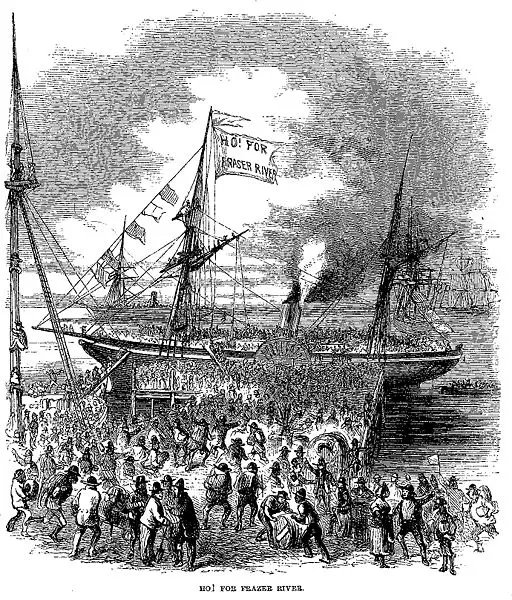
The gold rush began in 1858 after Hudson’s Bay Company officials sent samples of gold dust from the Fraser River to the San Francisco Mint. At the time, California’s own gold rush was fading, leaving thousands of experienced miners looking for new opportunities. Word spread rapidly through West Coast newspapers, sparking a massive migration northward.
The sudden arrival of thousands of miners threatened the stability of the region, which was then under the control of the Hudson’s Bay Company. Governor James Douglas feared that the influx of American prospectors would lead to the United States annexing the territory. To secure British sovereignty, the British government formally established the Colony of British Columbia in August 1858. This political maneuver ensured that the law of the Crown would prevail over the chaotic frontier conditions brought by the gold seekers.
How did miners travel to the Fraser Canyon?
Reaching the gold fields was a perilous journey that required significant preparation and endurance. Most prospectors traveled by sea from San Francisco to Victoria, Vancouver Island, before navigating the treacherous waters of the Strait of Georgia and the Fraser River. Once they reached the mainland, the journey became even more physically demanding as they moved inland toward the canyon.
- Secure passage on a steamship or sailing vessel from San Francisco to Victoria.
- Transfer to smaller boats or canoes to navigate the Fraser River’s powerful currents.
- Hike along the steep, narrow canyon trails when the river became impassable.
- Establish a temporary camp near known sandbars or river bends to begin panning.
The terrain was rugged, and many travelers lacked the supplies necessary to survive the harsh winter conditions. Those who attempted to bypass the river by land faced the daunting task of traversing the dense, mountainous wilderness of the Cascade Range.
What were the conditions like in the gold fields?
Life in the mining camps was characterized by extreme hardship, isolation, and intense competition. Prospectors typically worked in teams, using basic tools like pans, rockers, and sluice boxes to separate gold from river gravel. The work was backbreaking, often involving standing in cold, fast-moving water for hours at a time. Success was never guaranteed, and many miners barely earned enough to cover the cost of their expensive supplies.
- Flour, bacon, and beans were the primary staples of the miners' diet.
- High prices for goods were common due to the difficulty of transporting supplies.
- Disputes over mining claims frequently led to violence and social unrest.
- Diseases like scurvy and dysentery were prevalent in overcrowded, unsanitary camps.
The environment was also a source of constant danger, as the Fraser River’s spring freshet—the annual surge of melting snow—could wash away equipment and claim the lives of those working too close to the banks.
How did the gold rush impact Indigenous peoples?
The arrival of thousands of prospectors had a devastating impact on the Indigenous Nlaka'pamux people, who had lived in the canyon for millennia. As miners pushed into their ancestral lands, conflicts over resources and territory became inevitable. The Fraser Canyon War of 1858 broke out when miners retaliated against the Nlaka'pamux for defending their homes and fishing sites from encroachment.
Tensions eventually subsided through a series of negotiations, but the long-term consequences for the Indigenous population were severe. The influx of outsiders introduced foreign diseases, such as smallpox, which decimated local communities. Furthermore, the colonial government’s focus on mining rights ignored Indigenous land title, leading to the systematic displacement of the Nlaka'pamux from their traditional hunting and gathering grounds. This period marked the beginning of a long struggle for Indigenous rights that would continue to define the political landscape of British Columbia for generations to come.
Common mistakes when studying the gold rush
A frequent error is assuming the Fraser Canyon Gold Rush was as long-lasting or as lucrative as the California Gold Rush. In reality, the most productive period was very short, peaking in 1858 and declining rapidly by 1860 as the easily accessible gold was exhausted. Many miners left as quickly as they arrived, disappointed by the lack of "easy" wealth and the high costs of living in the wilderness.
- Underestimating the role of the Hudson’s Bay Company in managing the colonial transition.
- Ignoring the environmental impact of hydraulic mining techniques introduced later.
- Overlooking the contributions of Chinese miners who arrived after the initial rush.
- Assuming that all participants were successful in finding significant quantities of gold.
To gain a true understanding of this era, one must look beyond the myth of the wealthy prospector. The legacy of the gold rush is not found in the gold itself, but in the rapid development of infrastructure, the establishment of permanent settlements, and the complex, often tragic, history of colonial expansion in the Pacific Northwest.
Key facts
- The Fraser Canyon Gold Rush began in 1858 when gold was discovered along the Fraser River in present-day British Columbia.
- Over 30,000 prospectors, mostly from California, flooded the region, causing a massive population surge in the territory.
- The rush led to the formal creation of the Colony of British Columbia in August 1858 to establish British authority.
- Prospectors primarily used simple tools like gold pans, sluice boxes, and rockers to extract gold from river gravel.
- The Fraser Canyon War of 1858 involved skirmishes between miners and the Nlaka'pamux people over territory and resources.
- To succeed, miners had to navigate dangerous river rapids and treacherous mountain trails, often losing supplies to the terrain.
The bottom line
The Fraser Canyon Gold Rush was a pivotal event that rapidly transformed British Columbia from a remote fur-trading territory into a formal British colony. Driven by the lure of gold, thousands of prospectors endured extreme hardships and conflict to seek their fortunes. While the boom was short-lived, it permanently altered the region’s demographics, infrastructure, and the long-standing relationships between colonial authorities and the Indigenous populations.
People also ask
How did the gold rush impact the Indigenous peoples of the region?
The influx of miners caused widespread displacement, introduced new diseases, and led to violent conflicts over land and resources. Many Indigenous communities were forced from their traditional territories as mining operations expanded along the river.
Why did the gold rush end so quickly?
The easily accessible surface gold was largely depleted by 1860, and high water levels in the river made mining difficult. Most prospectors moved further north to the Cariboo region in search of more lucrative deposits.
What was the role of the Hudson’s Bay Company during the rush?
The company controlled the region’s trade and initially acted as the de facto government. They attempted to regulate mining and collect licenses, but the sheer volume of miners eventually forced the British government to intervene.
How did miners travel to the Fraser Canyon?
Most arrived by sea at Victoria or Port Townsend and then traveled by boat or canoe to the mainland. Once on the Fraser River, they trekked along narrow, dangerous canyon trails on foot.
What was the most common mistake made by prospectors?
Many miners arrived without adequate food supplies or winter clothing, leading to starvation and exposure. Another mistake was ignoring the expertise of local Indigenous guides who knew the safest routes and most productive areas.
What is the legacy of the Fraser Canyon Gold Rush today?
The event permanently transformed British Columbia from a fur-trading outpost into a settler colony. It accelerated the development of infrastructure, such as the Cariboo Wagon Road, and established the foundation for the province’s modern economy.
This answer was created with the help of AI research tools and reference sources. Spotted an error? Let us know — we correct mistakes quickly. See our editorial policy.