What was the Klondike Gold Rush?
Short answer
The Klondike Gold Rush was a frantic migration of approximately 100,000 prospectors to the Yukon region of northwestern Canada between 1896 and 1899. Sparked by a massive gold discovery in Bonanza Creek, the event transformed the remote wilderness into a bustling frontier, ultimately fueling the economic development of Alaska and the Pacific Northwest.
On this page
Why the Klondike Gold Rush started
The gold rush began on August 16, 1896, when George Carmack, his wife Kate, her brother Skookum Jim, and their nephew Dawson Charlie discovered gold in Rabbit Creek, later renamed Bonanza Creek. The trio was fishing near the Klondike River in the Yukon Territory when they stumbled upon the deposit. News of the discovery remained localized until the following year, when the steamships Excelsior and Portland arrived in San Francisco and Seattle carrying miners with over a ton of gold.
This arrival triggered a national frenzy in the United States, which was then suffering through a severe economic depression. Newspapers headlined the "Ton of Gold," prompting thousands of people from all walks of life to quit their jobs and head north. The rush was characterized by a desperate hope for quick wealth, drawing people from as far away as Europe and Australia to the frozen, inhospitable wilderness of the North.
How people reached the Klondike
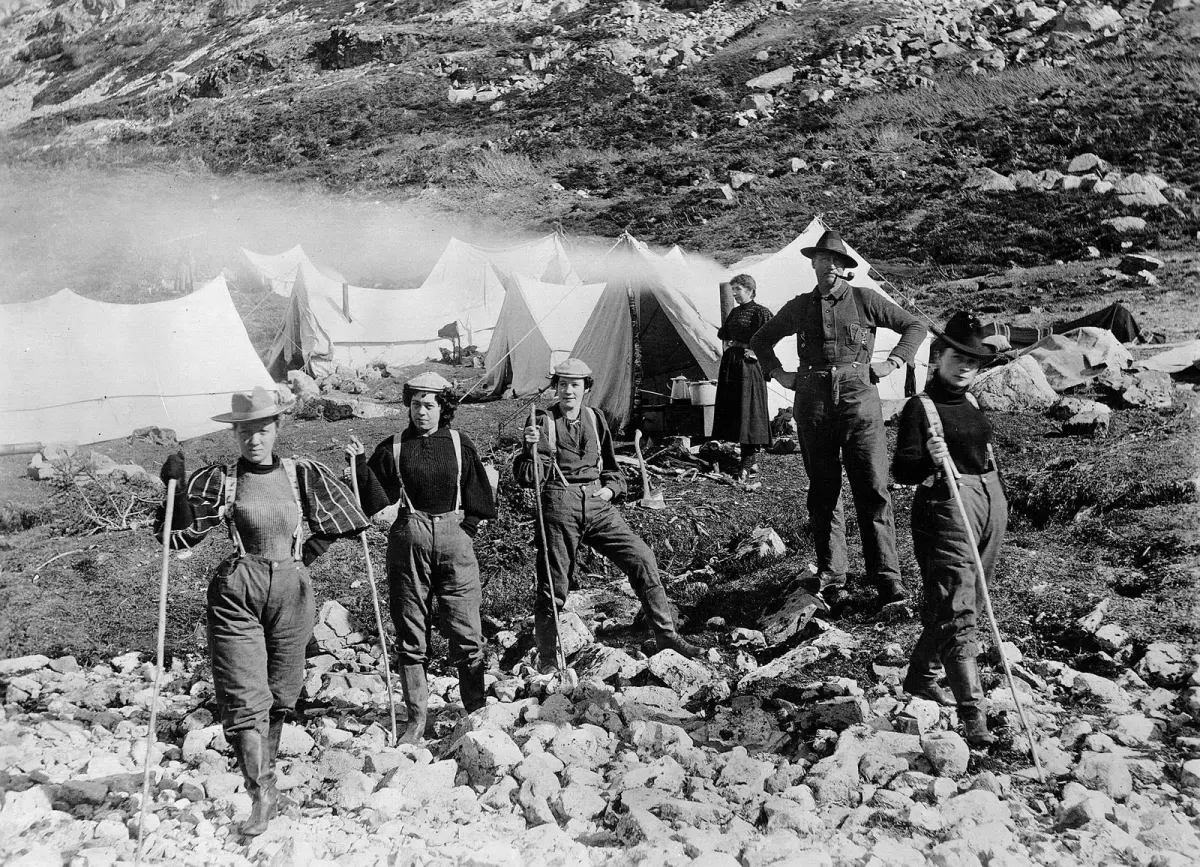
Traveling to the Klondike was a grueling ordeal that tested the physical and mental limits of every prospector. Most travelers arrived by boat in the Alaskan towns of Skagway or Dyea before attempting to cross the coastal mountain ranges. From there, they faced the treacherous Chilkoot Pass or the White Pass, both of which required climbing steep, snow-covered terrain while carrying heavy loads of supplies.
To manage the logistics of the journey, the Canadian government mandated that every prospector bring one year's worth of supplies to prevent starvation. This requirement meant that a single person had to move roughly 2,000 pounds of gear across the border. Many individuals made dozens of trips back and forth across the mountain passes to transport their equipment, a process that took months of back-breaking labor.
- Secure passage on a steamship to Skagway or Dyea.
- Purchase a "ton of goods" including flour, bacon, beans, and dried fruit.
- Hike the Chilkoot Pass, often requiring 30 to 40 trips to move all supplies.
- Build or purchase a boat to navigate the Yukon River to Dawson City.
What life was like in Dawson City
Dawson City emerged as the epicenter of the gold rush, growing from a small camp into a chaotic, vibrant boomtown almost overnight. By 1898, the population had swelled to approximately 30,000 residents. The town featured saloons, theaters, and gambling halls, providing a stark contrast to the grueling labor occurring in the nearby gold fields. Prices for basic goods skyrocketed due to extreme scarcity and the high cost of transportation.
Despite the excitement, life in Dawson City was harsh and unsanitary. The lack of proper sewage systems led to outbreaks of typhoid and scurvy, while the bitter cold made daily existence a constant struggle. Many prospectors found that the gold was already claimed by the time they arrived, leaving them to work as laborers for others rather than striking it rich on their own. The reality of the gold rush was far less glamorous than the promotional materials suggested.
- Eggs cost as much as $1 each, equivalent to roughly $35 today.
- Fresh vegetables were virtually non-existent, leading to widespread malnutrition.
- The town lacked a formal police presence initially, though the North-West Mounted Police soon established order.
- Fire was a constant threat to the wooden structures of the camp.
Why the gold rush ended
The Klondike Gold Rush effectively ended by 1899, as the easily accessible gold deposits were exhausted. As individual prospectors struggled to find new claims, the industry shifted toward corporate mining. Large companies arrived with heavy machinery, such as hydraulic monitors and massive dredges, which could process vast amounts of earth more efficiently than manual labor. This transition made it impossible for the average person to compete.
The discovery of gold in Nome, Alaska, in 1899 also acted as a catalyst for the exodus from the Yukon. Thousands of disillusioned miners abandoned their claims in the Klondike to chase the next big strike on the Alaskan coast. By the turn of the century, the frantic pace of the Klondike had evaporated, leaving behind a legacy of boom-and-bust cycles that defined the history of the American and Canadian frontiers.
Common mistakes when researching the Klondike
Many people mistakenly believe that everyone who went to the Klondike became wealthy. In reality, only a small fraction of the 100,000 people who set out ever found significant amounts of gold. A common error is ignoring the role of the North-West Mounted Police, who were essential in maintaining law and order in a region that could have easily descended into violent anarchy. Understanding their role is vital to grasping how the territory developed.
Another frequent mistake is overlooking the devastating impact the gold rush had on the indigenous Hän people. The influx of miners destroyed local food sources and introduced diseases that decimated the native population. When studying this period, it is important to look beyond the stories of individual prospectors and consider the broader environmental and social consequences of the rapid industrialization of the Yukon. By avoiding these generalizations, one can gain a much more accurate perspective on the true human and historical cost of the rush.
Key facts
- The Klondike Gold Rush began on August 16, 1896, when George Carmack, Skookum Jim, and Tagish Charlie discovered gold in Bonanza Creek.
- An estimated 100,000 prospectors attempted to reach the Klondike region in Yukon, Canada, between 1896 and 1899.
- Most travelers entered through the ports of Skagway or Dyea, Alaska, before trekking over the treacherous Chilkoot or White Pass trails.
- The Canadian government required stampeders to bring one ton of supplies, including food and gear, to prevent mass starvation in the remote wilderness.
- Only about 30,000 to 40,000 people successfully completed the journey to the gold fields, and only a small fraction found significant wealth.
- A common mistake was underestimating the harsh climate; temperatures frequently dropped to -50 degrees Fahrenheit, causing frostbite and exhaustion.
The bottom line
The Klondike Gold Rush was a frantic, short-lived migration driven by the promise of sudden wealth in the harsh Yukon wilderness. While it captured the world's imagination and spurred the development of Northern Canada, it proved physically grueling and financially disappointing for most participants. Ultimately, the event serves as a historical reminder that the greatest profits in a gold rush often belong to those selling supplies.
People also ask
Where exactly is the Klondike region?
The Klondike is located in the Yukon Territory of northwestern Canada, near the border with Alaska. It centers on the Klondike River, a tributary of the Yukon River.
How did people travel to the gold fields?
Prospectors traveled by steamship to Alaskan coastal towns and then hiked inland over mountain passes. They often built flat-bottomed boats to navigate the Yukon River to reach Dawson City.
What was the role of Dawson City?
Dawson City served as the primary hub for the gold fields, growing from a small camp into a bustling town of 30,000 people. It provided supplies, entertainment, and administrative offices for the territory.
How much gold was actually found?
Miners extracted approximately $29 million in gold—roughly $1 billion in today’s currency—during the peak of the rush. However, the high cost of goods meant many miners barely broke even.
Why did the gold rush end so quickly?
The rush largely concluded by 1899 when gold was discovered in Nome, Alaska. Many prospectors abandoned the Klondike to chase the new, more accessible strikes elsewhere.
Was the Klondike Gold Rush a profitable venture for everyone?
No, the vast majority of prospectors lost money or returned home empty-handed. The merchants who sold food, tools, and lodging in Dawson City often made more profit than the miners themselves.
This answer was created with the help of AI research tools and reference sources. Spotted an error? Let us know — we correct mistakes quickly. See our editorial policy.