Why do clouds float?
Short answer
Clouds stay aloft because the individual water droplets and ice crystals within them are incredibly small and light. They are supported by rising air currents, known as updrafts, which counteract the downward pull of gravity. As long as these droplets remain tiny and the air continues to rise, the cloud remains suspended.

On this page
Why do clouds stay in the sky?
Clouds are not solid objects; they are vast collections of microscopic water droplets or ice crystals suspended in the atmosphere. Because these particles are so small, they possess a very high surface-area-to-mass ratio. This physical characteristic allows air resistance to play a dominant role in their movement, effectively slowing their descent to a negligible speed.
Gravity is constantly pulling these droplets toward the ground, but they fall at an incredibly slow rate. A typical cloud droplet might fall at a speed of only a few centimeters per second. Because the air in the atmosphere is rarely perfectly still, even the slightest upward breeze is sufficient to keep these droplets from reaching the surface.
How do updrafts keep clouds afloat?
Updrafts are columns of rising air that act as a natural support system for clouds. When the sun heats the Earth's surface, the air above it warms up, becomes less dense, and begins to rise. This rising air carries the water droplets upward, counteracting the force of gravity and keeping the cloud mass buoyant.
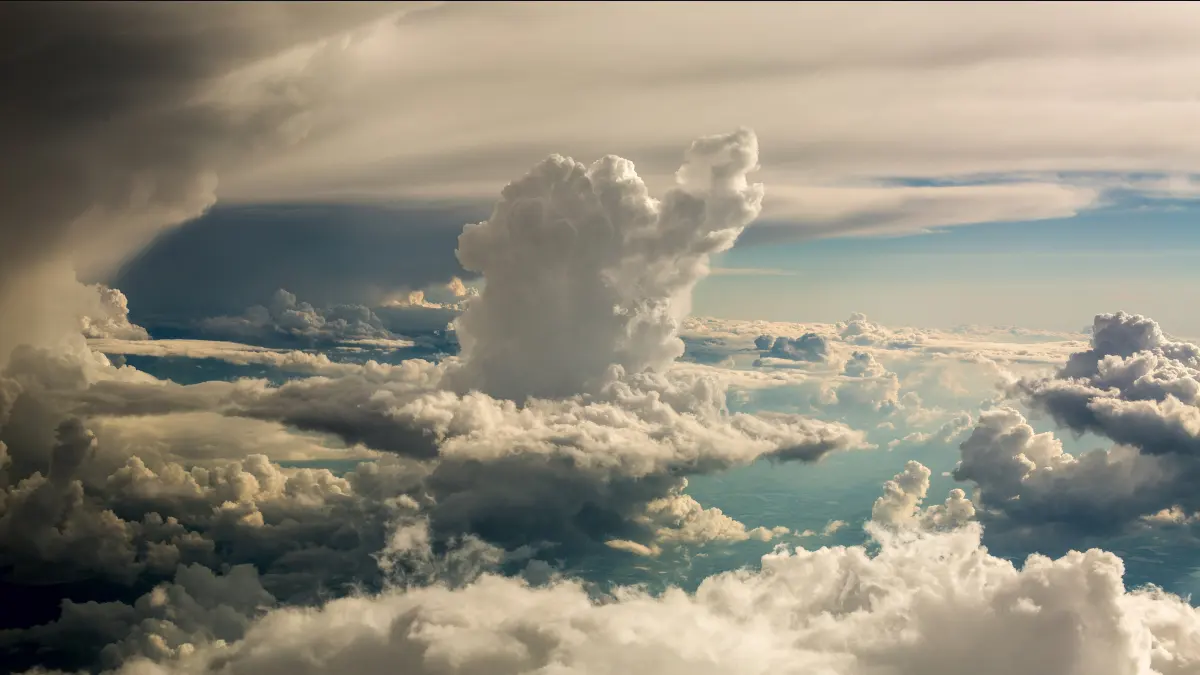
The stability of a cloud depends on the balance between these rising air currents and the weight of the water. If the updrafts are strong enough, they can hold massive amounts of water in the sky. This is why large, towering cumulus clouds can maintain their shape for hours, even though they contain thousands of tons of water.
- Solar radiation heats the ground.
- Warm air expands and rises as an updraft.
- As the air rises, it cools, causing water vapor to condense into droplets.
- The updraft supports the weight of these droplets, keeping the cloud suspended.

What determines the size of cloud droplets?
The size of droplets within a cloud is determined by the presence of cloud condensation nuclei. These are tiny particles, such as dust, salt, or smoke, that provide a surface for water vapor to condense onto. Without these particles, water vapor would struggle to turn into liquid droplets at the humidity levels found in the atmosphere.
When there are many nuclei available, the water is spread across a larger number of small droplets. These small droplets are much easier for updrafts to keep aloft. If there are few nuclei, the water gathers into fewer, larger droplets, which are more likely to fall as precipitation.
- Dust particles from windblown soil.
- Sea salt crystals from ocean spray.
- Smoke particulates from forest fires or industrial activity.
- Sulfates and nitrates from chemical reactions in the air.
Why do clouds eventually fall as rain?
Clouds eventually lose their buoyancy when the droplets inside them grow too large. This process, known as coalescence, occurs when droplets collide and merge into larger ones. Once a droplet becomes heavy enough that the force of gravity overcomes the upward push of the air currents, it begins to fall toward the Earth.
This transition from a floating cloud to falling rain is a matter of scale. A typical cloud droplet is about 20 micrometers in diameter, while a raindrop can be 2,000 micrometers or larger. Once the particles reach this size, they fall rapidly, effectively clearing the cloud of its water content and ending its life cycle.
Common mistakes when observing clouds
A common misunderstanding is the belief that clouds are made of water vapor. In reality, water vapor is an invisible gas; the white, fluffy appearance of a cloud is caused by the scattering of sunlight off liquid water droplets or ice crystals. Confusing invisible vapor with visible liquid droplets leads to errors in understanding how weather systems function.
Another mistake is assuming that clouds are stationary objects. While they may appear to hang in one place, they are constantly evolving. New droplets are forming at the leading edge of the cloud while others are evaporating or falling out at the trailing edge. To observe this effectively, focus on the edges of the cloud, where the constant process of condensation and evaporation creates the shifting, dynamic shapes that define the sky.
Key facts
- Clouds are composed of billions of tiny water droplets or ice crystals that are so small they stay suspended in the air.
- The average cumulus cloud weighs approximately 1.1 million pounds, roughly equivalent to 100 elephants.
- Air currents, known as updrafts, constantly push these droplets upward, counteracting the downward pull of gravity.
- Water droplets in clouds are often smaller than 0.01 millimeters, allowing them to drift on air currents like dust motes.
- Clouds do not "float" like a boat on water; they are part of the atmosphere and move with the wind.
- A cloud disappears when the water droplets evaporate into invisible water vapor as the air warms or sinks.
The bottom line
Clouds float because their constituent water droplets are incredibly small and light, allowing them to remain suspended by rising air currents. Although they contain massive amounts of water, these droplets are spread over such a vast volume that gravity cannot pull them down until they coalesce into rain. Ultimately, a cloud is a dynamic, shifting region of moisture that exists only while conditions permit its visibility.
People also ask
Why do clouds turn grey before it rains?
As cloud droplets grow larger and denser, they scatter more light, preventing it from passing through. This increased density creates a shadow effect, causing the cloud to appear dark or grey to observers on the ground.
How much water is actually inside a typical cloud?
A typical fair-weather cumulus cloud contains about 0.5 grams of water per cubic meter. While this sounds small, the massive volume of a cloud means it holds hundreds of tons of water.
Can clouds ever become too heavy to stay in the sky?
Clouds do not "fall" because they are too heavy; they release water when droplets collide and grow large enough to overcome updrafts. Once these droplets become raindrops, gravity pulls them to the surface as precipitation.
Why do clouds stay at different altitudes?
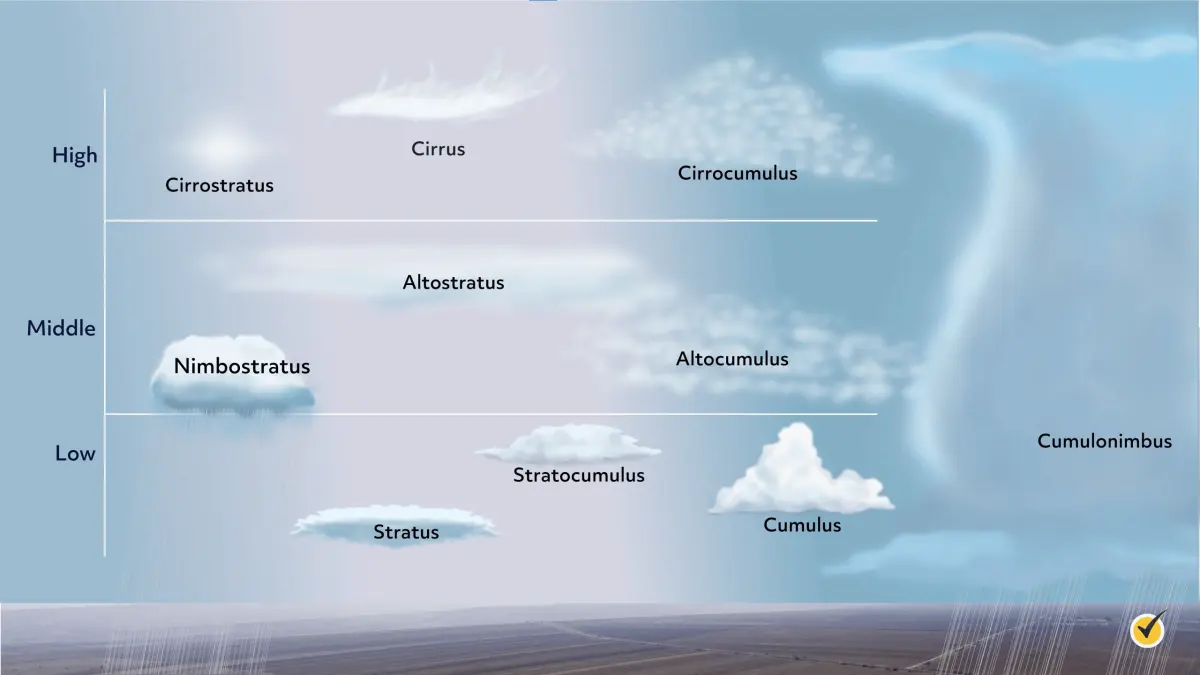
Clouds form at specific levels based on temperature and moisture content in the atmosphere. High-altitude clouds are composed of ice crystals, while low-altitude clouds consist primarily of liquid water droplets.
Do clouds have a solid surface?
Clouds are not solid objects but are regions of visible moisture in the air. If you were to fly through one, it would feel like moving through a dense, cool fog.
How do clouds stay in one place if the wind is blowing?
Clouds often appear stationary because they are constantly forming on the windward side and evaporating on the leeward side. This process creates the illusion that the cloud is fixed even while air flows through it.
This answer was created with the help of AI research tools and reference sources. Spotted an error? Let us know — we correct mistakes quickly. See our editorial policy.