Did the Vikings reach North America?
Short answer
Yes, the Vikings reached North America approximately 500 years before Christopher Columbus. Led by Leif Erikson, Norse explorers established a settlement at L’Anse aux Meadows in present-day Newfoundland, Canada, around 1000 CE. Archaeological evidence, including iron smithing tools and timber structures, confirms their presence in the region during the medieval period.
On this page
How did the Vikings reach North America?
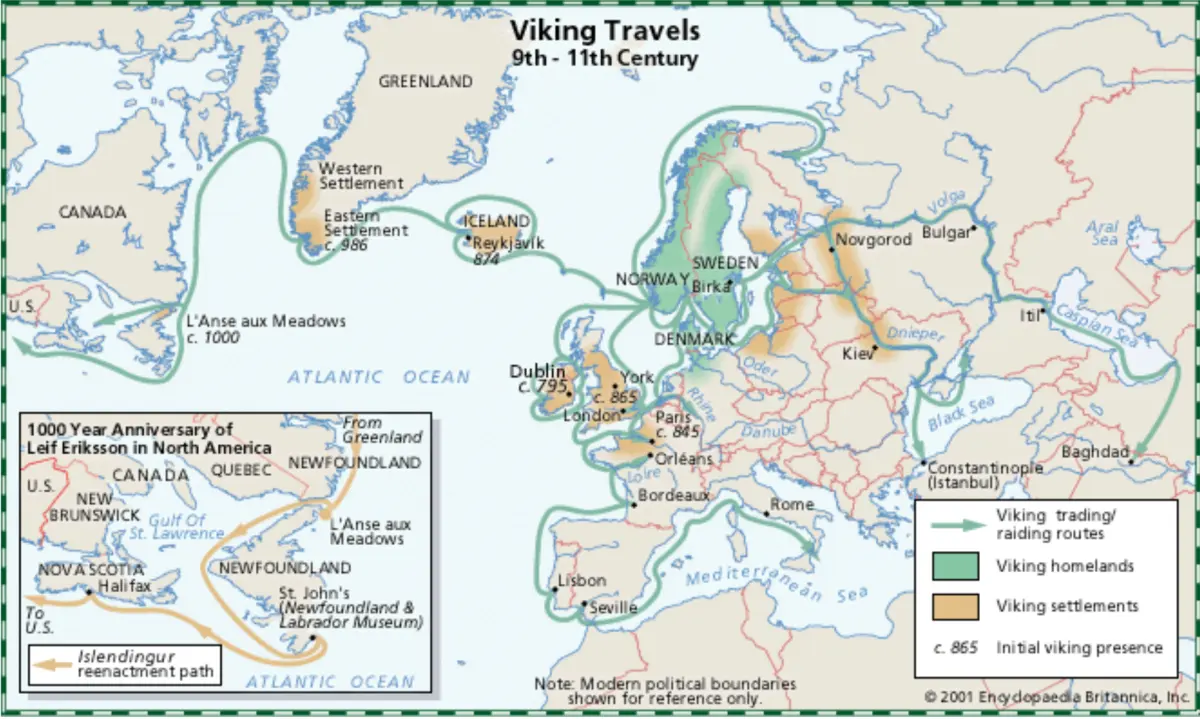
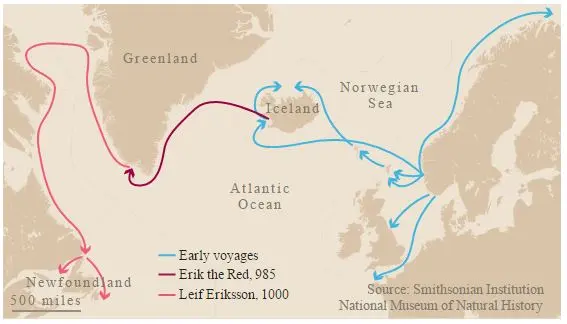
The Norse expansion into North America was the culmination of centuries of maritime innovation. Using longships—vessels characterized by their shallow draft, symmetrical design, and dual-purpose oars and sails—Vikings navigated the treacherous North Atlantic. They moved in stages, settling Iceland in the late 9th century and Greenland by 985 CE under the leadership of Erik the Red.
From Greenland, explorers pushed further west, driven by a need for resources like timber, which was scarce in the treeless landscapes of Greenland and Iceland. According to the Norse Sagas, specifically the Saga of the Greenlanders and the Saga of Erik the Red, Leif Erikson sailed from Greenland around 1000 CE. He encountered three distinct regions: Helluland (likely Baffin Island), Markland (Labrador), and Vinland, a fertile area further south where they established a base.
- Departed from Greenland settlements.
- Navigated via the Davis Strait to the Labrador coast.
- Established a base camp at L’Anse aux Meadows.
- Conducted exploratory expeditions further south into the Gulf of St. Lawrence.
Where is the Viking settlement located?
The only confirmed Norse site in North America is located at L’Anse aux Meadows, on the northern tip of Newfoundland’s Great Northern Peninsula. Discovered in 1960 by explorers Helge and Anne Stine Ingstad, the site provided the physical evidence necessary to move Viking exploration from the realm of legend into historical fact. The site consists of eight turf-walled buildings, including dwellings, a forge, and workshops.
Excavations revealed artifacts that are distinctly Norse, such as a bronze cloak pin, a spindle whorl, and iron nails. These items demonstrate that the site was not merely a temporary stop but a functional repair station and base for further exploration. The location was strategically chosen for its proximity to sea lanes and access to local resources, allowing the small group of settlers to maintain their ships and prepare for future voyages.
- The site features three multi-room dwellings.
- A small forge was used for smelting bog iron.
- The geography matches descriptions of "Vinland" in the sagas.
- UNESCO designated the area a World Heritage site in 1978.
Why did the Vikings leave North America?
The Norse presence in North America was relatively short-lived, likely lasting only a few years. Several factors contributed to their withdrawal, primarily the extreme distance from their primary power bases in Greenland and Iceland. Maintaining supply lines across the North Atlantic was logistically difficult and dangerous, making long-term colonization unsustainable for the small groups that traveled there.
Furthermore, the Norse encountered indigenous populations, whom they referred to as "Skrælings." The sagas describe frequent conflicts and hostilities between the settlers and the local groups. Faced with a hostile environment, limited manpower, and the difficulty of defending their settlement, the Norse eventually abandoned Vinland. They returned to their Greenland colonies, where they continued to reside for several centuries before those settlements also eventually vanished.
What are common mistakes when studying Viking exploration?
A frequent error is assuming that the Vikings intended to establish a permanent, large-scale colony similar to later European settlements. In reality, the Vinland expeditions were likely exploratory missions aimed at resource extraction. Another common misconception is that the Vikings arrived in the 15th century; they arrived five centuries earlier, and their presence remained largely unknown to the rest of Europe at the time.
Researchers and enthusiasts often mistake various artifacts found across North America for Viking origin. For example, the Kensington Runestone, found in Minnesota, is widely considered a modern hoax by historians and linguists. It is important to rely on verified archaeological evidence from sites like L’Anse aux Meadows rather than unproven claims or local folklore. Always verify the provenance of any object before accepting it as evidence of Norse contact.
- Do not assume every stone structure is Viking-made.
- Avoid relying on 19th-century "runestone" discoveries.
- Distinguish between archaeological fact and literary saga descriptions.
- Remember that "Vinland" was a region, not a single city.
How can I visit the Viking site today?
Visiting L’Anse aux Meadows is the best way to understand the scale and reality of Norse exploration. The site is managed by Parks Canada and features a reconstructed Viking camp, providing a visual representation of how the settlers lived. Visitors can walk through the original archaeological site, view the foundations of the buildings, and interact with interpreters who explain the daily life of the Norse voyagers.
To plan your trip, aim for the summer months between June and September, as the weather in Newfoundland can be harsh during other seasons. The site is remote, so travelers should book accommodations in nearby towns like St. Anthony well in advance. When visiting, respect the archaeological integrity of the site by staying on marked paths and following all park regulations to ensure the preservation of this unique historical treasure for future generations.
Key facts
- Norse explorers led by Leif Erikson reached North America around 1000 CE.
- Archaeological evidence confirms a Norse settlement at L’Anse aux Meadows in Newfoundland, Canada.
- The site was rediscovered in 1960 by Helge and Anne Stine Ingstad.
- Norse sagas, specifically the Saga of the Greenlanders and the Saga of Erik the Red, describe the voyages.
- The Vikings called the new land "Vinland," likely referring to the wild grapes or berries found there.
- Carbon dating of wood artifacts at the site indicates the settlement was active in the year 1021 CE.
The bottom line
Norse explorers definitively reached North America approximately five centuries before Christopher Columbus, establishing a short-lived settlement in Newfoundland around 1021 CE. While the Vikings did not establish a permanent foothold, their voyages remain a landmark achievement in maritime exploration. Today, the site at L’Anse aux Meadows serves as the primary physical proof of this historic contact between European travelers and the North American continent.
People also ask
How long did the Vikings stay in North America?
The Norse presence was likely sporadic and short-lived, lasting only a few years. They lacked the numbers and logistical support to maintain a permanent colony against indigenous resistance and the harsh environment.
Did the Vikings encounter Indigenous people in North America?
Yes, the sagas describe encounters with people they called "Skrælings." These interactions were often hostile, involving trade disputes and violent skirmishes that contributed to the Norse decision to abandon the region.
Why did the Vikings stop traveling to North America?
The distance from Greenland and Iceland made regular travel dangerous and expensive. Furthermore, the lack of valuable trade goods and the hostile relations with local populations made the settlements unsustainable.
What physical evidence remains of their visit?
Excavations at L’Anse aux Meadows revealed the foundations of eight turf-walled buildings, including dwellings and a smithy. Artifacts found include iron nails, a spindle whorl, and bronze pins.
Did the Vikings reach as far as the United States?
While some claim evidence of Norse presence in the U.S., such as the Kensington Runestone, most historians consider these items to be hoaxes. L’Anse aux Meadows remains the only undisputed Norse site in North America.
How did the Vikings navigate to North America without modern technology?
They used celestial navigation, observing the sun and stars, and relied on their deep knowledge of ocean currents, winds, and animal migration patterns. They also utilized simple tools like sun stones to locate the sun on cloudy days.
This answer was created with the help of AI research tools and reference sources. Spotted an error? Let us know — we correct mistakes quickly. See our editorial policy.