What is a supernova?
Short answer
A supernova is the cataclysmic explosion of a star, marking the final stage of its life cycle. These events release immense amounts of energy, briefly outshining entire galaxies and dispersing heavy elements into space. They occur either when a massive star exhausts its nuclear fuel or when a white dwarf accretes too much matter.
On this page
Why a supernova happens
A supernova occurs when a star can no longer sustain the delicate balance between gravity and nuclear fusion. In massive stars, the core eventually fuses elements until it creates iron. Because iron fusion consumes energy rather than releasing it, the outward pressure vanishes, causing the star to collapse under its own gravity in a fraction of a second. This collapse triggers a violent rebound explosion.
In binary systems, a different process occurs involving a white dwarf. If the white dwarf draws too much material from a companion star, it crosses a critical mass threshold known as the Chandrasekhar limit. This triggers a runaway nuclear reaction that incinerates the star entirely. These two distinct mechanisms result in different types of supernovae, categorized by astronomers based on their light spectra and chemical signatures.
How to observe a supernova
Observing a supernova requires patience, a dark sky, and a reliable telescope. Because these events are unpredictable, amateur astronomers often participate in supernova search programs to monitor nearby galaxies for sudden increases in brightness. When a star explodes, it can appear as a new "star" that was not visible in previous images of that specific patch of the night sky.
- Select a target galaxy known for frequent stellar activity, such as the Whirlpool Galaxy.
- Use a star chart to identify the galaxy’s normal appearance.
- Compare current observations with archived photographs of the same region.
- Look for a bright, point-like object that does not appear on historical star maps.
- Report your findings to a professional astronomical organization for verification.
What happens after the explosion
The aftermath of a supernova is a transformative event for the surrounding interstellar medium. The explosion ejects vast quantities of gas and dust at speeds reaching thousands of kilometers per second. This material, enriched with heavy elements like gold, silver, and uranium, travels across space to seed future star systems and planets. Without these explosions, the universe would lack the chemical complexity required for terrestrial life.
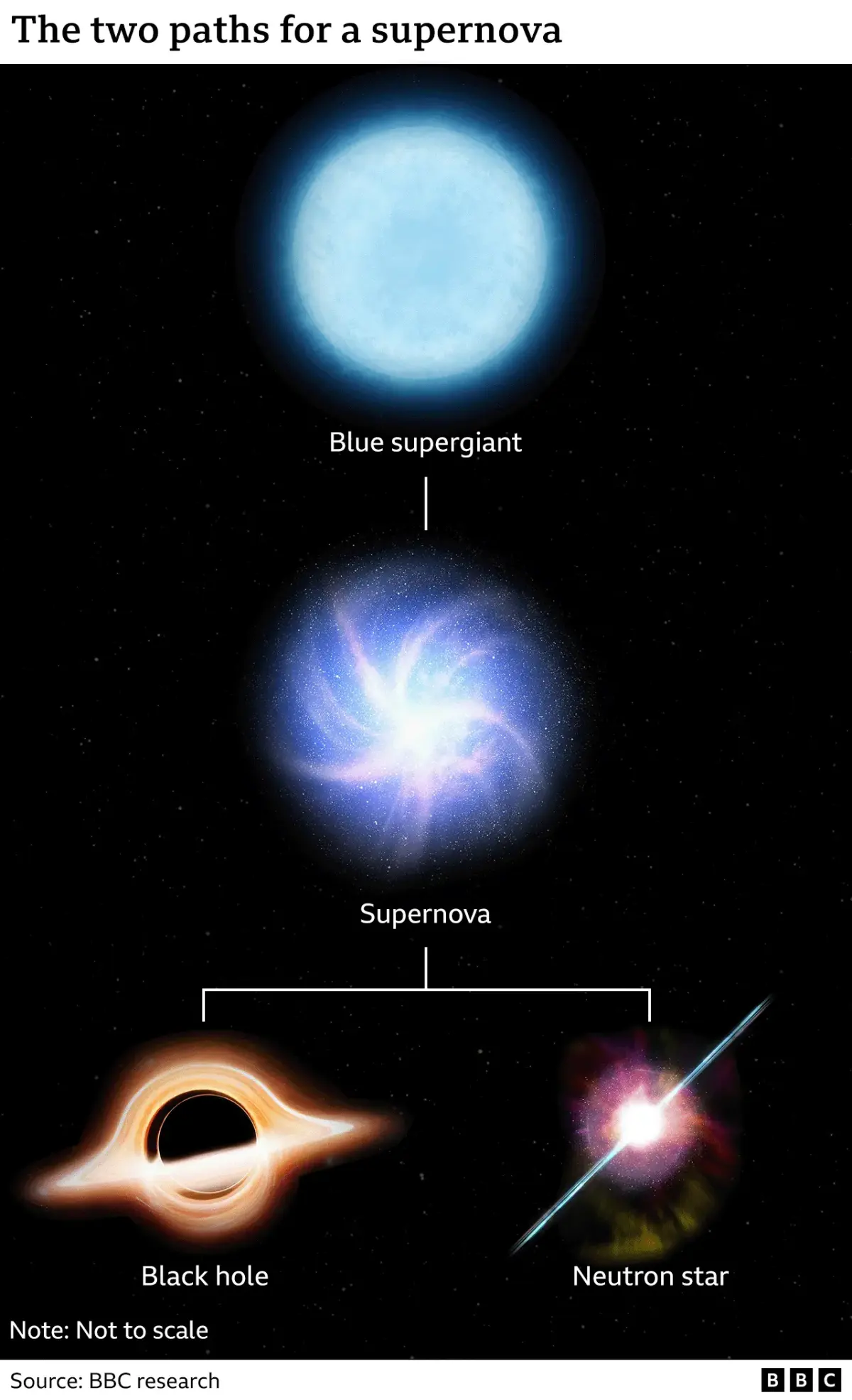
The core of the progenitor star remains behind, transformed into a dense remnant. Depending on the initial mass of the star, this remnant becomes one of two exotic objects:
- A neutron star, which is an incredibly dense sphere of neutrons only about 20 kilometers wide.
- A black hole, which occurs if the remaining mass is so great that not even the density of neutrons can stop the gravitational collapse.
Common mistakes when tracking supernovae
One common mistake is confusing a supernova with a transient object within our own galaxy, such as a variable star or a foreground asteroid. Novas, which are smaller explosions on the surface of a white dwarf, are also frequently mistaken for supernovae. A true supernova is significantly more luminous and remains visible for a much longer duration, often fading over several months rather than days.
Another error involves failing to account for light pollution or atmospheric conditions. High-altitude clouds or light haze can create artifacts that look like stellar points, leading to false reports. Always verify a potential discovery by checking multiple observation sources or waiting for the object to rise higher in the sky. Relying on a single observation without cross-referencing against professional databases often leads to disappointment and wasted effort for the observer.
Why supernovae are important to science
Supernovae serve as the primary "standard candles" for measuring the expansion rate of the universe. Because Type Ia supernovae have a consistent peak brightness, astronomers can calculate their distance with high precision. By observing these distant explosions, scientists discovered in the late 1990s that the expansion of the universe is actually accelerating, a phenomenon attributed to the mysterious force known as dark energy.
Beyond cosmology, these events are essential for understanding the origins of the chemical elements. The extreme heat and pressure generated during the explosion facilitate nucleosynthesis, the process of creating new atomic nuclei. Almost every heavy element found on Earth was forged in the heart of a dying star or during the terminal blast of a supernova. By studying these events, humanity gains a deeper understanding of the fundamental forces that govern the cosmos and the origins of the matter that composes our own planet.
Key facts
- A supernova is the colossal explosion of a star that marks the end of its life cycle.
- These events can briefly outshine an entire galaxy, radiating as much energy as the Sun will emit over its 10-billion-year lifetime.
- Type Ia supernovae occur in binary systems where a white dwarf star pulls matter from a companion until it reaches a critical mass and detonates.
- Core-collapse supernovae happen when massive stars run out of nuclear fuel and their iron cores collapse under gravity, triggering a rebound explosion.
- Supernovae are the primary source of heavy elements like gold, silver, and uranium in the universe.
- If you hope to spot a supernova, use a telescope with at least an 8-inch aperture and compare your observations against established star charts to identify new bright points.
The bottom line
Supernovae are the universe’s most powerful explosions, acting as cosmic crucibles that forge the heavy elements necessary for life. Whether resulting from a white dwarf’s runaway fusion or a massive star’s gravity-driven collapse, these events reshape galaxies and seed space with vital matter. Understanding these cataclysms is essential for mapping the history of the cosmos and grasping the fundamental processes that govern the lifecycle of stars.
People also ask
How often do supernovae occur in our galaxy?
Astronomers estimate that a supernova occurs in the Milky Way roughly once every 50 to 100 years. However, many are obscured by the thick dust clouds located in the galactic plane.
What is the difference between a supernova and a nova?
A nova is a recurring surface explosion on a white dwarf that does not destroy the star. In contrast, a supernova is a terminal event that completely obliterates the star or leaves behind a dense remnant.
Can a supernova destroy the Earth?
A supernova would need to occur within about 50 to 100 light-years of Earth to cause significant atmospheric damage. There are currently no stars within this danger zone that are poised to go supernova in the near future.
What happens to the star after it explodes?
Depending on the initial mass of the star, the core may collapse into an incredibly dense neutron star or, if the mass is sufficient, a black hole. The outer layers are blasted into space, forming a nebula.
How do scientists detect supernovae in distant galaxies?
Researchers use automated robotic telescopes to scan the night sky nightly, comparing new images to older ones. When a new point of light appears where none existed before, it is flagged for further study.
Why are Type Ia supernovae important for cosmology?
Because they explode at a consistent mass, they have a predictable brightness. Astronomers use them as "standard candles" to measure distances across the universe and calculate the rate of cosmic expansion.
This answer was created with the help of AI research tools and reference sources. Spotted an error? Let us know — we correct mistakes quickly. See our editorial policy.