What is a neutron star?
Short answer
A neutron star is the incredibly dense, collapsed core of a massive star that has exhausted its nuclear fuel and exploded in a supernova. Measuring only about 12 miles in diameter, these objects contain more mass than our Sun, resulting in gravity so intense that protons and electrons fuse into neutrons.
On this page
How does a neutron star form?
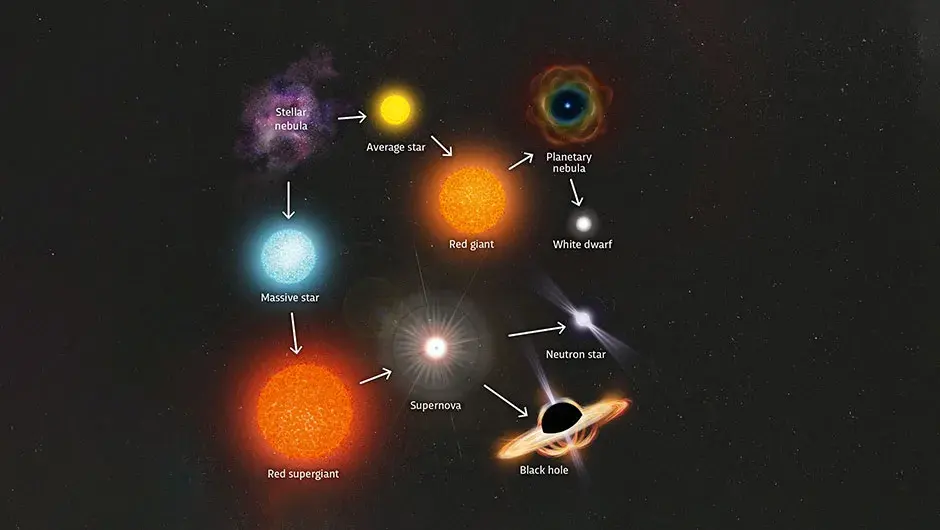
The formation of a neutron star begins with a massive star, typically between 8 and 25 times the mass of our Sun. Throughout its life, the star maintains equilibrium by balancing the inward pull of gravity with the outward pressure generated by nuclear fusion in its core. Once the star consumes its supply of hydrogen, helium, and heavier elements, it eventually creates iron. Because fusing iron consumes energy rather than releasing it, the outward pressure vanishes instantly.
Without this pressure, the star's core collapses under its own immense weight in a fraction of a second. The outer layers of the star are ejected in a violent explosion known as a supernova, leaving behind the ultra-dense remnant. The core is crushed so tightly that the atomic structure collapses, forcing electrons and protons to merge into neutrons. This creates a sphere of nuclear matter that is essentially a giant, city-sized atomic nucleus held together by gravity.
What are the physical properties of a neutron star?
Neutron stars are defined by their extreme density and compact size. If you were to take a single teaspoon of material from a neutron star, it would weigh approximately one billion tons on Earth. This density is so high that the surface gravity is roughly 200 billion times stronger than what we experience on our planet. Despite this, they are relatively small, typically spanning a diameter comparable to a large metropolitan area.
The structure of a neutron star is generally divided into several distinct layers:
- The thin, solid crust composed of iron nuclei and a sea of electrons.
- An inner crust where nuclei become increasingly neutron-rich as pressure rises.
- A core region where the density is so high that neutrons may form a superfluid, a state of matter with zero viscosity.
- A potential exotic core where matter may exist as a quark-gluon plasma or other high-energy states.
Why do neutron stars spin so fast?
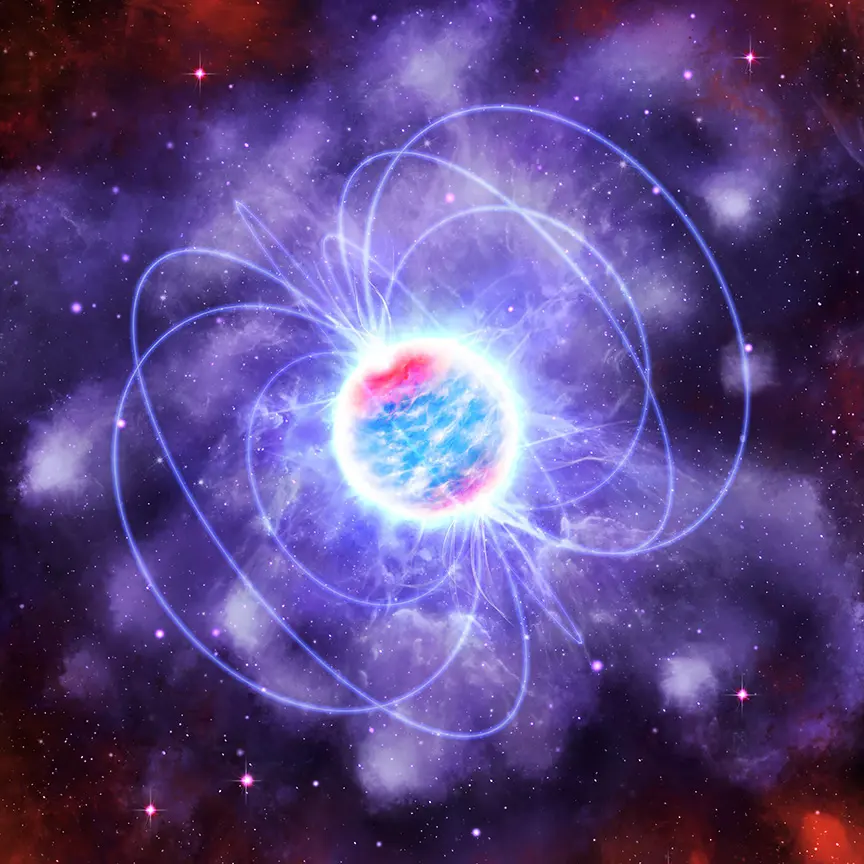
When a massive star collapses into a neutron star, it conserves its angular momentum, similar to how an ice skater spins faster when pulling their arms inward. Because the star’s radius shrinks from millions of miles to just a dozen, the rotation speed increases dramatically. Many neutron stars, known as pulsars, rotate hundreds of times per second. They emit beams of electromagnetic radiation from their magnetic poles, which sweep across space like a lighthouse beam.
Observers on Earth detect these beams as regular, rhythmic pulses of radio waves, X-rays, or gamma rays. The precision of these pulses is so consistent that they can rival the accuracy of the best atomic clocks. However, these stars do not spin at a constant rate forever. Over millions of years, the emission of energy and the interaction with magnetic fields cause the star to gradually lose rotational energy and slow down.
Common mistakes when studying neutron stars
One frequent error is confusing a neutron star with a black hole. While both are remnants of massive stars, a black hole forms when the remaining core is so massive that not even the degeneracy pressure of neutrons can prevent a total collapse into a singularity. A neutron star remains a physical object with a defined surface, whereas a black hole is a region of spacetime from which nothing can escape.
Another mistake is assuming that all neutron stars are pulsars. While many are, a neutron star must be oriented correctly for its beams to sweep across our line of sight. Furthermore, some neutron stars have magnetic fields so intense that they are classified as magnetars, which behave differently than standard pulsars. When researching these objects, keep these distinctions in mind:
- Verify if the object is a solitary neutron star or part of a binary system.
- Distinguish between thermal X-ray emission and non-thermal synchrotron radiation.
- Remember that distance measurements to these stars are notoriously difficult and often carry high margins of error.
How to observe neutron stars from home
While you cannot see a neutron star directly with an optical telescope, you can participate in the science of high-energy astrophysics. Because these stars emit radiation primarily in the X-ray and radio spectrums, professional observatories like the Chandra X-ray Observatory or the Very Large Array are required to "see" them. However, amateur astronomers can track the light curves of binary systems where a neutron star is actively pulling material from a companion star.
If you are interested in exploring this field, follow these steps to get started:
- Download publicly available data from the High Energy Astrophysics Science Archive Research Center.
- Use software like FTOOLS to process raw X-ray data files into viewable images.
- Join citizen science projects that analyze light curves to identify potential pulsar candidates or transient events.
- Study the periodic signals of known pulsars to understand how signal processing works in modern radio astronomy.
By engaging with these datasets, you can gain a practical understanding of how astronomers confirm the presence of these dense, spinning remnants in the deep reaches of the galaxy.
Key facts
- A neutron star is the collapsed core of a massive star that has exhausted its nuclear fuel and exploded in a supernova.
- These objects are incredibly dense, packing the mass of about 1.4 times that of the Sun into a sphere only 12 miles (20 kilometers) in diameter.
- A single teaspoon of neutron star material would weigh approximately one billion tons on Earth.
- Neutron stars rotate extremely rapidly, with some spinning hundreds of times per second, creating beams of radiation known as pulsars.
- The gravity on the surface of a neutron star is roughly 200 billion times stronger than the gravity on Earth.
- If you were to observe a neutron star, do not confuse it with a black hole; while both are dense remnants, neutron stars remain composed of matter, whereas black holes are singularities.
The bottom line
Neutron stars represent the final evolutionary stage for massive stars, serving as laboratories for extreme physics. By compressing vast amounts of matter into a city-sized sphere, they push the limits of density and gravity. Understanding these remnants helps researchers unlock the secrets of nuclear matter and the formation of heavy elements in our universe, illustrating the violent yet creative nature of the life cycles of stars.
People also ask
How are neutron stars formed?
They form when a star with 8 to 25 times the mass of the Sun runs out of fuel and undergoes a core-collapse supernova. The outer layers are blasted away, while the remaining core is crushed by gravity until protons and electrons merge into neutrons.
What happens if two neutron stars collide?
A collision between two neutron stars creates a kilonova, an event that releases massive amounts of energy and heavy elements like gold and platinum. This process also generates ripples in spacetime known as gravitational waves, which scientists can detect on Earth.
Can humans ever visit a neutron star?
No, the extreme gravity and intense radiation fields surrounding a neutron star make it impossible for any spacecraft or human to approach it. The tidal forces would shred any object long before it reached the surface.
Why do some neutron stars emit radio pulses?
These stars, called pulsars, have powerful magnetic fields that accelerate particles to near the speed of light. These particles emit beams of radiation from the magnetic poles, which sweep across space like a lighthouse beam as the star rotates.
How do scientists detect neutron stars if they are so small?
Astronomers use radio telescopes to detect the periodic pulses of radiation emitted by pulsars. Because these pulses are incredibly precise, they serve as excellent cosmic clocks for studying gravity and interstellar space.
Are all neutron stars the same?
No, they vary based on their magnetic field strength and rotation speed. Some are quiet, while others, known as magnetars, possess the strongest magnetic fields in the universe and can trigger massive starquakes.
This answer was created with the help of AI research tools and reference sources. Spotted an error? Let us know — we correct mistakes quickly. See our editorial policy.