How do you draw without a reference?
Short answer
Drawing without a reference requires building a mental library of visual information through consistent practice. By breaking complex objects into basic geometric shapes—cubes, spheres, and cylinders—you can construct accurate forms from imagination. Mastering perspective, anatomy, and lighting principles allows you to manipulate these structures confidently without needing a direct visual guide.
On this page
How to build a visual library
Drawing from imagination is essentially the process of recalling and reconstructing stored visual data. When you observe the world, your brain processes information about form, texture, and light. To draw without a reference, you must intentionally practice "visual filing," which involves studying objects in real life to understand how they occupy space. Sketching from life regularly helps your brain internalize the rules of anatomy and architecture.
You can improve your recall by following a structured observation routine:
- Spend ten minutes daily sketching simple household items from different angles.
- Focus on the silhouette of an object rather than internal details.
- Attempt to redraw the object from memory immediately after observing it for one minute.
- Compare your memory sketch to the actual object to identify missing information.
By repeating this, you create a mental catalog of shapes that become second nature. Over time, you will no longer need to look at a reference because your brain has mapped the object’s essential geometry.
How to break objects into basic shapes
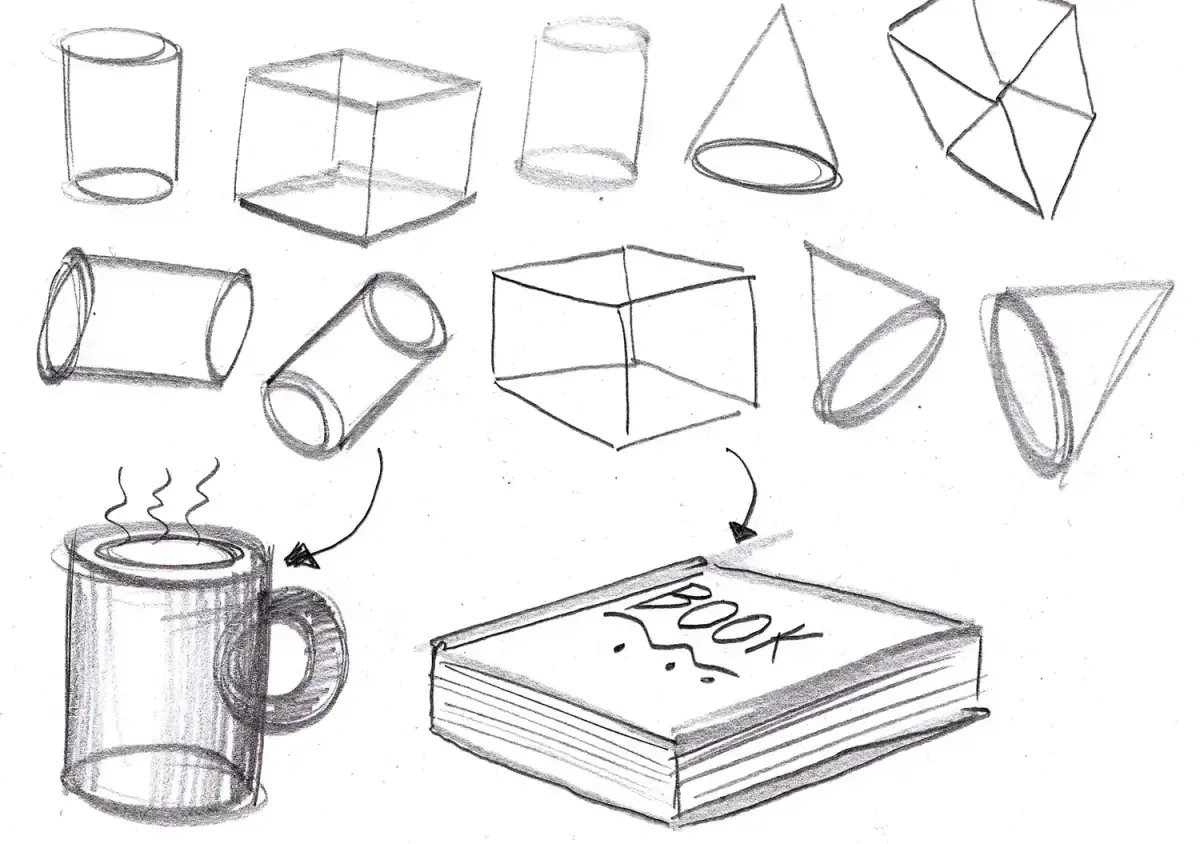
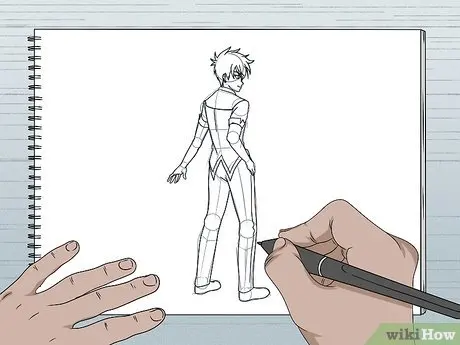
Every complex form can be simplified into a combination of primitive shapes. Whether you are drawing a human figure or a landscape, the foundation remains the same: spheres, cubes, and cylinders. This technique, often called "constructive drawing," allows you to build a three-dimensional structure on a two-dimensional surface. Once the basic frame is established, you can refine the contours and add details.
To master this method, follow these steps:
- Identify the primary volumes of the subject, such as the torso as a box or a head as a sphere.
- Connect these volumes using simple lines to establish the gesture or flow of the object.
- Apply perspective rules to ensure the shapes appear to sit correctly in space.
- Add secondary forms, like limbs or architectural features, onto the primary structure.
This approach prevents you from getting lost in details. By focusing on the underlying volume first, you ensure that the drawing remains structurally sound regardless of the complexity of the final image.
Why perspective is essential for imagination
Perspective is the mathematical foundation that makes drawings look realistic without a reference. It dictates how objects shrink, overlap, and change shape as they move away from the viewer. Without a solid grasp of horizon lines and vanishing points, drawings from imagination often look flat or distorted. Learning one-point, two-point, and three-point perspective provides the grid necessary to place objects accurately in a scene.
Perspective provides the context for your forms to exist. When you draw a character or a building, you are placing them within an invisible coordinate system. If you understand how a box rotates in two-point perspective, you can rotate any complex object by imagining it inside that box. This spatial awareness is what separates a novice sketch from a professional-looking illustration. Practicing perspective exercises, such as drawing grids or boxes in various orientations, creates a mental framework that supports every drawing you attempt from your mind.
Common mistakes when drawing without references
The most frequent error is attempting to draw details before establishing the structure. Beginners often focus on eyes, hair, or surface textures before ensuring the underlying proportions are correct. This leads to "floating" features that do not align with the volume of the object. Another common mistake is ignoring the light source, which causes the drawing to look muddy or flat. Without a consistent light direction, your brain cannot accurately render shadows, making the final piece feel disconnected.
Avoid these pitfalls by maintaining a strict workflow:
- Never start with fine-tipped pens or detailed shading.
- Use light, loose lines to map out the entire composition before finalizing any edges.
- Check your proportions by measuring distances between key points using your pencil as a guide.
- Ensure all shadows fall in the same direction relative to a single, imagined light source.
By forcing yourself to work from the "big picture" down to the details, you maintain control over the entire composition throughout the creative process.
Best exercises for practicing memory drawing
Consistency is the primary factor in developing the ability to draw without a reference. You should dedicate time to "blind" exercises where you intentionally remove your reference material. One effective method is the "rotation drill," where you choose a simple object and draw it from three different angles without looking at it again. This forces your brain to synthesize the object’s 360-degree form rather than just copying a single view.
Another powerful exercise is the "imagination reconstruction" technique. Find a reference photo, study it for thirty seconds, then close it and draw the subject entirely from memory. Once finished, open the reference and overlay your drawing to see where your understanding of the form failed. This highlights exactly which parts of your mental library need more work. By identifying these gaps, you can target your future practice sessions. This iterative cycle of observation, memory, and correction is the most efficient way to achieve total independence from reference materials in your artistic practice.
Key facts
- Drawing from imagination requires a strong mental library built through years of observational drawing.
- Use basic geometric primitives like spheres, cubes, and cylinders to construct complex forms in 3D space.
- Master the rules of linear perspective, such as vanishing points and horizon lines, to create believable environments.
- Practice "visual memory" by sketching an object, hiding it, and attempting to redraw it from memory to identify gaps in your knowledge.
- Understand human anatomy by studying skeletal structures and muscle groups rather than just memorizing surface features.
- Incorporate "constructionist" drawing, where you build figures from simple shapes before refining the final details.
The bottom line
Drawing without a reference is the result of deep observation rather than innate talent. By mastering geometric construction, linear perspective, and anatomical structure, you create a mental database that allows you to invent forms convincingly. Focus on understanding the "why" behind shapes instead of just copying lines. Consistent practice will eventually bridge the gap between your mental vision and the physical page, enabling true creative freedom.
People also ask
Is it necessary to learn how to draw from life before drawing from imagination?
Yes, drawing from life teaches you how light, shadow, and form interact in reality. Without this foundation, drawings from imagination often lack structural integrity and realistic depth.
How long does it take to develop the ability to draw without references?
The timeline varies, but most artists dedicate years to consistent daily practice. It is a gradual process of internalizing patterns, textures, and proportions through observation.
What are the most common mistakes when drawing from memory?
Beginners often focus on surface details before establishing the underlying structure. This leads to "flat" drawings that lack proper volume or anatomical correctness.
How can I improve my visual memory for drawing?
Try the "look-cover-draw" method, where you study a subject for 30 seconds, hide it, and draw it. Gradually increase the observation time and complexity of the subjects.
Do professional artists ever stop using references?
Rarely, as professionals frequently use references to ensure accuracy, especially for complex lighting or specific textures. Using a reference is a tool for improvement, not a sign of weakness.
Why do my drawings look distorted when I don't use a reference?
Distortion usually occurs because of a misunderstanding of perspective or incorrect proportions. Building your subject with simple, transparent geometric shapes helps maintain balance and alignment.
This answer was created with the help of AI research tools and reference sources. Spotted an error? Let us know — we correct mistakes quickly. See our editorial policy.