What is the history of perspective in art?
Short answer
Perspective in art is the technique used to represent three-dimensional objects on a two-dimensional surface to create the illusion of depth and space. While ancient civilizations utilized intuitive depth, the mathematical system of linear perspective was formalized during the Italian Renaissance, fundamentally transforming how artists composed space and perceived the natural world.
On this page
How did perspective evolve in art history?
Ancient artists, including the Egyptians and Mesopotamians, primarily used hierarchical scale to show importance rather than spatial accuracy. Figures were often flattened, and depth was implied through overlapping layers rather than a unified geometric system. During the Classical period, Greek and Roman painters experimented with "foreshortening" and intuitive perspective, though they lacked a rigorous mathematical framework to maintain consistent spatial logic across an entire composition.
The medieval period largely abandoned these experiments in favor of symbolic representation, where the size of figures reflected their spiritual significance. It was not until the early 15th century that Italian architect Filippo Brunelleschi conducted his famous experiments in Florence. By using a mirror and a painted panel of the Baptistery, he demonstrated that parallel lines appear to converge at a single point on the horizon. This breakthrough provided the foundation for the scientific approach to visual space that would define Western art for centuries.
Why is linear perspective used in drawing?
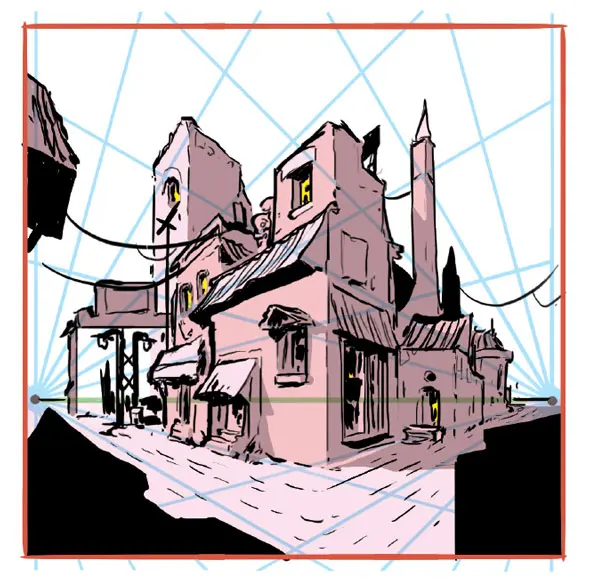
Linear perspective provides a reliable structure for organizing complex scenes, ensuring that objects diminish in size at a mathematically consistent rate as they recede from the viewer. By establishing a horizon line and one or more vanishing points, an artist can create a convincing "window" into a scene. This technique is essential for architectural rendering, interior design, and realistic figurative painting because it mimics the way the human eye processes light and distance.
Without this system, drawings often look distorted or "flat," leading to a lack of realism. Mastery of perspective allows an artist to manipulate the viewer's focus and emotional response to a space. By placing the vanishing point in specific areas, an artist can make a room feel claustrophobic, grand, or inviting. The primary components of this system include:
- The Horizon Line: Represents the viewer’s eye level.
- The Vanishing Point: The spot where parallel lines appear to meet.
- Orthogonals: Diagonal lines drawn toward the vanishing point.
- Transversals: Horizontal lines that define the depth of objects.
How to use one-point perspective for beginners
One-point perspective is the most straightforward method for creating depth, making it the ideal starting point for students. This method is best used for scenes where the viewer is looking directly at a flat surface, such as the face of a building or the back wall of a room. To practice this technique, follow these foundational steps:
- Draw a horizontal line across your paper to serve as the horizon line.
- Place a single dot anywhere on that line to act as your vanishing point.
- Draw the front face of your object, such as a square or rectangle, using only vertical and horizontal lines.
- Connect the corners of your shape to the vanishing point using a ruler.
- Draw parallel lines between these "orthogonals" to define the back edge of the object, then erase the excess lines.
This process ensures that every object in your scene aligns with the same spatial logic, resulting in a cohesive and believable environment.
Common mistakes when drawing perspective
Even experienced artists often fall into common traps that break the illusion of depth. One frequent error is failing to keep vertical lines perfectly perpendicular to the horizon line. If a building's corners tilt even slightly, the entire structure appears to be falling over, which ruins the viewer's sense of stability. Another common issue is inconsistent scaling, where objects in the foreground are drawn too small compared to those in the background, violating the laws of optics.
To maintain accuracy, keep these troubleshooting tips in mind:
- Always use a straightedge; freehand lines often drift and cause "warping" in the perspective grid.
- Avoid placing your vanishing point too close to the edge of the paper, as this creates extreme, unnatural distortion.
- Remember that objects closer to the vanishing point should appear smaller and less detailed than those in the foreground.
- Never assume that all lines must go to the same point; if an object is rotated, it requires its own set of vanishing points.
How does atmospheric perspective create depth?
While linear perspective handles the geometry of shapes, atmospheric perspective—also known as aerial perspective—handles the quality of light and color. As objects move further away, they lose contrast, detail, and color saturation due to the particles in the atmosphere. This technique was perfected by Renaissance masters like Leonardo da Vinci, who observed that distant mountains appear cooler, lighter, and blurrier than objects in the immediate foreground.
To apply this effectively, artists should use a limited palette for distant elements, favoring cool blues and greys. Foreground objects should feature high contrast, sharp edges, and warm, vibrant colors. By combining the rigid geometric structure of linear perspective with the soft, shifting qualities of atmospheric perspective, an artist can achieve a profound sense of three-dimensional space. This dual approach allows for the creation of immersive landscapes that feel vast and expansive, effectively bridging the gap between a flat canvas and the complexity of the natural world.
Key facts
- Ancient Egyptian art prioritized symbolic hierarchy over spatial depth, often depicting important figures larger than others regardless of their distance.
- Linear perspective relies on a horizon line and vanishing points where all parallel lines appear to converge.
- Filippo Brunelleschi is credited with formally demonstrating the mathematical principles of linear perspective in Florence around 1415.
- Atmospheric perspective uses color and clarity to suggest distance, as objects appear cooler, lighter, and less detailed the further away they are.
- To practice one-point perspective, draw a horizon line at eye level and place a single dot in the center to serve as your vanishing point.
- A common mistake is drawing objects with parallel sides that do not angle toward the vanishing point, which makes the structure look flat or distorted.
The bottom line
The history of perspective is a transition from symbolic representation to mathematical realism. By mastering techniques like linear and atmospheric perspective, artists gained the ability to translate three-dimensional reality onto two-dimensional surfaces. Whether using a single vanishing point or complex multi-point systems, these tools remain essential for creating convincing depth. Understanding these principles allows any artist to manipulate space and guide the viewer's eye through a composition.
People also ask
What is the difference between one-point and two-point perspective?
One-point perspective uses a single vanishing point to show depth, typically when looking directly at the front of an object. Two-point perspective uses two separate vanishing points on the horizon line, which is necessary when viewing an object from a corner or angle.
Read the full answer →Did artists before the Renaissance understand perspective?
Yes, ancient Roman artists used intuitive perspective, which approximated depth through overlapping and scale, though it lacked the rigid mathematical precision developed later. They did not use a single, unified vanishing point for their compositions.
How does foreshortening change the appearance of an object?
Foreshortening is a technique used to create the illusion that an object is receding strongly into the background. It involves compressing the proportions of an object, such as a limb or a building, to account for how it appears to the eye from a specific angle.
Why do distant mountains look blue in paintings?
This is known as atmospheric or aerial perspective, caused by the scattering of light by particles in the atmosphere. As distance increases, the contrast between light and dark decreases, and colors shift toward the blue end of the spectrum.
Can perspective be used in abstract art?
Even in abstract works, artists often manipulate perspective to create tension or spatial ambiguity. By intentionally breaking the rules of traditional geometry, an artist can make a flat surface feel like a complex, shifting environment.
What is the "vanishing point" in a drawing?
The vanishing point is the specific coordinate on the horizon line where all lines representing parallel paths in the real world seem to converge. It is the anchor point that allows the viewer to perceive the depth of the scene.
This answer was created with the help of AI research tools and reference sources. Spotted an error? Let us know — we correct mistakes quickly. See our editorial policy.