What is linear perspective?
Short answer
Linear perspective is a mathematical system used by artists to create the illusion of three-dimensional depth on a two-dimensional surface. By converging parallel lines toward a single distant point on the horizon, it simulates how objects appear smaller as they recede from the viewer, mimicking human binocular vision and spatial perception.
On this page
How does linear perspective work?
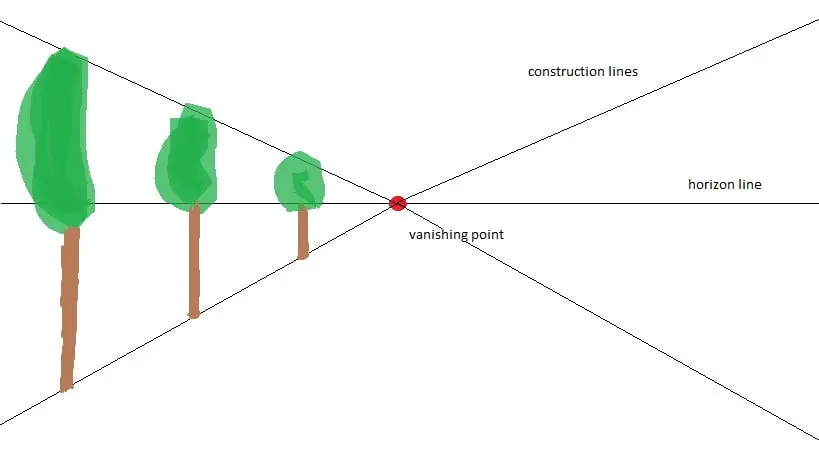
Linear perspective relies on the geometric principle that parallel lines appear to converge at a specific point in the distance, known as the vanishing point. This point is always situated on the horizon line, which represents the viewer's eye level. As objects move toward this point, they undergo a proportional reduction in size, creating a convincing sense of recession into deep space. The system functions by mapping the three-dimensional world onto a flat plane, such as a canvas or paper, using precise mathematical ratios.
To construct this effect, artists establish a horizon line and place one or more vanishing points upon it. All lines that are perpendicular to the picture plane, such as the sides of a road or the edges of a building, are drawn to meet at these points. This technique ensures that objects maintain their correct spatial relationship to one another. By strictly adhering to these geometric constraints, the artist can dictate exactly where the viewer’s eye is directed, effectively controlling the composition's narrative and structural focus.
Who invented linear perspective?
While ancient civilizations understood basic foreshortening, the formal mathematical rules of linear perspective were codified during the Italian Renaissance. The architect Filippo Brunelleschi is credited with demonstrating these principles in Florence around 1413 through a series of optical experiments involving a mirror and a painted panel of the Baptistery. His discovery revolutionized architecture and painting, providing a scientific basis for realism that had previously been elusive in Western art.
Following Brunelleschi, the scholar Leon Battista Alberti published De pictura in 1435, the first written treatise on the subject. Alberti described the picture plane as an "open window" through which the viewer looks into a scene. This concept became the standard for centuries, influencing masters such as Leonardo da Vinci, Raphael, and Piero della Francesca. These artists refined the system, incorporating multiple vanishing points to depict complex architectural spaces and landscapes. Their work transformed art from a symbolic representation into a rigorous exploration of physical space and human optics.
How to draw using linear perspective
Applying linear perspective requires patience and a few basic tools, such as a long ruler, a pencil, and an eraser. The process involves defining your spatial environment through a series of logical steps that anchor your subject matter within a consistent grid. Once you master the basic one-point system, you can progress to two-point or three-point perspective to capture more dynamic angles and architectural complexity.
- Draw a horizontal line across your paper to serve as the eye level or horizon.
- Place a single dot on this line to act as your primary vanishing point.
- Sketch the front face of your object, such as a square or rectangle, as a flat shape.
- Use your ruler to draw faint lines from each corner of the shape back to the vanishing point.
- Determine the depth of your object by drawing horizontal and vertical lines between these receding lines.
- Erase the excess construction lines to reveal a solid, three-dimensional form.
Why use linear perspective in art?
Linear perspective is essential for creating a sense of realism and scale in a composition. It allows an artist to organize a complex scene into a coherent structure that the human brain can easily interpret as a physical environment. Without this system, objects often appear to float or lack a clear relationship to the ground plane, which can disorient the viewer. By using perspective, an artist can lead the eye across a vast landscape or into the interior of a room, creating a narrative flow that feels intuitive and grounded in reality.
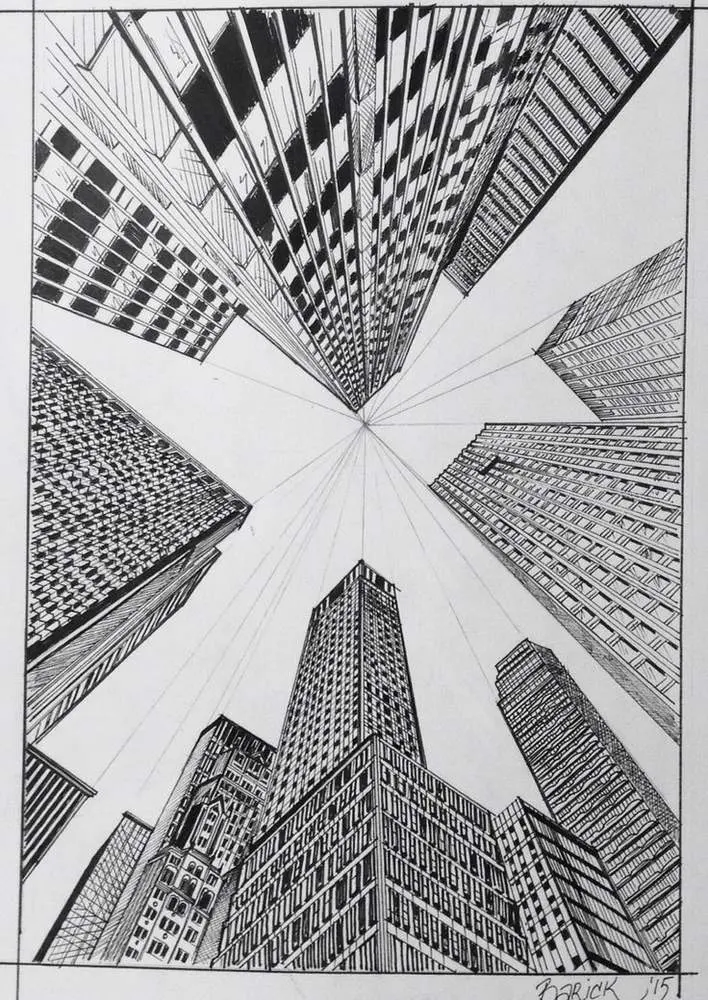
Beyond simple realism, perspective is a powerful tool for visual storytelling and emotional impact. A low horizon line can make a building appear monumental and imposing, while a high horizon line can suggest a sprawling, expansive vista. Artists use these techniques to emphasize the importance of certain subjects or to create tension within a scene. By manipulating the vanishing points, the artist can distort space to create surreal or dramatic effects, proving that perspective is as much a creative choice as it is a technical requirement.
Common mistakes when using linear perspective
The most frequent error beginners make is neglecting to keep the horizon line perfectly horizontal. If the horizon tilts, the entire structural integrity of the drawing collapses, making buildings appear as if they are sliding off the page. Another common pitfall is failing to align all receding lines precisely with the vanishing point. Even a slight deviation can make an object look warped or "off," breaking the illusion of depth. It is vital to check your work frequently with a ruler to ensure that every diagonal line is heading exactly toward its designated point.
- Forgetting to account for the viewer's eye level, which results in inconsistent heights for objects.
- Crowding the vanishing point too close to the center of the page, which can create unnatural, distorted angles.
- Neglecting to draw light construction lines, making it difficult to erase them later without damaging the final sketch.
- Over-complicating the scene by adding too many vanishing points before mastering the basic one-point technique.
- Ignoring the scale of objects relative to the horizon, which causes items in the distance to appear larger than those in the foreground.
Key facts
- Linear perspective is a mathematical system used to create the illusion of depth on a flat surface.
- The horizon line represents the viewer's eye level, where the sky meets the ground or water.
- Vanishing points are specific spots on the horizon line where all parallel lines appear to converge.
- Orthogonal lines are the diagonal lines drawn from objects toward the vanishing point to establish depth.
- Filippo Brunelleschi is credited with formalizing the rules of linear perspective in Florence around 1415.
- To maintain realism, ensure all horizontal lines remain parallel to the bottom of the page unless they recede into the distance.
The bottom line
Linear perspective is the fundamental geometry of spatial representation, allowing artists to translate three-dimensional reality onto a two-dimensional plane. By anchoring lines to a horizon and converging them at vanishing points, you create a convincing sense of distance and volume. Mastering these mathematical rules transforms flat sketches into immersive environments, providing a reliable framework for realism that has defined Western art since the early Renaissance period.
People also ask
What is the difference between one-point and two-point perspective?
One-point perspective uses a single vanishing point and is used when viewing an object head-on. Two-point perspective uses two vanishing points and is used when viewing an object from an angle, showing two sides simultaneously.
Read the full answer →How do I find the horizon line in a drawing?
The horizon line is always placed at the exact height of the viewer’s eyes. If you are drawing a landscape from a standing position, the horizon line will be significantly higher than if you are drawing while sitting on the ground.
Why do my drawings look distorted?
Distortion often occurs when vanishing points are placed too close together or when orthogonal lines are not drawn perfectly straight. Use a ruler to ensure all receding lines meet precisely at the designated vanishing point.
Can linear perspective be used for non-architectural subjects?
Yes, it is essential for placing figures, trees, or furniture within a scene accurately. By establishing the horizon line first, you can determine the scale of objects relative to their distance from the viewer.
What is the "foreshortening" technique?
Foreshortening is the visual effect where an object appears shorter than it actually is because it is angled toward the viewer. It relies on the principles of perspective to compress the depth of an object while maintaining its recognizable shape.
Do I always need a ruler to draw in perspective?
While a ruler is recommended for beginners to learn the strict geometry, professional artists often use "freehand perspective." This involves sketching light guidelines to maintain structural integrity without the rigid look of mechanical drafting.
This answer was created with the help of AI research tools and reference sources. Spotted an error? Let us know — we correct mistakes quickly. See our editorial policy.