What is a horizon line in drawing?
Short answer
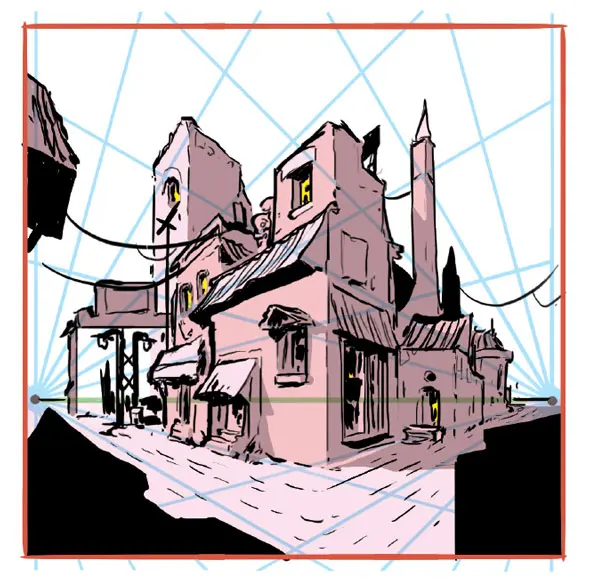
The horizon line is a horizontal reference line in a drawing that represents the viewer’s eye level. It serves as the primary anchor for linear perspective, determining where objects appear to meet the sky or ground. All parallel lines receding into the distance converge toward vanishing points located on this specific line.
On this page
What is a horizon line in drawing?
The horizon line, often called the eye-level line, is the horizontal axis that divides a composition into two distinct visual planes. In technical drawing, it represents the exact height of the observer’s eyes relative to the scene. Whether you are standing on a beach or sitting in a chair, the horizon line shifts to match your vertical position.
This line is essential for creating the illusion of depth on a two-dimensional surface. Because it dictates where the viewer is positioned in space, it controls how the rest of the environment is rendered. If you place the horizon line high on the page, you create a "bird's-eye view," looking down at the ground. Conversely, a low horizon line creates a "worm's-eye view," looking up at the sky.
How to find the horizon line in a scene
Locating the horizon line is the first step in establishing accurate perspective. When sketching from life, identify the point where the sky meets the earth or water; this is your physical horizon. If you are indoors, the horizon line is simply the height of your eyes as you look straight ahead at the wall.
To accurately place this line on your paper, follow these steps:
- Stand or sit in your chosen position and remain still.
- Hold your pencil horizontally at eye level, keeping your arm extended.
- Observe which objects in the room align with the top of your pencil.
- Lightly draw a horizontal line across your paper at that corresponding height.
By consistently using this method, you ensure that your drawing maintains a stable, realistic perspective that feels grounded to the viewer.
Why the horizon line is important for perspective
The horizon line acts as the anchor for all vanishing points in a drawing. In one-point and two-point perspective, every line that recedes away from the viewer must eventually connect to a vanishing point located on this line. Without a defined horizon, objects in your drawing will appear to float or tilt awkwardly, destroying the sense of spatial realism.
When you draw a cube or a building, the top and bottom edges must angle toward the horizon line. If these lines do not converge correctly, the object will look distorted. By keeping your vanishing points fixed on the horizon, you ensure that all architectural elements align harmoniously. This mathematical consistency is what allows artists to build complex, believable worlds on a flat sheet of paper.
Common mistakes when drawing the horizon line
Beginners often make the mistake of drawing the horizon line as a literal, dark line that remains visible in the finished artwork. In reality, the horizon is a conceptual guide rather than a physical object. If you draw it too heavily, it becomes a distracting element that breaks the continuity of your scene. Always use a light touch so you can easily erase or blend the line later.
Another frequent error is shifting the horizon line during the drawing process. If you move your head or change your posture while sketching, your eye level changes, which alters the perspective of every object in the frame. To avoid this, maintain a consistent physical posture throughout your session. If you must move, re-verify your horizon line before continuing to add details to ensure your vanishing points remain accurate.
Best tips for mastering horizon lines
To improve your technical skills, practice drawing simple geometric shapes from different eye levels. Start by drawing a series of boxes at, above, and below the horizon line. You will notice that you cannot see the top of a box placed above the line, and you cannot see the bottom of a box placed below it. This exercise builds an intuitive understanding of how vertical placement affects visibility.
Consider these additional strategies for professional results:
- Use a T-square or ruler to ensure your horizon line is perfectly parallel to the edges of your paper.
- Experiment with extreme horizon placements to add drama to your compositions.
- Keep your vanishing points far apart to avoid overly distorted, "fisheye" perspectives.
- Use the horizon line to organize your composition by placing focal points near intersections.
By mastering the relationship between the viewer's eye level and the geometry of the scene, you gain full control over the depth and narrative impact of your drawings.
Key facts
- The horizon line is a horizontal line that represents your eye level in a drawing.
- It acts as the boundary where the sky meets the land or sea in a landscape.
- Objects positioned above the horizon line are viewed from below, while those below it are viewed from above.
- In linear perspective, all parallel lines that recede into the distance converge at vanishing points located on this line.
- If you are standing on flat ground, the horizon line will always be at your exact eye level, regardless of your height.
- When drawing a portrait or figure, the horizon line corresponds to the viewer's eye level relative to the subject.
The bottom line
The horizon line is the most critical element in establishing accurate perspective in any drawing. By serving as the viewer's eye level, it dictates how objects recede, scale, and align within a composition. Mastering this concept allows you to create a convincing sense of depth and spatial reality. Remember that while it is an invisible guide, its precise placement fundamentally shapes the narrative and atmosphere of your artwork.
People also ask
Does the horizon line always have to be in the center of the page?
No, the placement of the horizon line determines the composition's focus. Placing it high creates a bird's-eye view, while placing it low emphasizes the sky and creates a worm's-eye perspective.
Can there be more than one horizon line in a single drawing?
A single drawing should only have one horizon line to maintain consistent perspective. If you depict multiple horizon lines, the viewer will perceive the objects as being on different planes or tilted surfaces.
How do I find the horizon line in a photograph?
You can find it by tracing the receding lines of buildings or roads until they meet at a common point. This point will always lie on the horizon line, which is level with the camera's lens.
What happens if I tilt my head while drawing?
If you tilt your head, your horizon line will also tilt, causing your vanishing points to shift accordingly. This creates a "Dutch angle" effect, which is often used to convey tension or instability in an image.
Should I always draw the horizon line as a visible line?
You do not need to draw a visible line, as it is a conceptual tool rather than a physical object. Most artists use it as a light guideline during the sketching phase and erase it before finalizing the work.
How does the horizon line affect the size of objects?
Objects appear to shrink as they approach the horizon line because they are moving further away in the distance. Objects placed closer to the horizon line will always appear smaller than those placed near the bottom of the frame.
This answer was created with the help of AI research tools and reference sources. Spotted an error? Let us know — we correct mistakes quickly. See our editorial policy.