How do you draw a nest with eggs?
Short answer
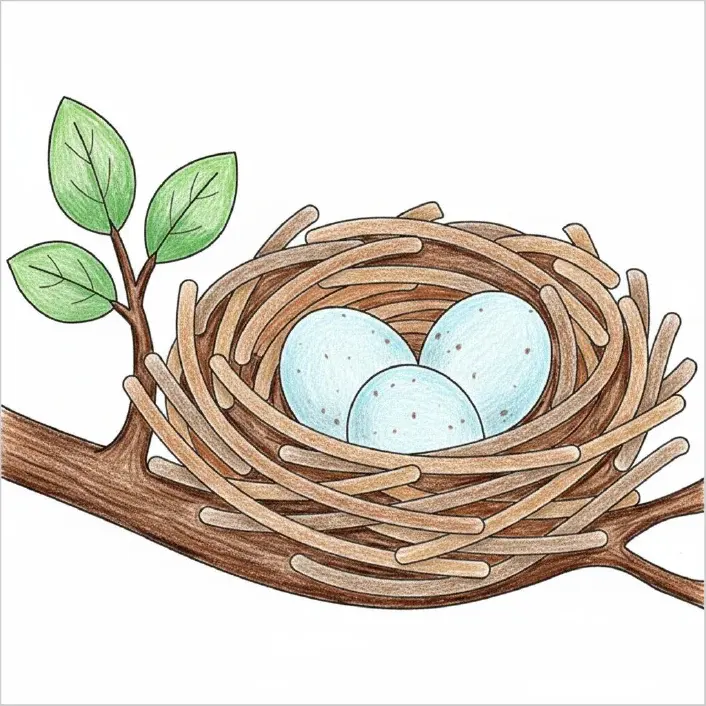
Drawing a nest with eggs requires building a layered, circular structure using varied line weights. Start by sketching a rough bowl shape, then layer overlapping twigs to create texture and depth. Finally, place smooth, oval-shaped eggs inside the center, ensuring they rest naturally against the inner curve of the woven nest base.
On this page
How to sketch the basic nest structure
Begin by drawing a wide, shallow "U" shape to establish the silhouette of the nest. Add an elliptical line across the top to define the opening, which helps you visualize the three-dimensional volume of the bowl. Keep your initial lines light, as these serve only as a structural guide for the more intricate details you will add later.
Once the basic form is set, refine the outer edges by adding irregular, jagged lines that suggest the messy, organic nature of twigs and dried grass. Avoid making the nest a perfect circle, as nests are typically built by birds using found materials that create an asymmetrical, natural aesthetic. Focus on creating a sense of weight at the bottom, where the nest would be thickest and most compressed from the bird's body heat and movement.
- Sketch a light, horizontal oval for the top opening.
- Draw a deep, rounded base below the oval.
- Connect the sides with loose, curved lines.
- Erase the internal guide lines once the shape is established.
How to add texture to the twigs
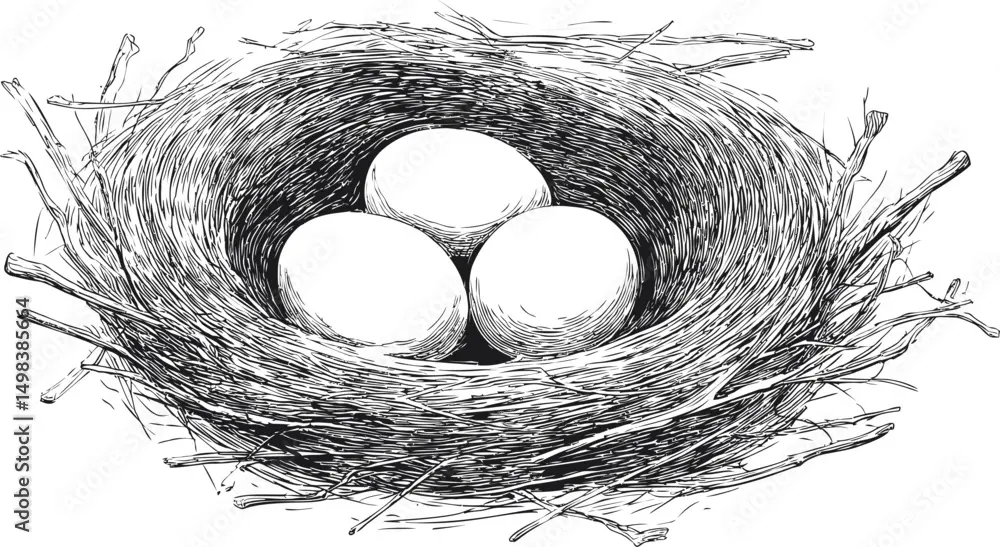
The realism of a nest relies heavily on the texture of the materials. Instead of drawing uniform lines, use short, overlapping strokes to represent individual twigs, straw, and bits of moss. Vary the pressure of your pencil to create darker shadows in the crevices where twigs overlap, while leaving the protruding ends lighter to suggest depth and light hitting the surface.
Focus on the directional flow of the materials. Birds weave their nests in a circular pattern, so your lines should generally follow the curve of the bowl. By layering these strokes, you create the illusion of a dense, woven mass rather than a hollow shell. Do not worry about making every twig distinct; a cluttered, chaotic appearance is actually more accurate to how a real bird constructs its home.
- Use cross-hatching to create deep, dark pockets between twigs.
- Employ flicking motions with your pencil to draw loose, protruding ends.
- Vary the thickness of your lines to show which twigs are in the foreground.
- Keep the bottom of the nest darker to suggest a shadow cast by the structure.
How to draw realistic bird eggs
Eggs are essentially ovals, but they are rarely perfectly symmetrical. To draw them convincingly, sketch a slightly elongated oval, making one end marginally wider than the other. This subtle variation in shape prevents the eggs from looking like plastic spheres and gives them a biological, organic feel that fits perfectly within the nest’s rough interior.
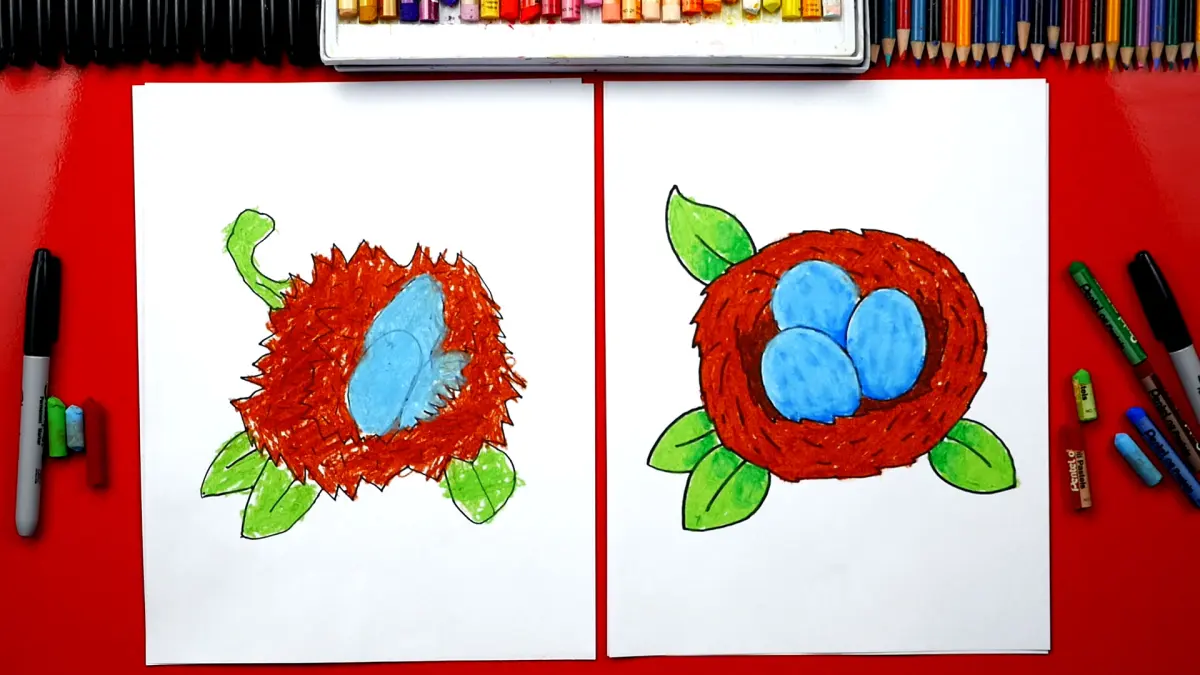
Placement is critical for a natural look. Ensure the eggs are nestled deep within the center of the structure, partially obscured by the inner twigs. If you are drawing multiple eggs, have them overlap slightly rather than sitting side-by-side in a perfect row. This overlapping creates a focal point and adds a sense of depth to the composition, making the eggs appear as if they are resting securely on the bottom of the nest.
- Draw a light, elongated oval for each egg.
- Taper one end slightly to mimic the natural shape of a bird's egg.
- Position the eggs so they overlap based on the perspective of the nest.
- Add small dots or light shading to represent natural speckling or surface texture.
Common mistakes when drawing nests
A frequent error is drawing the nest as a perfectly smooth, symmetrical cup. In nature, nests are constructed from debris, mud, and vegetation, which results in a rugged, uneven exterior. If your drawing looks too clean, it will lack the necessary character. Introduce more chaotic, protruding lines and vary the density of the weaving to break up the monotony of the shape.
Another mistake is ignoring the light source, which makes the drawing look flat. Decide where your light is coming from and apply shadows accordingly. The side of the nest opposite the light source should be significantly darker, and the eggs themselves should have a small highlight on their upper surfaces. Without these tonal values, the nest will appear as a two-dimensional symbol rather than a three-dimensional object occupying space.
- Avoid using perfectly straight lines for twigs; always add a slight curve.
- Don't make the nest opening a perfect circle; tilt it to show perspective.
- Ensure the shadows inside the nest are deep enough to create contrast.
- Do not make the eggs uniform in size; slight variations add visual interest.
Best shading techniques for depth
To finish your drawing, focus on the interplay between light and shadow. Use a soft-leaded pencil to darken the interior of the nest, as this is where the least amount of light reaches. By keeping the center dark, you create a natural cradle for the eggs, which will stand out more effectively when you apply lighter shading to their upper surfaces.
Finally, consider the cast shadows. The nest itself will cast a shadow on the surface it rests upon, and the eggs will cast small shadows onto the twigs beneath them. These small, dark accents ground the objects in the scene and provide the final touch of realism. Step back periodically to observe the overall balance of light and dark, adding more contrast where necessary to make the nest truly pop off the page.
Key facts
- A bird's nest is typically constructed as a circular, bowl-shaped structure to cradle eggs securely.
- Use a cross-hatching technique to mimic the tangled, overlapping texture of twigs and dried grass.
- Draw eggs as ovals, but vary their size and placement slightly to avoid a rigid, unnatural appearance.
- Place eggs in the center of the nest, ensuring they look like they are resting inside rather than floating on top.
- Add shadows beneath the eggs where they touch the nest to create a sense of depth and weight.
- Keep the outer edges of the nest irregular and messy to reflect the organic nature of gathered materials.
The bottom line
Drawing a realistic nest requires balancing structural chaos with deliberate composition. By layering irregular, overlapping lines to form a bowl, you create the illusion of woven twigs. Placing slightly asymmetrical, speckled ovals in the center provides a focal point, while deep shadows beneath the eggs anchor them firmly. With practice, these simple techniques transform basic geometric shapes into a lifelike representation of nature’s architectural marvels.
People also ask
What is the best pencil grade for sketching a nest?
Use an HB pencil for the initial light outline, then switch to a 4B or 6B pencil for the dark, textured shadows. Softer leads allow for richer, darker lines that define the depth of the twigs.
How do I make the nest look realistic instead of like a solid bowl?
Focus on drawing individual, overlapping lines rather than a smooth, continuous circle. Leaving small gaps between lines suggests the airy, woven structure of real nesting materials.
Should I draw the eggs with patterns or plain?
Adding small, irregular dots or speckles to the eggshells adds visual interest and realism. Most bird eggs feature natural camouflage patterns that help them blend into their environment.
How can I show that the nest is sitting in a tree?
Draw a few thick, curved lines crossing behind or underneath the nest to represent a sturdy branch. Connecting the nest to a branch provides essential context and stability to your drawing.
What is a common mistake when drawing eggs?
A frequent error is drawing eggs as perfect, symmetrical circles. Real eggs are slightly asymmetrical, with one end often broader and blunter than the other.
How many eggs should I put in the nest?
Most songbirds lay between three and five eggs in a clutch. Choosing an odd number often creates a more balanced and visually appealing composition for the viewer.
This answer was created with the help of AI research tools and reference sources. Spotted an error? Let us know — we correct mistakes quickly. See our editorial policy.