Why is The School of Athens so famous?
Short answer
The School of Athens is famous because it serves as the ultimate visual synthesis of Renaissance humanism. Painted by Raphael between 1509 and 1511, it masterfully harmonizes classical philosophy with Christian theology. Its technical brilliance in perspective, composition, and characterization captures the intellectual spirit of the High Renaissance, defining Western artistic achievement.
On this page
Why is The School of Athens considered a masterpiece?
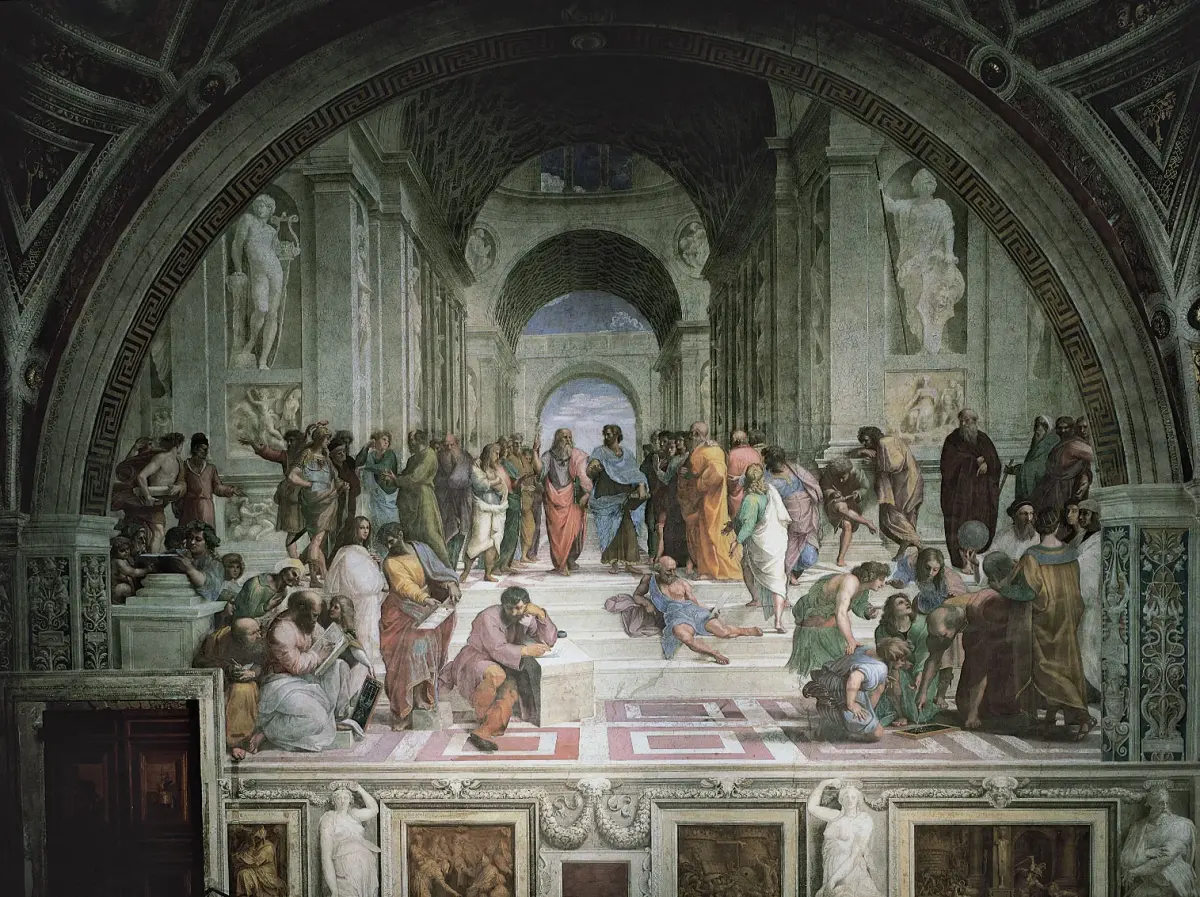
Raphael’s fresco, located in the Apostolic Palace of the Vatican, represents the pinnacle of High Renaissance painting. It is celebrated for its perfect application of linear perspective, which draws the viewer’s eye toward the central figures of Plato and Aristotle. By organizing dozens of historical thinkers into a balanced, architectural space, Raphael demonstrated an unprecedented level of compositional control.
The work is not merely a technical exercise; it is a profound intellectual statement. It depicts the greatest minds of antiquity gathered in an idealized setting, suggesting that the pursuit of knowledge is a noble, unified endeavor. This synthesis of classical wisdom and contemporary artistic mastery remains a cornerstone of Western art history, influencing centuries of painters who sought to emulate its harmony and clarity.
Who are the figures in The School of Athens?
The painting functions as a "who’s who" of ancient philosophy, with Raphael cleverly using the faces of his contemporaries to represent these historical figures. Plato, pointing upward toward the realm of ideas, is modeled after Leonardo da Vinci. Aristotle, gesturing toward the earth, represents empirical observation. Other figures include:
- Socrates, shown counting on his fingers while explaining logic.
- Pythagoras, writing in a book in the foreground.
- Euclid, depicted with a compass, modeled after the architect Donato Bramante.
- Heraclitus, a solitary figure sitting on the steps, bearing the features of Michelangelo.
By placing these thinkers together in a grand, vaulted hall, Raphael bridged the gap between ancient thought and the intellectual fervor of the 16th century. Each figure is characterized by distinct gestures and poses, ensuring that the viewer can identify their specific philosophical contributions through visual cues alone.
How does the painting use perspective and composition?
The architectural setting of the painting is as important as the figures themselves. Raphael utilized a rigorous one-point perspective, with the vanishing point located exactly between the heads of Plato and Aristotle. This technique creates a sense of immense depth, making the flat wall of the Stanza della Segnatura appear as if it opens into a massive, three-dimensional hall.
To achieve this spatial mastery, follow these fundamental principles of Renaissance composition:
- Establish a clear horizon line to ground the viewer’s perspective.
- Use orthogonal lines—diagonal lines that converge at the vanishing point—to define the depth of floors and ceilings.
- Group figures into clusters to create a sense of movement and narrative interaction, preventing the scene from feeling static.
Common mistakes include failing to maintain consistent scale across the foreground and background, which destroys the illusion of space, or overcrowding the composition, which obscures the central focus of the work.
What is the historical context of the work?
Commissioned by Pope Julius II, the fresco was part of a larger project to decorate the private library of the Vatican. The room, known as the Stanza della Segnatura, was intended to house the Pope’s books and represent the four branches of human knowledge: philosophy, theology, poetry, and justice. The School of Athens represents philosophy, standing directly across from The Disputation of the Holy Sacrament, which represents theology.
This placement was intentional, reflecting the Renaissance belief that faith and reason were compatible paths to truth. By integrating pagan philosophers into the heart of the Catholic Church, the painting signaled a shift in the cultural climate. It acknowledged that the wisdom of the ancient world was not a threat to Christianity but a foundation upon which it could be understood and expanded.
How can students analyze the painting today?
When viewing or studying this work, it is helpful to look beyond the grand scale and focus on the individual interactions. The painting is a narrative of intellectual history, where every gesture serves a purpose. To analyze it effectively, observe how the light source illuminates the central figures while casting others in subtle shadow, guiding the viewer's attention through the complex scene.
Avoid the mistake of viewing the painting as a mere portrait gallery. Instead, treat it as a dialogue between different schools of thought. Consider the following steps for a deeper analysis:
- Identify the central conflict between the idealism of Plato and the realism of Aristotle.
- Research the specific philosophical theories associated with the thinkers in the foreground.
- Compare the architectural style of the painting to actual Roman ruins, such as the Baths of Caracalla, which inspired Raphael’s design.
By engaging with the painting as an intellectual map rather than just a decorative image, you can appreciate why it remains the definitive image of the Renaissance.
Key facts
- Painted by Raphael between 1509 and 1511, the fresco resides in the Apostolic Palace in the Vatican.
- The work measures approximately 20 feet by 26 feet, dominating the Stanza della Segnatura.
- It depicts a gathering of history’s greatest philosophers, mathematicians, and scientists from classical antiquity.
- Plato and Aristotle are the central figures, representing the divide between idealism and empiricism.
- Raphael included portraits of his contemporaries, such as Leonardo da Vinci as Plato and Michelangelo as Heraclitus.
- To view it in person, purchase Vatican Museums tickets in advance to avoid the massive daily crowds.
The bottom line
The School of Athens remains a masterpiece of the High Renaissance because it perfectly captures the intellectual ambition of its era. By blending complex perspective, classical themes, and portraits of contemporary geniuses, Raphael created a visual manifesto of human knowledge. It serves as a timeless bridge between the ancient world and the Renaissance, reminding viewers of the enduring power of reason, dialogue, and artistic mastery.
People also ask
Who are the two central figures in the painting?
The central figures are Plato, pointing upward toward the heavens, and Aristotle, gesturing toward the earth. This contrast illustrates their differing philosophical focuses on abstract forms versus observable reality.
Are the people in the painting real historical figures?
Most figures represent ancient thinkers like Socrates, Pythagoras, and Euclid. However, Raphael used the faces of his Renaissance peers to give the ancient scholars a modern, recognizable human presence.
Why is the architecture in the painting significant?
The complex, vaulted architecture reflects the influence of Donato Bramante, the architect of the new St. Peter’s Basilica. It creates a sense of grand, rational space that mirrors the intellectual order of the philosophers.
What does the painting symbolize?
It symbolizes the harmony between philosophy, science, and theology. By placing pagan thinkers in the heart of the Vatican, Raphael celebrated the synthesis of classical wisdom and Christian thought.
How can I identify the different philosophers?
Look for specific attributes, such as Pythagoras writing in a book or Diogenes lounging on the steps. Many guides provide a "key" map that correlates each figure with their historical identity.
Is it possible to see the painting without visiting Rome?
While nothing replaces the physical scale of the fresco, high-resolution digital scans are available through the Vatican Museums' official virtual tour website. These allow you to zoom in on individual brushstrokes and details.
This answer was created with the help of AI research tools and reference sources. Spotted an error? Let us know — we correct mistakes quickly. See our editorial policy.