What is Titian known for?
Short answer
Titian was the preeminent Venetian painter of the 16th century, celebrated for his revolutionary use of color and expressive brushwork. He transformed Western art through his mastery of oil painting, emotive portraiture, and complex mythological compositions. His long, prolific career established the Venetian school’s dominance and influenced generations of European masters.
On this page
Why is Titian considered a master of color?
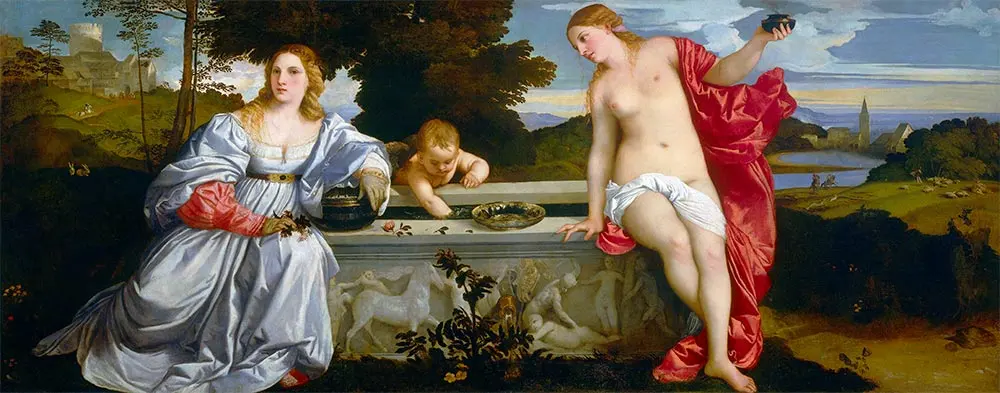
Titian’s primary contribution to art history is his sophisticated manipulation of color, known as colore. Unlike his Florentine contemporaries who prioritized precise line and structure, Titian built his images through layers of pigment that created depth and atmosphere. He utilized a technique called glazing, where thin, translucent layers of oil paint were applied over a textured base to achieve a luminous, lifelike quality. This approach allowed him to capture the subtle play of light on skin, fabric, and landscape, making his figures appear as though they were breathing within their environments.
His transition from the bright, local colors of his early work to the rich, earthy tones of his later years reflects his evolving mastery of light. By the end of his life, he employed a loose, almost impressionistic style that relied on the viewer's eye to blend the colors from a distance. This method, often called pittura di macchia or "painting of patches," moved away from rigid outlines entirely. His technical innovations in color include:
- The use of warm, golden underpainting to unify the canvas.
- The application of thick, impasto highlights to catch ambient light.
- The integration of deep, shadowed backgrounds to push figures into the foreground.
How to identify a Titian portrait
Titian was the most sought-after portraitist of the Renaissance, capturing the likenesses of popes, emperors, and aristocrats. His portraits are distinguished by their psychological depth rather than mere physical resemblance. He often positioned his subjects in three-quarter views, using subtle gestures and gaze to suggest their status and personality. His ability to convey the texture of velvet, fur, and metal through paint made his work highly desirable for the elite of the 16th century.
When analyzing a portrait attributed to Titian, look for these specific characteristics:
- Observe the eyes; they often possess a reflective, intelligent quality that engages directly with the viewer.
- Check the background; he frequently used dark, neutral, or landscape settings to emphasize the subject’s silhouette.
- Examine the clothing; he used varied brushstrokes to differentiate between heavy brocades and soft, translucent lace.
- Note the hands; Titian often painted them in relaxed, natural poses that added a sense of casual authority to the sitter.
What are Titian’s most famous mythological paintings?
Titian’s mythological works, often referred to as poesie, represent the pinnacle of his creative freedom. Commissioned by King Philip II of Spain, these large-scale canvases depict scenes from Ovid’s Metamorphoses. In these works, Titian combined sensuality with dramatic tension, moving away from static poses toward dynamic, swirling compositions. Paintings such as Diana and Actaeon and The Rape of Europa demonstrate his ability to manage complex groups of figures while maintaining a cohesive narrative flow.
These works are defined by their emotional intensity and the way they blend the human form with the natural world. Titian successfully integrated classical themes with a contemporary Venetian aesthetic, emphasizing the beauty of the human body in motion. His influence on later artists, particularly Peter Paul Rubens and Diego Velázquez, is most evident in these mythological cycles. They remain essential studies for understanding how he used light and shadow to create a sense of impending action and physical weight within a two-dimensional space.
Common mistakes when studying Titian’s work
A frequent error for beginners is attempting to categorize Titian’s style as a single, static approach. Because his career spanned over six decades, his technique changed drastically from his early collaboration with Giorgione to his final, hauntingly abstract works. Assuming that his early, polished surfaces represent his entire output ignores the radical evolution of his later period. Students often mistake his later, loose brushwork for lack of skill, failing to recognize that it was a deliberate, sophisticated choice to prioritize texture and mood over minute detail.
Another common pitfall is focusing solely on the subject matter while ignoring the physical construction of the painting. To truly understand Titian, one must look at:
- The weave of the canvas, which he often used to add texture to his paints.
- The layering of glazes, which can be seen in the deep reds and blues of his drapery.
- The historical context of the Venetian school, which prioritized sensory experience over the mathematical perspective favored in Rome.
By avoiding these oversimplifications, you can better appreciate how Titian’s technical experimentation paved the way for modern painting techniques.
Where to see Titian’s art today
Titian’s works are dispersed among the world’s most prestigious museums, reflecting his international fame during the Renaissance. Because he was a favorite of the Habsburg dynasty, many of his finest masterpieces reside in the Museo del Prado in Madrid. Other significant collections are housed at the Gallerie dell'Accademia in Venice, which provides essential context for his Venetian roots. Visiting these institutions allows for a direct comparison between his early, vibrant works and the somber, profound paintings of his final years.
If you are planning to study his work in person, follow these practical steps:
- Research the specific period of the artist's life represented in the collection you intend to visit.
- Use a magnifying glass or high-resolution digital zoom to examine the brushwork on the edges of the figures.
- Compare his treatment of landscape backgrounds with those of his contemporaries to see his unique atmospheric perspective.
- Look for the artist’s signature or inventory marks, which can provide clues about the painting’s provenance and original commission.
By engaging with the physical reality of the paint, you will gain a deeper understanding of why Titian remains a titan of art history.
Key facts
- Titian, born Tiziano Vecelli around 1488, was the most important member of the 16th-century Venetian school of painting.
- He is renowned for his revolutionary use of color, which he applied in layers to create depth and atmosphere rather than relying on rigid outlines.
- His career spanned over 60 years, allowing him to evolve from the influence of Giorgione to his own expressive, loose brushwork style.
- He served as the official painter to the Republic of Venice and held a prestigious position as court painter to Holy Roman Emperor Charles V.
- His masterpiece "Assumption of the Virgin" (1516–1518) in the Basilica di Santa Maria Gloriosa dei Frari established his reputation as a master of large-scale religious compositions.
- When studying his work, pay close attention to his "late style," where he used his fingers to smear and blend paint, a technique that anticipated modern Impressionism.
The bottom line
Titian remains a titan of Western art because he transformed painting from a rigid, outline-based craft into a medium defined by color and texture. By mastering the potential of oil paints, he brought unprecedented depth and emotion to his subjects. Whether through grand religious altarpieces or intimate royal portraits, his innovative techniques bridged the gap between the Renaissance and the expressive freedom of modern art.
People also ask
What is the Venetian school of painting?
This movement emphasized color, light, and atmosphere over the linear precision favored by artists in Florence and Rome. Artists like Titian used oil paints to achieve rich textures and vibrant hues that reflected the unique light of Venice.
How did Titian influence later artists?
His mastery of color and expressive brushwork directly inspired masters such as Rubens, Velázquez, and Rembrandt. Even 19th-century painters like Delacroix studied his techniques to improve the emotional impact of their own compositions.
Did Titian paint portraits or only religious scenes?
He was one of the most sought-after portraitists of his time, capturing the likenesses of popes, kings, and aristocrats. His portraits are noted for their psychological depth and the realistic rendering of fabrics like velvet and fur.
What is the best way to view Titian's work today?
Visit major institutions like the Prado in Madrid, the Uffizi in Florence, or the National Gallery in London. If visiting in person, try to view the paintings from different angles to see how the light interacts with the textured paint surface.
What are common mistakes when analyzing Titian's paintings?
A common error is focusing only on the subject matter while ignoring the physical application of paint. Viewers often overlook how his loose, seemingly unfinished strokes create a sense of movement and vitality that defines his genius.
Why are his paintings often described as "sensual"?
Titian used soft lighting and warm, glowing skin tones to bring a human, tactile quality to mythological and religious figures. This approach made his subjects appear more lifelike and emotionally accessible compared to the idealized figures of his contemporaries.
This answer was created with the help of AI research tools and reference sources. Spotted an error? Let us know — we correct mistakes quickly. See our editorial policy.