What is Wassily Kandinsky's most famous painting?
Short answer
Composition VIII (1923) is widely considered Wassily Kandinsky’s most famous painting. This masterpiece serves as a definitive example of his transition into geometric abstraction. Housed at the Solomon R. Guggenheim Museum in New York, it exemplifies his belief that colors and shapes possess spiritual properties capable of evoking profound emotional responses.
On this page
Why is Composition VIII considered his masterpiece?
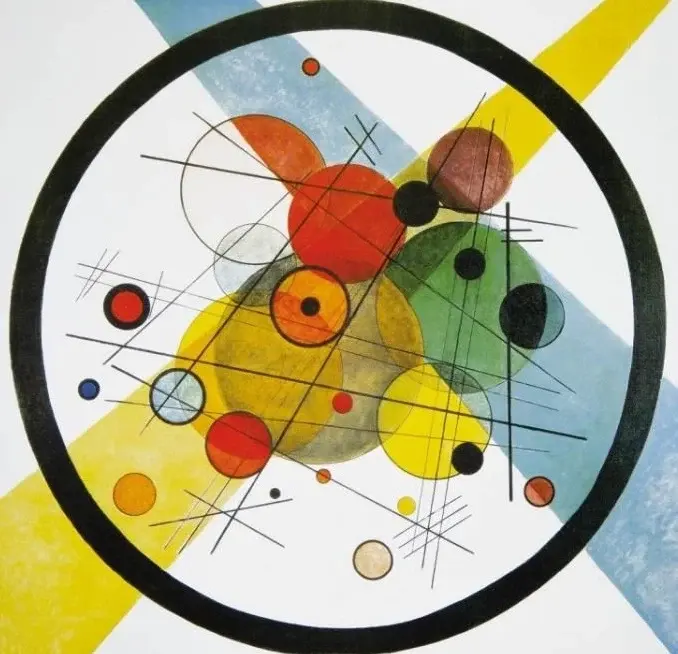
Composition VIII represents the pinnacle of Kandinsky’s theoretical exploration of form and color. After returning to Germany to teach at the Bauhaus, he moved away from the chaotic, organic shapes of his earlier works toward a more disciplined, geometric style. This painting is a complex arrangement of circles, triangles, and intersecting lines that create a sense of rhythmic movement across the canvas.
The work is celebrated because it perfectly balances his intellectual rigor with his intuitive approach to art. By utilizing precise mathematical forms, Kandinsky sought to create a "universal language" of art that transcended cultural boundaries. Scholars often point to this piece as the moment he successfully synthesized his theories on the psychological impact of specific shapes and colors. It remains a cornerstone of modern art history, illustrating the shift from representational painting to pure abstraction.
How to analyze Kandinsky’s use of shapes
When viewing Kandinsky’s work, it is helpful to understand the specific meanings he assigned to basic geometric forms. He believed that these shapes were not merely decorative but functioned as the building blocks of a visual language. By observing how these elements interact, you can better grasp the underlying structure of his compositions.
- Circles: Kandinsky associated the circle with the cosmic, stability, and the "most peaceful" shape.
- Triangles: These were often used to suggest aggressive or dynamic energy due to their sharp angles.
- Squares: These represented a sense of groundedness, order, and objective reality.
- Intersecting lines: These were employed to create tension and movement, guiding the viewer’s eye across the canvas.
Common mistakes when analyzing these works include looking for hidden representational images or narrative scenes. Kandinsky explicitly rejected the idea that his paintings were "pictures" of real-world objects. Instead, focus on the rhythm and the "vibration" of the colors as they interact with the geometric forms.
Where can you see his most famous works?
While Composition VIII is his most iconic painting, Kandinsky’s career spanned several decades and continents. To gain a comprehensive understanding of his evolution, it is best to visit institutions that hold significant portions of his archive. The Solomon R. Guggenheim Museum in New York City holds the largest collection of his work, providing a chronological view of his development from early landscapes to late-stage abstraction.
Other notable locations to view his art include:
- The Centre Pompidou in Paris, which houses a vast collection of his later works.
- The Lenbachhaus in Munich, which focuses on his influential early period and the Blue Rider group.
- The State Tretyakov Gallery in Moscow, which preserves his early Russian-inspired pieces.
If you cannot visit these museums in person, high-resolution digital archives maintained by these institutions offer excellent educational resources. These platforms allow you to zoom in on brushwork and color transitions that are often difficult to appreciate in smaller reproductions.
What is the history of the Composition series?
The Composition series consists of ten large-scale paintings that Kandinsky considered his most significant artistic statements. He began the series in 1910, but unfortunately, many of the original canvases were destroyed during the chaos of the two World Wars. Only a few remain, making the surviving pieces, such as Composition VIII, incredibly valuable to art historians and the public alike.
The series serves as a diary of his intellectual growth. The early works, such as Composition II and Composition IV, are characterized by vibrant, swirling colors and representational hints of landscapes or figures. As the series progressed, the paintings became increasingly abstract and controlled. By the time he reached Composition VIII, he had fully embraced the Bauhaus aesthetic, emphasizing clarity and architectural precision. This progression tracks the broader evolution of 20th-century art from the emotional intensity of Expressionism to the logical structure of Constructivism.
How to appreciate abstract art as a beginner
Approaching abstract art can feel intimidating, but it is best viewed as an experience rather than a puzzle to be solved. You do not need to find a "hidden meaning" to enjoy the work. Instead, treat the painting like a piece of music, where the colors and shapes act as notes and melodies that evoke a specific mood or feeling.
To get the most out of your viewing experience, follow these steps:
- Stand back from the painting to take in the entire composition as a whole.
- Identify the dominant color and ask yourself what emotion it triggers.
- Move closer to inspect how the lines and textures interact with one another.
- Allow your eyes to wander naturally without trying to force a specific interpretation.
A common mistake is assuming that because a painting lacks recognizable objects, it lacks effort or skill. Kandinsky’s work is the result of years of intense study and meticulous planning. By letting go of the need for realism, you open yourself up to the purely visual experience he intended to create.
Key facts
- Wassily Kandinsky is widely considered the pioneer of abstract art, moving away from representational forms in the early 20th century.
- His most famous work is widely considered to be Composition VIII, painted in 1923 during his tenure at the Bauhaus school.
- Composition VIII is currently housed in the permanent collection of the Solomon R. Guggenheim Museum in New York City.
- The painting features a complex arrangement of geometric shapes, including circles, triangles, and intersecting lines that suggest rhythmic movement.
- When studying his work, avoid searching for literal objects; instead, focus on how colors and shapes evoke emotional or musical responses.
- To appreciate his art, visit a major museum to see the scale of his canvases, as digital reproductions often fail to capture his precise brushwork.
The bottom line
While Wassily Kandinsky produced a vast body of influential work, Composition VIII remains his most celebrated achievement. By blending geometric precision with a profound understanding of color theory, he transformed the landscape of modern art. Understanding his transition from figurative landscapes to pure abstraction is essential for any art enthusiast. His legacy continues to challenge viewers to experience art through emotion rather than literal representation.
People also ask
Did Kandinsky paint only abstract art?
No, Kandinsky began his career painting landscapes and folk-inspired scenes in a figurative style. He transitioned to complete abstraction gradually between 1910 and 1913.
What inspired Kandinsky to create abstract paintings?
Kandinsky was deeply influenced by music, particularly the compositions of Arnold Schoenberg. He believed that colors and shapes could function like musical notes to create a visual symphony.
What is the significance of the Bauhaus in Kandinsky's career?
The Bauhaus was a German art school where Kandinsky taught from 1922 to 1933. His time there led to a more disciplined, geometric style compared to his earlier, more fluid works.
How does synesthesia relate to Kandinsky's work?
Kandinsky reportedly experienced synesthesia, a neurological condition where senses overlap. He claimed to "hear" colors and "see" sounds, which guided his unique approach to color theory.
Are there other famous paintings by Kandinsky?
Yes, works such as Composition VII and Yellow-Red-Blue are also highly regarded. These pieces are frequently cited alongside Composition VIII as masterpieces of modern art.
How can I identify a genuine Kandinsky painting?
Authentic works are documented in the Kandinsky catalogue raisonné. If you are researching a specific piece, verify its provenance through major museums or established auction houses to avoid forgeries.
This answer was created with the help of AI research tools and reference sources. Spotted an error? Let us know — we correct mistakes quickly. See our editorial policy.
