What is Jackson Pollock's most famous painting?
Short answer
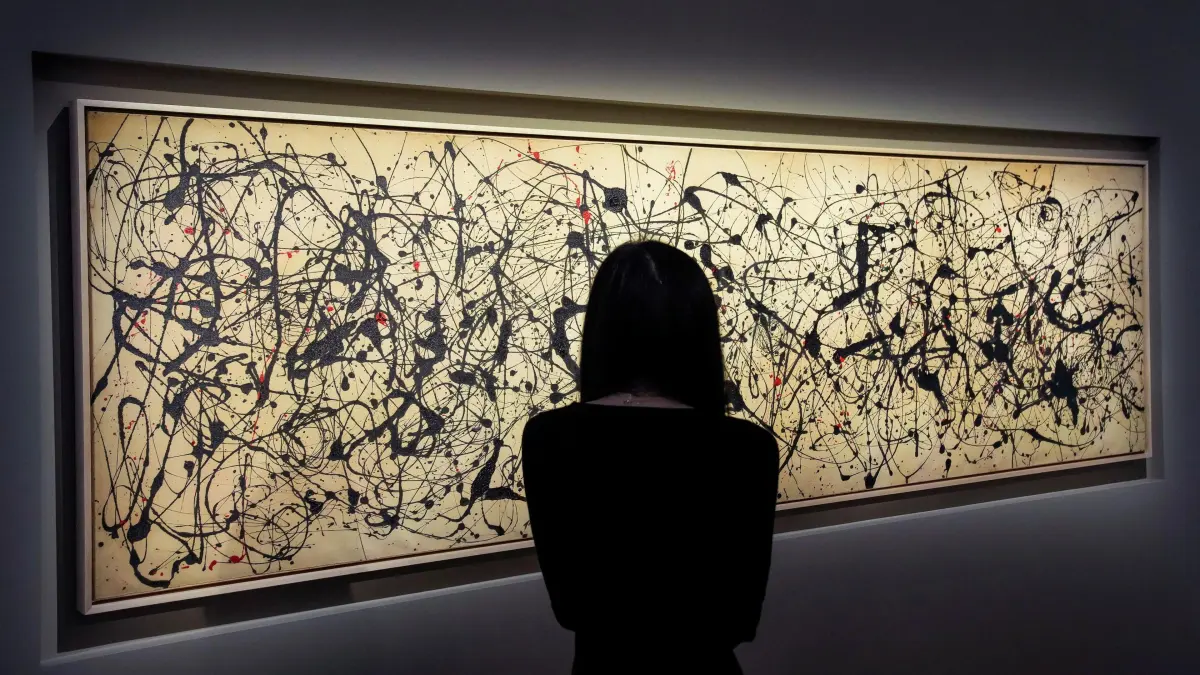
Autumn Rhythm (Number 30), painted in 1950, is widely considered Jackson Pollock’s most famous and significant work. This monumental abstract expressionist masterpiece, held by the Metropolitan Museum of Art, exemplifies his signature "drip" technique. Its complex, rhythmic web of poured house paint redefined the boundaries of modern art in the mid-20th century.

On this page
What makes Autumn Rhythm (Number 30) famous?
Autumn Rhythm (Number 30) is a massive canvas measuring approximately 8 feet by 17 feet. It represents the pinnacle of Pollock’s "drip period," during which he abandoned traditional easels and brushes in favor of placing canvases directly on the floor. By pouring, flicking, and dripping commercial enamel paint, he created a dense, non-hierarchical composition that lacks a central focal point. This approach, which critics later termed "Action Painting," emphasized the physical process of creation over the final representational image.
The painting’s fame stems from its ability to capture the raw energy and spontaneity of the artist's movement. Because there is no "up" or "down" to the composition, the viewer is invited to experience the work as an immersive environment rather than a static picture. It serves as the definitive example of how Pollock transitioned art from the depiction of objects to the manifestation of pure gesture and psychological intensity.
How did Pollock create his drip paintings?
Pollock’s technique was a radical departure from the academic standards of the time. Instead of using thin oil paints, he utilized fluid household enamels that allowed for continuous, sweeping lines. He moved around the perimeter of the canvas, often stepping onto the surface itself, to ensure that his body’s rhythm was directly translated into the paint’s trajectory.
To achieve his unique aesthetic, Pollock employed several specific methods:
- He used sticks, hardened brushes, and turkey basters to control the flow of paint.
- He layered colors in stages, allowing each application to dry partially before adding the next.
- He incorporated sand, glass, and other materials to add texture and depth to the surface.
- He utilized gravity as a primary tool, letting the paint pool and splatter according to the canvas's tilt.
This process was not random, despite the chaotic appearance of the final result. Pollock maintained a high degree of control over the viscosity and velocity of the paint, ensuring that the final web of lines maintained a sense of balance and structural integrity.
Where can you see Pollock’s famous work today?
The original Autumn Rhythm (Number 30) is part of the permanent collection at the Metropolitan Museum of Art in New York City. It has been a cornerstone of their modern art wing since it was acquired in 1957. Because of its immense size and the delicate nature of the materials used, the painting is rarely moved, making the museum the primary destination for those wishing to study the work in person.
If you plan to visit the museum to view this masterpiece, keep these tips in mind:
- Check the museum’s online gallery map before arriving, as the painting is occasionally relocated for special exhibitions.
- Spend time viewing the painting from different distances; the work changes dramatically when seen from across the room versus standing inches away.
- Observe the edges of the canvas to see how the paint drips off the sides, which highlights the performative nature of the work.
- Visit during weekday mornings to avoid large crowds, allowing for a more contemplative experience with the piece.
Why is Pollock’s style often misunderstood?
A common misconception is that Pollock’s paintings are merely accidental splashes of color. Critics often dismiss his work as chaotic or lacking in technical skill, assuming that anyone could replicate the process. However, scientific analysis of his work has shown that Pollock possessed a sophisticated understanding of fluid dynamics and fractal geometry. His lines are not haphazard; they are carefully calibrated to create a sense of infinite complexity that keeps the viewer's eye constantly moving across the surface.
Another error is assuming that Pollock was purely improvisational. While he embraced the element of chance, he often reworked sections of his paintings to adjust the density and color balance. He was deeply influenced by Surrealist concepts of "automatic" drawing, which sought to bypass the conscious mind to reveal the subconscious. By viewing his work as a structured system rather than a random mess, one gains a much deeper appreciation for the discipline required to execute such expansive, intricate compositions.
Common mistakes when analyzing Abstract Expressionism
When studying works like Autumn Rhythm, viewers often make the mistake of searching for hidden symbols or narrative meanings. Because the work is non-representational, attempting to "decode" the painting as if it were a puzzle often leads to frustration. Instead, the goal should be to experience the emotional and sensory impact of the lines, colors, and scale. Focus on how the painting makes you feel rather than what it is supposed to represent.
Another frequent error is ignoring the historical context of the post-World War II era. Pollock’s work emerged during a time of significant social and political anxiety, and his rejection of traditional form mirrored the broader cultural desire for a new, authentic language of expression. When you look at his work, consider the following:
- How the scale of the painting forces the viewer to confront it physically.
- The tension between the artist's controlled movements and the unpredictable nature of liquid paint.
- The way the painting functions as a record of a specific moment in time, documenting the artist's presence through every drop and smear.
Key facts
- Jackson Pollock’s most famous painting is Autumn Rhythm (Number 30), created in 1950.
- The work is a massive canvas measuring approximately 8 feet 9 inches by 17 feet 3 inches.
- It is currently housed in the permanent collection of The Metropolitan Museum of Art in New York City.
- Pollock utilized his signature "drip" technique, pouring and flicking house paint directly onto an unprimed canvas laid on the floor.
- To appreciate the scale, view the painting from a distance to grasp the overall composition before stepping closer to examine the intricate, layered webs of paint.
- Avoid looking for a specific subject or focal point, as the work is non-representational and intended to express movement and rhythm rather than a literal scene.
The bottom line
Autumn Rhythm (Number 30) stands as the definitive example of Jackson Pollock’s revolutionary drip style. By abandoning traditional brushes and easels, he transformed the act of painting into a dynamic physical performance. Today, the work remains a cornerstone of 20th-century American art, challenging viewers to engage with pure abstraction, complex rhythmic layers, and the raw, unmediated energy of the artist’s creative process in motion.
People also ask
What is the "drip technique"?
This method involves applying paint by dripping, pouring, or splashing it from a stick or brush onto a horizontal canvas. It allowed Pollock to move around the entire artwork, integrating his physical gestures into the final image.
Why is Pollock’s work considered Abstract Expressionism?
Abstract Expressionism emphasizes spontaneous, automatic, or subconscious creation. Pollock’s work defines this movement because it prioritizes the act of painting itself over the depiction of recognizable objects.
How did Pollock create such large paintings?
He laid unprimed canvases on the floor of his studio in East Hampton, New York. This provided him with 360-degree access to the work, enabling him to reach every part of the surface easily.
Did Pollock use traditional artist paints?
No, he primarily used commercial house paints like Duco or Sapolin. These synthetic paints had a thinner consistency that was ideal for the fluid, rhythmic motions he employed.
How should I interpret a painting with no clear subject?
Focus on the energy, line quality, and density of the paint layers. Instead of asking what the painting represents, consider how the patterns of color and movement make you feel.
Are there other famous paintings by Pollock?
Yes, Number 1, 1948 and Lavender Mist (Number 1, 1950) are also highly significant. These works showcase similar techniques and are frequently cited alongside Autumn Rhythm as masterpieces of the era.
This answer was created with the help of AI research tools and reference sources. Spotted an error? Let us know — we correct mistakes quickly. See our editorial policy.