Why is Luncheon of the Boating Party so famous?
Short answer
Pierre-Auguste Renoir’s Luncheon of the Boating Party is famous for its masterful synthesis of Impressionist light, complex social narrative, and technical virtuosity. Painted in 1881, it captures a fleeting moment of modern leisure with vibrant color and psychological depth, serving as a definitive portrait of late 19th-century Parisian bourgeois life.
On this page
Why is Luncheon of the Boating Party so famous?
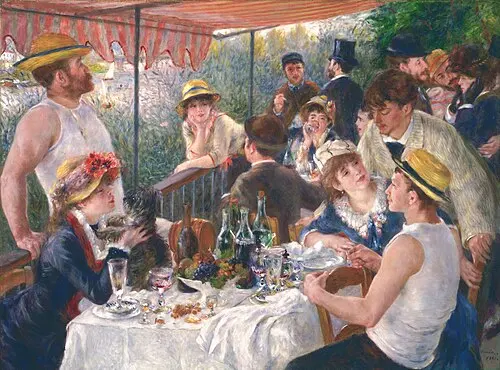
The painting, completed in 1881, stands as the pinnacle of Renoir’s early career and a landmark of the Impressionist movement. It depicts a group of friends relaxing on the balcony of the Maison Fournaise restaurant in Chatou, overlooking the Seine. The work is celebrated for its intricate composition, which balances a large number of figures while maintaining a sense of spontaneous, informal intimacy.
By capturing the specific atmosphere of a Sunday afternoon, Renoir elevated a genre scene into a complex study of human interaction. The painting is famous because it perfectly encapsulates the "joie de vivre" associated with the Impressionist era. It remains a primary reference point for art historians studying the transition between traditional studio portraiture and the modern, light-filled aesthetic that defined the late 1800s.
How to analyze the composition of the painting
Analyzing this masterpiece requires looking beyond the surface to understand how Renoir structured the chaos of a social gathering. The painting uses a diagonal perspective to draw the viewer’s eye from the bottom left toward the background, creating a sense of depth. This technique allows the viewer to feel as though they are standing at the edge of the table, participating in the conversation.
When studying the canvas, pay attention to how Renoir organized the space:
- The foreground features still-life elements, such as glasses and fruit, which ground the viewer.
- The middle ground contains the main cluster of figures, each engaged in distinct social dynamics.
- The background provides a glimpse of the river and the railing, establishing the setting.
- The use of light, filtering through the striped awning, creates a dappled effect that unifies the disparate figures into a single, cohesive scene.
Who are the people in the painting?
The subjects of the painting were real individuals from Renoir’s social circle, which adds a layer of historical intrigue to the work. The woman playing with the dog in the foreground is Aline Charigot, a seamstress who later became Renoir’s wife. The man sitting backward on his chair is Gustave Caillebotte, a fellow painter and wealthy patron of the arts who was instrumental in supporting the Impressionist group.
Other notable figures include:
- Alphonse Fournaise Jr., the son of the restaurant owner, standing on the left.
- Alphonsine Fournaise, the daughter of the owner, leaning against the railing.
- Baron Raoul Barbier, a former cavalry officer, who is seen chatting with the women.
- Charles Ephrussi, a prominent art critic and collector, depicted in a top hat.
By including his own friends and acquaintances, Renoir transformed a generic scene into a personal record of his life and professional connections.
What techniques did Renoir use?
Renoir employed a sophisticated approach to color and brushwork that was revolutionary for the time. He utilized a vibrant palette, favoring warm tones to emphasize the sunlight and the relaxed mood of the afternoon. Unlike the rigid outlines of academic painting, his figures are defined by soft edges and fluid strokes, which give the impression of movement and breath.
Common techniques observed in the work include:
- Glazing: Applying thin, transparent layers of paint to create depth in the skin tones.
- Impasto: Using thick, textured paint on the tablecloth and glasses to capture the reflection of light.
- Color Contrast: Placing complementary colors next to each other to make the image appear more luminous.
- Soft Focus: Blurring the background details to ensure the viewer focuses on the facial expressions and interactions of the primary subjects.
Common mistakes when viewing Impressionist art
A frequent error when viewing this painting is focusing solely on the identity of the figures rather than the overall sensory experience. While knowing the subjects is interesting, the true genius lies in how the light interacts with the textures of the clothing and the glassware. Viewers often miss the subtle play of light on the wine glasses, which serves as a masterclass in capturing transparency and reflection.
Another mistake is assuming the scene was painted entirely on-site. While Renoir made sketches at the Maison Fournaise, the final large-scale composition was refined in his studio over several months. To fully appreciate the work, avoid these pitfalls:
- Do not stand too close; the brushwork is designed to be viewed from a distance where the colors blend optically.
- Do not ignore the negative space, as the empty areas of the balcony are essential for balancing the crowded table.
- Do not overlook the dog, as it serves as a focal point that connects the foreground figures to the rest of the group.
Key facts
- Pierre-Auguste Renoir painted Luncheon of the Boating Party in 1881.
- The painting features 14 distinct figures, including Renoir’s future wife, Aline Charigot.
- The setting is the Maison Fournaise, a restaurant located on the Seine River in Chatou, France.
- It is a quintessential example of Impressionism, focusing on the play of light and leisure.
- The artwork measures approximately 51 by 68 inches, making it one of Renoir’s largest compositions.
- To appreciate the work, observe how the diagonal composition guides your eye from the foreground table to the distant river view.
The bottom line
Luncheon of the Boating Party remains famous because it perfectly captures the spirit of French leisure during the late 19th century. By blending candid social interaction with masterful light effects, Renoir created a timeless snapshot of joy. Its large scale and complex composition demonstrate the artist's technical growth, securing its status as a landmark of Impressionist art that continues to captivate viewers in modern museums today.
People also ask
Where is the painting currently located?
The painting is housed in the The Phillips Collection in Washington, D.C. It was acquired by Duncan Phillips in 1923 and remains one of the museum's most prized possessions.
Who are the people depicted in the painting?
The figures include friends, patrons, and models of Renoir. Notable individuals include the restaurant owner's daughter, Louise-Alphonsine Fournaise, and the painter Gustave Caillebotte, who is seated in the foreground.
What techniques did Renoir use to create the atmosphere?
Renoir used loose, vibrant brushstrokes and a warm color palette to capture the feeling of a sunny afternoon. He balanced the light filtering through the awning with the darker tones of the clothing to create depth.
Why is the painting considered a transition in Renoir's style?
Around this time, Renoir began moving away from pure Impressionism toward a more structured, classical style. You can see this in the clearly defined forms of the figures compared to his earlier, blurrier works.
How can I identify a fake print of this painting?
Authentic prints will have high-resolution detail in the textures of the tablecloth and the glasses. Avoid versions where the colors appear muddy or where the distinct light patterns on the awning seem flat or overly dark.
What is the significance of the dog in the painting?
The small dog in the foreground adds a touch of domestic intimacy to the scene. It helps humanize the group and reinforces the casual, relaxed nature of the social gathering.
This answer was created with the help of AI research tools and reference sources. Spotted an error? Let us know — we correct mistakes quickly. See our editorial policy.