What is Raphael's most famous painting?
Short answer
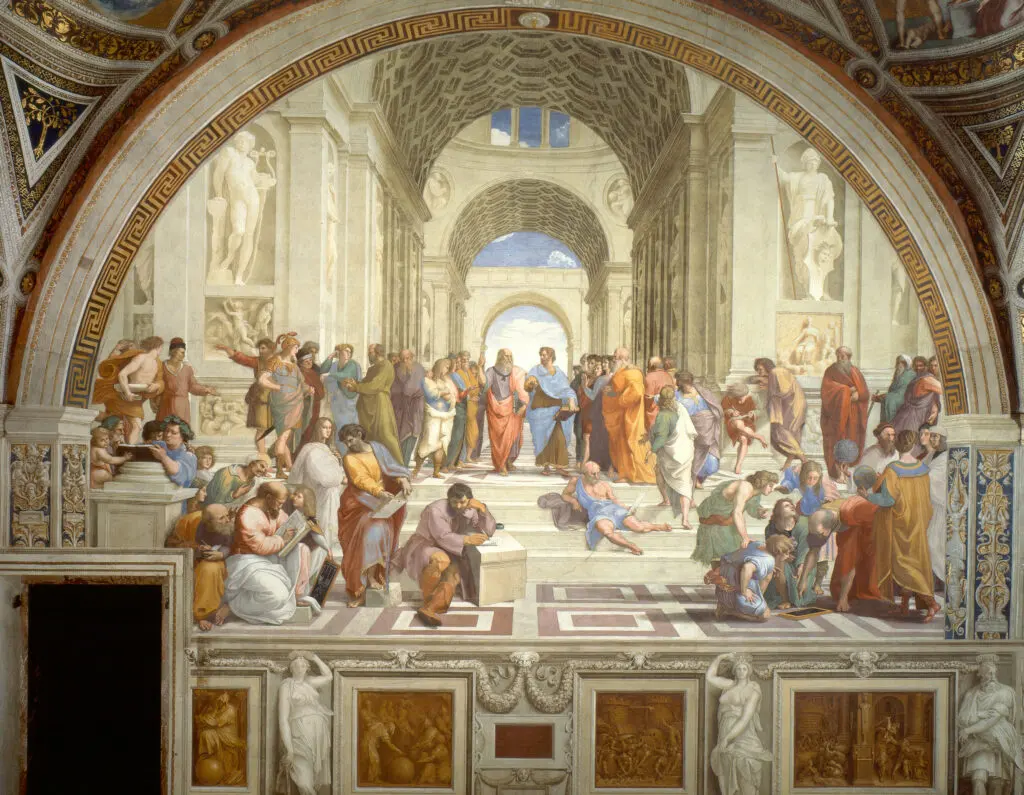
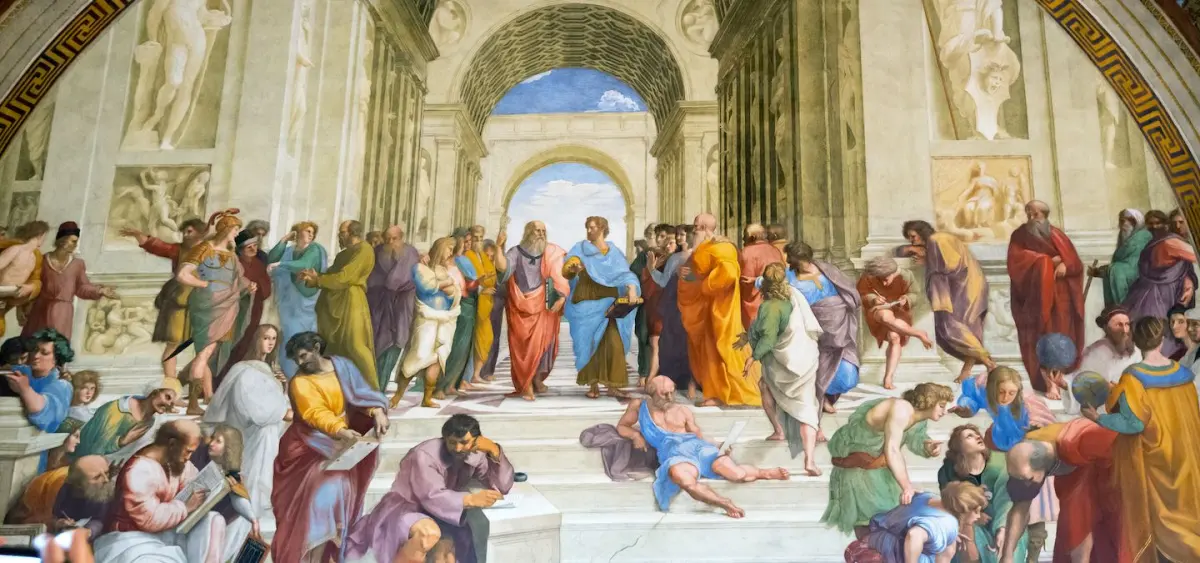
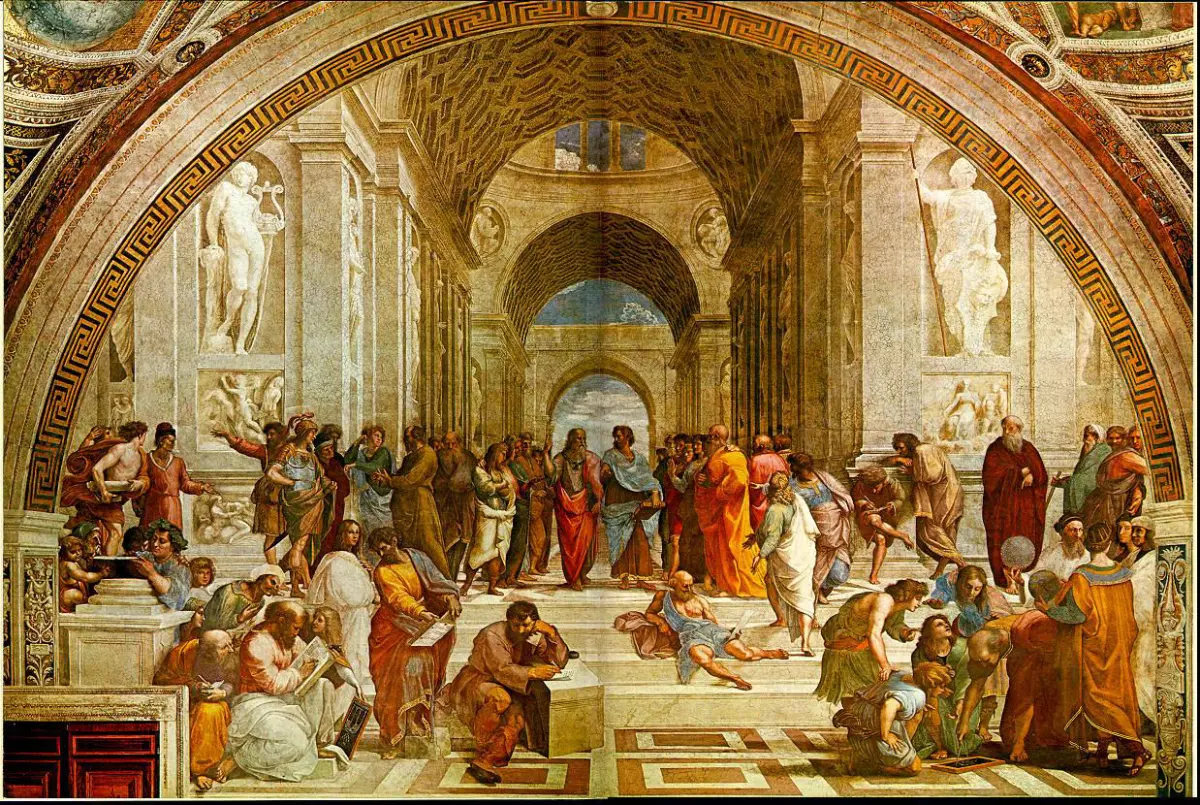
The School of Athens is widely considered Raphael’s most famous painting. Created between 1509 and 1511, this monumental fresco resides in the Vatican Museums. It masterfully depicts a gathering of history’s greatest philosophers, mathematicians, and scientists, serving as a quintessential embodiment of High Renaissance humanism, balance, and classical intellectual harmony.
On this page
Where can you see The School of Athens?
The School of Athens is located in the Apostolic Palace within the Vatican City, specifically inside the Stanza della Segnatura, which was once the private library of Pope Julius II. As part of a larger commission to decorate the papal apartments, Raphael was tasked with representing the four branches of human knowledge: philosophy, theology, poetry, and justice. This specific fresco represents philosophy, standing directly opposite the Disputa, which depicts the triumph of religion.
Visiting this site requires careful planning due to the immense crowds that visit the Vatican Museums daily. To view the painting in person, you must purchase tickets well in advance through the official Vatican website. Because the room is a protected historical space, visitors are often moved through the area relatively quickly by security staff. It is helpful to study the composition beforehand so you can identify the key figures immediately upon entering the room, as the fresco is massive, measuring approximately 16.5 by 25 feet.
Who are the figures in the painting?
Raphael populated the scene with ancient thinkers, but he famously modeled their faces after his own contemporaries. By doing this, he bridged the gap between the classical past and the Renaissance present, honoring the intellectual giants of antiquity while celebrating the creative minds of his own era. The central figures are Plato and Aristotle, who represent the two primary schools of thought regarding the nature of reality.
- Plato: Pointing upward to the heavens, representing his theory of forms and abstract philosophy.
- Aristotle: Holding his hand out toward the earth, representing his focus on empirical observation and physical reality.
- Euclid: Depicted with the likeness of architect Donato Bramante, shown bending down to draw a geometric proof.
- Heraclitus: A brooding figure sitting alone on the steps, widely believed to be a portrait of Michelangelo.
- Raphael himself: The artist included a self-portrait, appearing as a young man looking directly at the viewer from the far right edge.
Why is this painting a masterpiece?
The painting is celebrated for its perfect use of linear perspective, a technique that creates the illusion of deep, three-dimensional space on a flat wall. By using a single vanishing point located between the heads of Plato and Aristotle, Raphael draws the viewer’s eye directly into the heart of the debate. This mathematical precision reflects the Renaissance obsession with order, symmetry, and the rational organization of the natural world.
Beyond its technical geometry, the fresco is a triumph of color and composition. Each group of figures is arranged in a balanced, rhythmic flow that prevents the large scene from feeling cluttered or chaotic. The architectural setting, inspired by the designs for the new St. Peter’s Basilica, provides a grand, vaulted backdrop that elevates the status of the philosophers to that of divine beings. This harmony between human intellect and architectural grandeur remains the definitive visual statement of the High Renaissance period.
Common mistakes when analyzing Raphael’s work
One frequent error is assuming that the painting is a literal historical record of a specific meeting. In reality, the philosophers depicted lived in different centuries and locations, making such a gathering physically impossible. Raphael was not attempting to document history but was instead creating a conceptual space where disparate ideas could coexist. Viewers who look for historical accuracy often miss the symbolic, allegorical purpose of the work.
Another common mistake is ignoring the influence of other artists on Raphael’s development. While he was a master of his own style, he was deeply influenced by the works of Leonardo da Vinci and Michelangelo, who were working in Rome at the same time. To appreciate the painting fully, consider these steps:
- Compare the poses in the fresco to Michelangelo’s figures on the Sistine Chapel ceiling.
- Observe the soft, smoky light effects known as sfumato, which Raphael adopted from Leonardo.
- Look for the influence of ancient Roman sculpture in the drapery and physical proportions of the figures.
How to appreciate Renaissance art
To truly understand the significance of The School of Athens, one should look at the broader context of the High Renaissance. This period was defined by a revival of classical learning and a belief that human achievement could reflect divine perfection. When viewing Renaissance art, look for the "pyramidal composition," a technique where figures are arranged in a triangle to create stability and focus. This structure helps the viewer navigate complex scenes without feeling overwhelmed by the amount of detail.
If you are new to studying this era, start by focusing on the relationship between the artist and their patron. Raphael’s work was heavily dictated by the needs and political goals of the Catholic Church, which sought to position itself as the heir to the glory of the Roman Empire. By understanding that these paintings were meant to communicate power and wisdom, you can better interpret the symbols and themes present in the work. Take your time to look at the background details, as they often contain the most important clues about the artist's intent and the cultural values of the time.
Key facts
- Raphael’s most famous painting is widely considered to be The School of Athens, a monumental fresco located in the Vatican Museums.
- The work was commissioned by Pope Julius II between 1509 and 1511 to decorate the Stanza della Segnatura.
- It depicts a gathering of history's greatest philosophers, mathematicians, and scientists, including Plato and Aristotle at the center.
- Raphael included a self-portrait in the painting, placing himself among the group of astronomers on the far right.
- To view the painting in person, visit the Apostolic Palace in Vatican City; it is part of the standard tour route.
- Avoid visiting during peak midday hours if you want to study the details, as the room becomes extremely crowded with tourists.
The bottom line
The School of Athens stands as the definitive masterpiece of the High Renaissance, showcasing Raphael’s unparalleled mastery of perspective and composition. By organizing the greatest minds of antiquity within a grand architectural setting, he created a timeless tribute to human knowledge. For any visitor to the Vatican, this iconic work remains an essential stop, offering a profound glimpse into the intellectual spirit of the sixteenth century.
People also ask
Where exactly is The School of Athens located?
The fresco is housed in the Stanza della Segnatura, which is one of the four "Raphael Rooms" in the Vatican Museums. It remains in its original location on the wall where the artist painted it over 500 years ago.
Did Raphael paint himself into the scene?
Yes, Raphael included his own likeness in the bottom right corner of the fresco. He is depicted as a young man wearing a dark cap, looking directly toward the viewer.
Who are the two central figures in the painting?
The central figures are Plato, pointing upward toward the heavens, and Aristotle, gesturing toward the earth. This contrast represents the divide between idealistic philosophy and empirical, scientific observation.
How large is the original painting?
The fresco is massive, measuring approximately 20 feet by 26 feet. Its scale is designed to make the viewer feel as though they are stepping into the architectural space depicted in the work.
What painting technique did Raphael use?
He used the fresco technique, which involves painting directly onto wet lime plaster. This method requires the artist to work quickly before the plaster dries, ensuring the pigments bond permanently with the wall.
Why is this painting considered a masterpiece of the Renaissance?
It is celebrated for its perfect use of linear perspective, which creates a convincing illusion of three-dimensional depth. Furthermore, it symbolizes the harmony between classical Greek thought and Christian humanist ideals of the era.
This answer was created with the help of AI research tools and reference sources. Spotted an error? Let us know — we correct mistakes quickly. See our editorial policy.