What is Albert Bierstadt known for?
Short answer
Albert Bierstadt is best known for his monumental, romanticized oil paintings of the American West. A central figure of the Hudson River School, he utilized dramatic lighting and vast scales to capture the grandeur of the Rocky Mountains and Yosemite Valley, significantly shaping the 19th-century public perception of the American frontier.
On this page
What defined Albert Bierstadt’s artistic style?
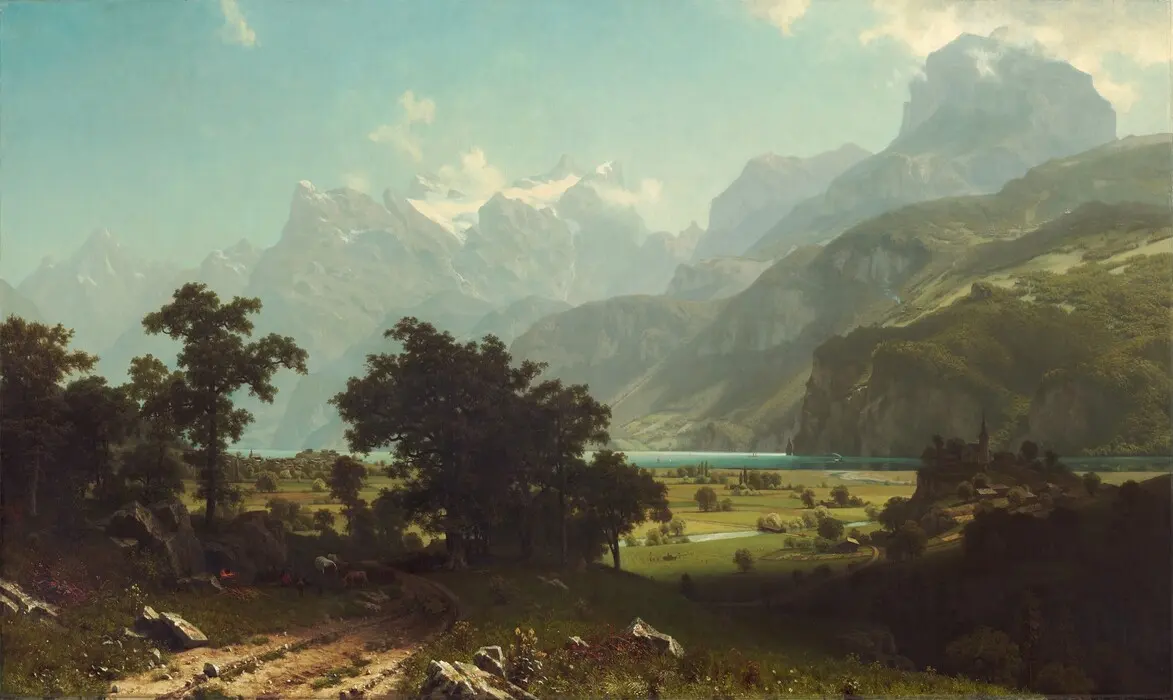
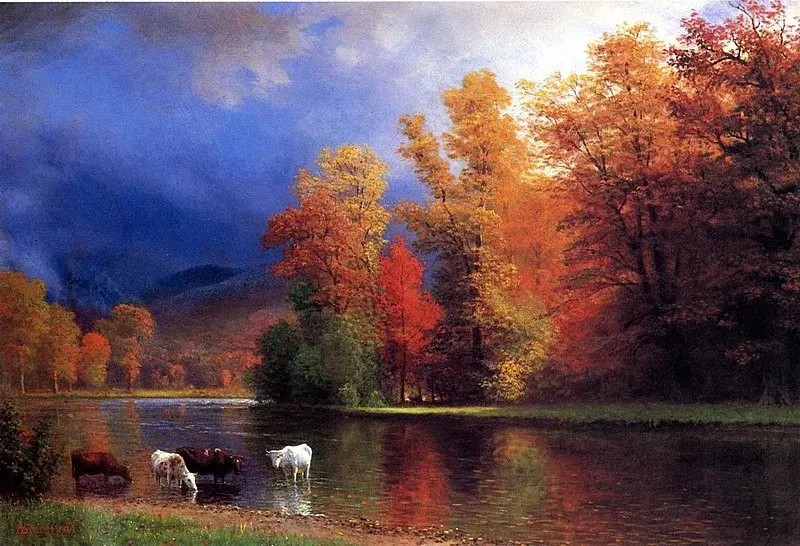
Bierstadt’s work is defined by the "Luminist" approach and his mastery of theatrical lighting. He frequently employed a technique known as chiaroscuro to create deep contrasts between shadowed valleys and sun-drenched, snow-capped peaks. By emphasizing the sheer scale of the landscape, he aimed to evoke a sense of awe and spiritual reverence in the viewer. His compositions often featured a low horizon line, which forced the audience to look upward, thereby magnifying the perceived height of the mountains.
His process involved meticulous preparation. During his travels, he would sketch extensively in pencil and oil, capturing specific geological formations and atmospheric conditions. Back in his studio, he synthesized these field studies into massive canvases, sometimes reaching ten feet in width. This blend of empirical observation and idealized romanticism became his signature, distinguishing him from his contemporaries who focused on more intimate, domestic scenes of the American landscape.
How did Bierstadt influence the American West?
Bierstadt’s paintings served as the primary visual introduction to the American West for many Easterners and Europeans. His depictions of the Rocky Mountains and the Sierra Nevada were so breathtaking that they helped fuel the national imagination regarding westward expansion. By presenting these regions as pristine, Edenic wildernesses, his work contributed to the cultural momentum that eventually led to the establishment of the National Park system.
His influence extended beyond aesthetics into the political and social spheres of the 1860s and 1870s. By romanticizing the frontier, he made the idea of settlement seem heroic and divinely ordained. However, his work often omitted the realities of conflict, such as the displacement of Indigenous peoples. His legacy remains a complex intersection of environmental advocacy and the myth-making that defined the American expansionist era. Key elements of his impact include:
- Generating widespread public interest in the preservation of Yosemite and Yellowstone.
- Establishing the "Western landscape" as a distinct and highly profitable genre in art history.
- Providing visual evidence that encouraged tourism and investment in the newly opened territories.
What are Bierstadt’s most famous paintings?
The artist produced hundreds of works, but a few stand out for their technical ambition and historical significance. These paintings were often exhibited as solo attractions, with audiences paying admission fees to view them in darkened rooms, enhancing the dramatic effect of the lighting.
- The Rocky Mountains, Lander's Peak (1863): This masterpiece brought him international fame and showcased his ability to render complex mountain textures.
- Among the Sierra Nevada, California (1868): A quintessential example of his idealized style, featuring a calm lake reflecting jagged, imposing peaks.
- Looking Down Yosemite Valley, California (1865): This work was instrumental in convincing Congress to protect the valley, as it served as a powerful visual argument for the area's natural beauty.
How to analyze a Bierstadt landscape painting?
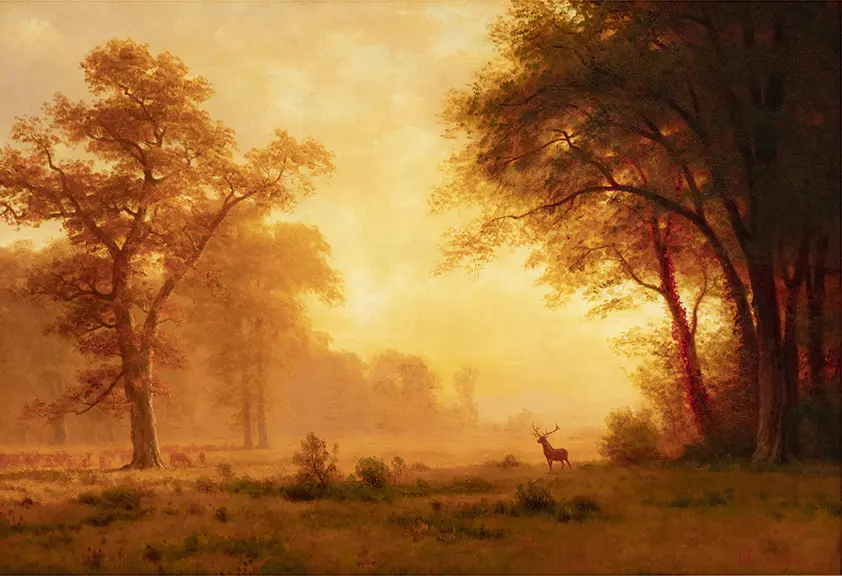
When viewing a Bierstadt painting, start by identifying the light source. He almost always placed the sun at a low angle, often breaking through clouds to create "god rays" that illuminate specific parts of the terrain. Notice how the foreground is typically dark and detailed, acting as a frame for the luminous, hazy distance. This use of atmospheric perspective creates a sense of immense depth that draws the eye deep into the canvas.
To better appreciate his work, consider the following steps:
- Identify the focal point: Look for the tallest peak or the most brightly lit area of the composition.
- Observe the scale: Look for tiny figures of humans or animals, which he included specifically to emphasize the massive proportions of the mountains.
- Evaluate the color palette: Note his transition from warm, golden tones in the sky to cool, blue-toned shadows in the crevasses.
- Check for historical accuracy: Ask yourself what details he might have exaggerated to heighten the emotional impact of the scene.
Common mistakes when studying Bierstadt’s work
A frequent error is assuming his paintings are literal photographic representations of the landscape. While he was a skilled draftsman, Bierstadt frequently moved mountains, altered river paths, and added dramatic weather effects to improve the composition. Viewing his work as a documentary record rather than a romanticized interpretation leads to a misunderstanding of his artistic intent. He was a storyteller, not a cartographer, and his primary goal was to inspire wonder rather than to provide a precise geological survey.
Another common mistake is ignoring the context of his studio production. Many viewers assume he painted these massive scenes on-site, but the logistical challenges of transporting canvases of that size across the frontier would have been impossible. Understanding that his finished works were carefully constructed studio compositions helps clarify why they feel so theatrical. By recognizing the difference between his spontaneous field sketches and his polished, public-facing masterpieces, you gain a clearer understanding of his technical brilliance and his role as a master of 19th-century American spectacle.
Key facts
- Albert Bierstadt was a German-American painter famous for his sweeping, epic-scale landscapes of the American West.
- He was a key member of the Hudson River School, a mid-19th-century group of artists inspired by the American wilderness.
- His canvases were often massive, sometimes reaching 10 by 15 feet, designed to immerse viewers in the grandeur of nature.
- He used a technique called "luminism," which emphasizes soft light and atmospheric effects to create a sense of awe and spiritual wonder.
- To appreciate his work, look for the minute details in the foreground contrasted against the dramatic, towering mountain peaks in the background.
- When viewing his paintings, avoid standing too close; step back several feet to allow the panoramic scale and light transitions to fully register.
The bottom line
Albert Bierstadt remains a towering figure in American art, celebrated for transforming the rugged Western frontier into a romanticized vision of paradise. By combining meticulous field sketches with dramatic, large-scale compositions, he captured the awe-inspiring scale of the American landscape. His work not only defined the Hudson River School’s late period but also fostered a national appreciation for wilderness that ultimately helped establish America’s majestic parks.
People also ask
Did Albert Bierstadt paint from life or memory?
Bierstadt traveled with geological survey expeditions, where he made small oil sketches and pencil drawings on-site. He later used these field studies as references to construct his large-scale, finished compositions in his studio.
Why are his paintings sometimes criticized?
Some critics argue that Bierstadt exaggerated the height and drama of mountain ranges to create a more theatrical effect. While his work was incredibly popular with the public, some contemporaries felt his focus on spectacle prioritized emotional impact over scientific accuracy.
Which American region did he focus on most?
He is best known for his depictions of the Rocky Mountains, the Sierra Nevada, and Yosemite Valley. These paintings were instrumental in shaping the American public's perception of the West as a majestic, untouched frontier.
How did his paintings influence national policy?
His breathtaking images of Yosemite and Yellowstone helped convince the United States government of the value of these landscapes. His art played a significant role in building public support for the creation of the National Park System.
What was the primary medium he used?
Bierstadt worked primarily with oil paints on canvas. He was known for his meticulous layering of glazes, which helped him achieve the glowing, ethereal quality of light that became his signature style.
Where can I see his paintings today?
Major collections of his work are housed at the Metropolitan Museum of Art in New York, the White House, and the Smithsonian American Art Museum. Many regional museums across the United States also hold significant examples of his Western landscapes.
This answer was created with the help of AI research tools and reference sources. Spotted an error? Let us know — we correct mistakes quickly. See our editorial policy.