What art style did Edward Hopper use?
Short answer
Edward Hopper is primarily associated with American Realism. His work captures the stark, lonely atmosphere of 20th-century urban and rural landscapes. While he rejected the label of "social realist," his paintings utilize precise light, shadow, and architectural geometry to evoke profound psychological isolation, setting him apart from his contemporaries in modern art.
On this page
What defines Edward Hopper’s art style?
Edward Hopper’s style is defined by a meticulous approach to American Realism, characterized by a focus on the mundane aspects of modern life. He often depicted empty streets, lonely diners, and quiet hotel rooms, stripping away excessive detail to highlight the underlying structure of a scene. His work is not merely a photographic representation of reality; it is a carefully curated vision that emphasizes solitude and the passage of time.
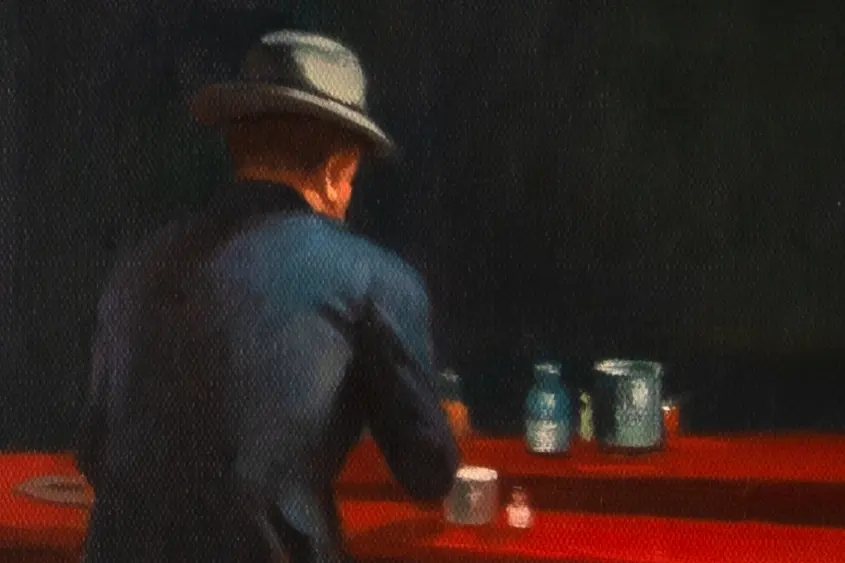
The hallmark of his aesthetic is the dramatic use of light and shadow, a technique he refined through his early work as an illustrator. By employing high-contrast lighting, he directed the viewer's eye toward specific architectural elements, creating a sense of theatrical staging. This technique transformed ordinary settings into stage-like environments where the human figures appear frozen in moments of introspection or waiting.
How to identify a Hopper painting
Identifying a Hopper painting involves looking for specific recurring themes and technical choices that define his visual language. His compositions are often sparse, featuring clean lines and geometric shapes that emphasize the starkness of the environment. He frequently utilized a muted color palette, occasionally punctuated by vibrant, artificial light sources that cast long, unsettling shadows across his subjects.
To recognize his work, look for these key visual indicators:
- Architectural precision: Buildings, windows, and doorways are rendered with rigid, clean lines.
- Emotional detachment: Human subjects rarely interact, appearing lost in their own private thoughts.
- Cinematic framing: Scenes often look like a still frame from a film, emphasizing a specific narrative moment.
- Urban and rural isolation: Whether in a bustling city or a desolate countryside, the subjects feel disconnected from their surroundings.
Why his work is categorized as American Realism
Hopper is categorized as an American Realist because he focused on depicting the authentic, unvarnished reality of the American experience during the early to mid-20th century. Unlike the abstract artists of his time who sought to deconstruct reality into shapes and colors, Hopper remained committed to recognizable subjects. He captured the industrialization of the country, the spread of the automobile, and the quiet loneliness inherent in modern urban living.
His commitment to realism was not about documenting social issues, but rather about capturing the psychological truth of his environment. He believed that the artist’s job was to project their own internal world onto the external landscape. By grounding his work in familiar, tangible settings, he made the abstract feeling of loneliness accessible and relatable to a wide audience, cementing his status as a pivotal figure in 20th-century American art.
![OC] Edward and Alphonse in the One Piece art style](/img/32/what-art-style-did-edward-hopper-use-2.webp)
Common mistakes when analyzing Hopper’s art
One common mistake when analyzing Hopper’s work is assuming that his paintings are direct social critiques of urban life or the Great Depression. While his settings often reflect the economic climate of the era, Hopper himself insisted that he was not interested in political commentary. Attributing a specific political agenda to his work often ignores the deeply personal and psychological motivations that drove his creative process.
Another error is over-interpreting the narrative of his paintings. Viewers often try to invent elaborate backstories for the figures in his work, such as the characters in Nighthawks. However, Hopper intentionally left his narratives ambiguous, refusing to provide clear answers about what his subjects were thinking or doing. To better understand his art, consider these steps:
- Focus on the light and shadow rather than the potential story.
- Observe how the architecture creates barriers between the figures and the viewer.
- Note the absence of clutter, which highlights the emptiness of the space.
How to appreciate the influence of light in his work
Hopper’s mastery of light is perhaps his most significant contribution to the development of modern art. He used light not just to illuminate a scene, but to define the mood and emotional weight of the composition. In many of his works, light acts as a physical presence, cutting through the darkness of an interior or highlighting the stark geometry of a building’s exterior. This manipulation of light creates a sense of stillness that forces the viewer to pause and reflect.
To truly appreciate this aspect of his style, one should look at how the light interacts with the surfaces in his paintings. Whether it is sunlight hitting the side of a Victorian house or the artificial glow of a gas station at night, the light is always deliberate and calculated. By focusing on these luminous details, you can begin to see how Hopper used technical skill to elevate everyday scenes into profound, timeless meditations on the human condition that continue to resonate with viewers today.
Key facts
- Edward Hopper is primarily classified as an American Realist painter, known for his depictions of modern American life.
- He utilized a technique called "cinematic composition," which often frames scenes like a still from a movie.
- Hopper’s signature style relies heavily on the dramatic use of light and shadow, known as chiaroscuro, to create psychological tension.
- His color palette frequently features bold, saturated colors contrasted against muted, neutral backgrounds.
- A common mistake when analyzing his work is interpreting his paintings as purely literal; they are often intended to evoke feelings of isolation or introspection.
- When attempting to emulate his style, focus on geometric shapes and clean lines rather than intricate, painterly details.
The bottom line
Edward Hopper’s style is defined by American Realism, characterized by his masterful manipulation of light, shadow, and architectural geometry. By stripping away unnecessary detail, he transformed ordinary urban and rural settings into profound meditations on human isolation. His work remains iconic for its cinematic quality and emotional resonance, proving that even the most mundane environments can convey deep psychological depth when viewed through a precise, observant lens.
People also ask
Did Edward Hopper belong to any specific art movement?
Hopper was associated with the Ashcan School early in his career, but he ultimately developed a distinct style of American Realism. He remained independent of the abstract movements that dominated the mid-20th century.
What was Hopper's most famous painting?
His most recognizable work is "Nighthawks," painted in 1942. It depicts four people in a downtown diner late at night, capturing a sense of urban loneliness.
Why are his paintings often described as "lonely"?
Hopper intentionally used empty spaces, glass windows, and solitary figures to suggest a disconnect between people. He focused on the quiet, mundane moments of life rather than social interaction.
Did Hopper paint outdoors or in a studio?
While he made sketches outdoors, he primarily painted in his studio in New York City. He often synthesized multiple sketches to create a single, idealized composition.
What medium did Hopper prefer to use?
Hopper was a master of oil on canvas, though he also produced a significant body of high-quality watercolor paintings. His watercolors often captured the architectural sunlight of New England.
How can I identify a Hopper painting?
Look for stark, artificial lighting, large windows, and a lack of clutter. His subjects are almost always captured in a moment of stillness or silent contemplation.
This answer was created with the help of AI research tools and reference sources. Spotted an error? Let us know — we correct mistakes quickly. See our editorial policy.