How do you draw closed eyes?
Short answer
Drawing closed eyes requires focusing on the gentle downward curve of the upper eyelid and the subtle fold of skin above it. By emphasizing the eyelashes and the slight protrusion of the eyeball beneath the lid, you create a realistic sense of peaceful rest rather than a flat, unnatural line.
On this page
How to draw the shape of closed eyes
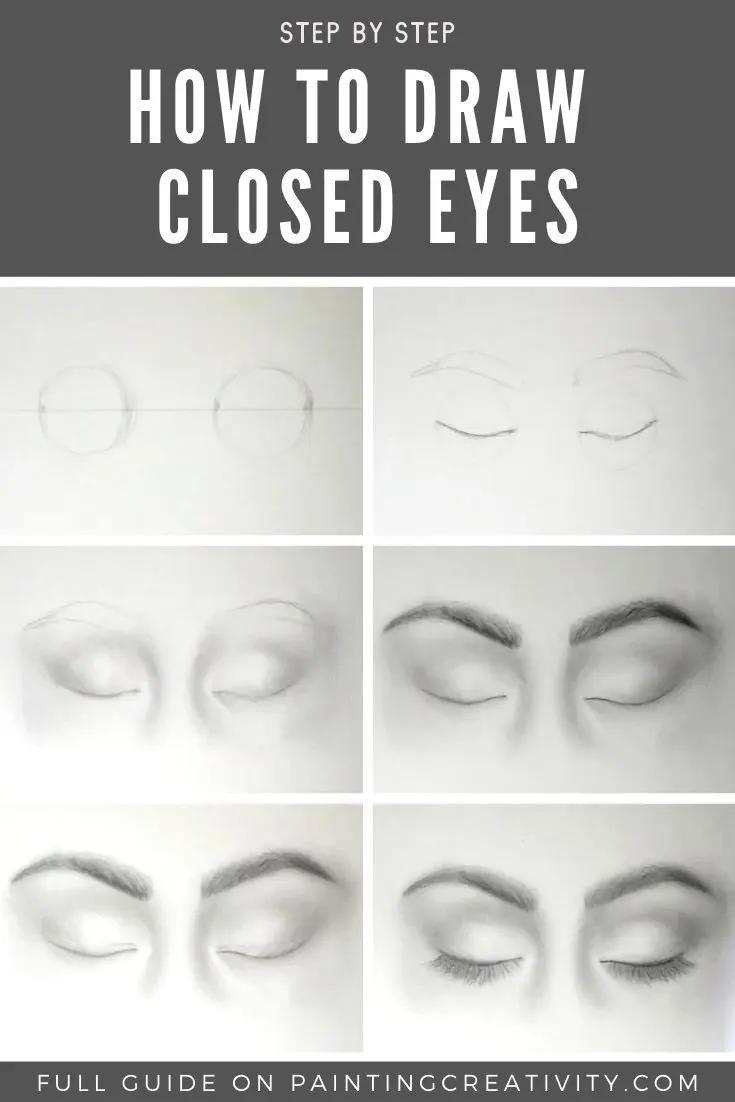
The primary challenge when drawing closed eyes is avoiding a simple, straight horizontal line, which often looks stiff or cartoonish. Instead, visualize the eye as a soft, elongated arch that follows the natural curvature of the skull’s eye socket. The highest point of this arch should be slightly toward the inner corner, mirroring the anatomy of an open eye.
When sketching, keep your lines light and fluid to suggest the delicate skin of the eyelid. Remember that the eyelid is a thin layer of tissue resting over a spherical eyeball. By adding a subtle, soft curve below the main lid line, you can imply the roundness of the eye underneath. This anatomical detail is crucial for moving away from two-dimensional symbols and toward a three-dimensional representation.
- Start with a light, horizontal guideline that curves slightly downward.
- Draw a gentle arc for the upper lash line, ensuring it is not perfectly flat.
- Add a soft, secondary line just below the lash line to suggest the thickness of the eyelid.
- Place a faint, curved line above the lash line to represent the crease of the eyelid.
Why closed eyes look unnatural
Many beginners struggle because they draw the eyelid as a perfectly symmetrical shape, ignoring the specific mechanics of how skin folds when the eye is shut. In reality, the upper eyelid is much larger than the lower one and covers the majority of the eye opening. If you draw the upper and lower lids meeting in the exact center, the eye will look forced or overly dramatic.
Another common issue is the placement of the eyelashes. When the eye is closed, the lashes do not point straight out; they point downward, often resting against the skin of the lower eyelid. Furthermore, the eyelashes should not be drawn as individual, perfectly spaced spikes. Instead, group them into small, irregular clusters to mimic the organic, overlapping nature of real hair. This variation in density and direction is what makes a drawing feel authentic rather than manufactured.
How to add depth and shading
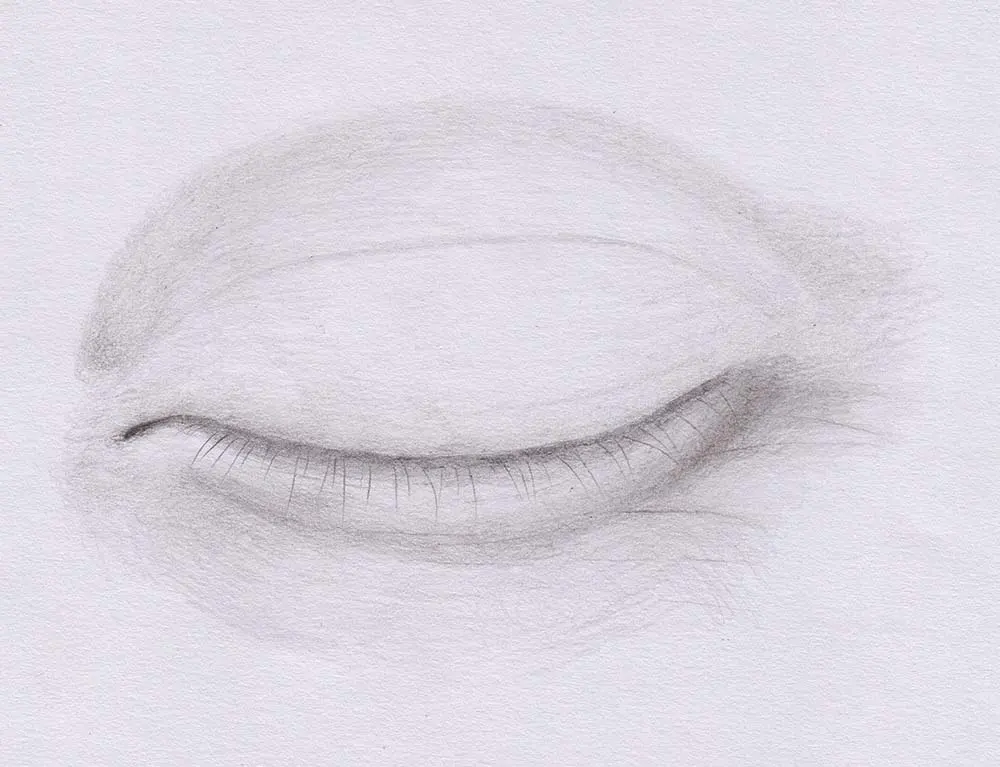
Shading is the most effective tool for transforming a flat sketch into a convincing, restful eye. Because the eyelid is a curved surface, it will have a highlight where light hits the apex of the curve and a shadow where the lid meets the lower socket. Use a soft graphite pencil or a blending stump to create smooth transitions between these tones.
Focus your shading on the area directly beneath the eyebrow and the crease of the eyelid. These areas naturally recede, so darkening them helps push the eye back into the skull. Conversely, the center of the eyelid should remain relatively light to emphasize its protrusion. By carefully managing these values, you give the viewer a sense of volume and weight, making the closed eye appear as if it is truly resting in the orbital cavity.
- Use a 2B pencil for initial sketching to ensure lines are easily erasable.
- Apply a 4B or 6B pencil for darker shadows in the crease and lash line.
- Utilize a kneaded eraser to lift graphite and create highlights on the eyelid.
- Maintain a sharp point on your pencils for detailing the fine tips of the lashes.
Common mistakes when drawing closed eyes
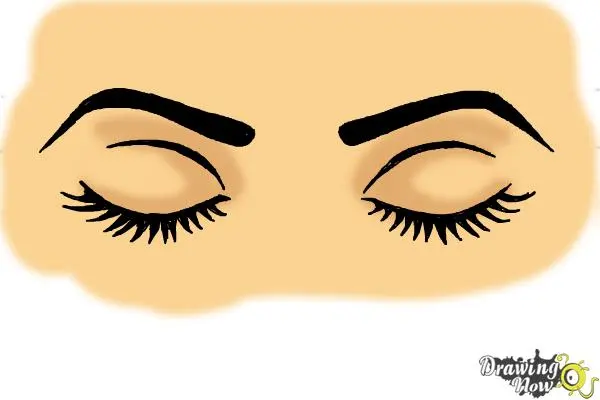
One frequent error is drawing the eyelid crease too high or too low, which can distort the proportions of the entire face. The crease should generally follow the same curve as the lash line, sitting about one-third of the way between the lash line and the eyebrow. If the crease is too high, the eye will appear surprised or hollow; if it is too low, the eye will look swollen or heavy.
Another mistake is neglecting the inner and outer corners of the eye. Even when closed, the tear duct—a small, fleshy nub—remains visible at the inner corner. Failing to include this detail makes the eye look like a simple slit. Additionally, avoid making the outer corner too pointed. The skin at the outer edge of the eye often bunches up slightly, creating a small, soft fold that adds a realistic, lived-in quality to the drawing.
Best techniques for realistic eyelashes
The appearance of eyelashes is defined by their base, which is thicker than the tips. When drawing them on a closed eye, start your stroke at the lash line and flick the pencil outward and downward with a quick, light motion. This creates a natural taper, starting with a thicker base and ending in a fine, delicate point. Avoid drawing long, uniform lines that look like spider legs.
Vary the length and angle of each lash to prevent a uniform, artificial look. Real eyelashes grow in multiple rows and overlap, so it is perfectly acceptable for some lashes to cross over others. By layering these strokes and keeping them slightly irregular, you capture the soft, feathery texture of natural lashes. Remember that the lashes on the outer corner of the eye are typically longer and more curved than those near the inner corner, providing a subtle gradient of length across the lid.
Key facts
- Draw a gentle, downward-curving arc to represent the upper eyelid, which holds the most weight in the expression.
- Place the eyelashes along the outer edge of this arc, angling them downward rather than outward.
- Add a subtle, shorter curve beneath the main arc to suggest the fullness of the lower eyelid.
- Ensure the distance between the eyebrow and the closed eye is slightly wider than it would be for an open eye.
- Use a soft, thin line for the crease of the eyelid to indicate the skin folding over the closed lid.
- Avoid drawing a perfectly straight line, as the natural curvature of the eyeball underneath creates a soft, rounded shape.
The bottom line
Drawing closed eyes is an exercise in capturing subtle curves rather than complex anatomical structures. By focusing on the gentle arc of the upper lid, the downward direction of the lashes, and the soft shadow of the crease, you can create a convincing sense of rest. Remember that simplicity is your greatest tool; avoid overworking the lines to maintain a natural, serene expression in your portraiture.
People also ask
Should I include eyelashes when drawing closed eyes?
Yes, eyelashes are essential for realism. Draw them as small, tapered strokes that curve downward from the edge of the upper eyelid.
How do I show that someone is sleeping versus just blinking?
Sleeping eyes usually have a softer, more relaxed curve and may show a slight indentation for the crease. Blinking eyes often feature a sharper, more tense arc and less visible eyelid skin.
Where should the eyebrow be positioned?
The eyebrow should sit slightly lower than it would for an open eye, as the muscles around the eye relax. This creates a more peaceful or resting appearance.
Can I use shading to make the eyes look more three-dimensional?
Shading is crucial for depth. Apply a soft shadow under the upper eyelid and along the lower lid to suggest the roundness of the eyeball beneath the skin.
Why do my closed eyes look like they are frowning?
This often happens if the arc is too steep or the outer corner is pulled too far down. Keep the curve gentle and ensure the inner corner remains slightly higher than the outer corner.
How much detail should I put into the eyelid crease?
Use a single, delicate line to represent the crease. Too much detail can make the eye look aged or tired, so keep the line clean and minimal.
This answer was created with the help of AI research tools and reference sources. Spotted an error? Let us know — we correct mistakes quickly. See our editorial policy.
![How To Draw Eyes In 7 Easy Steps [Video + ]](/img/8e/how-do-you-draw-eyes-1.webp)