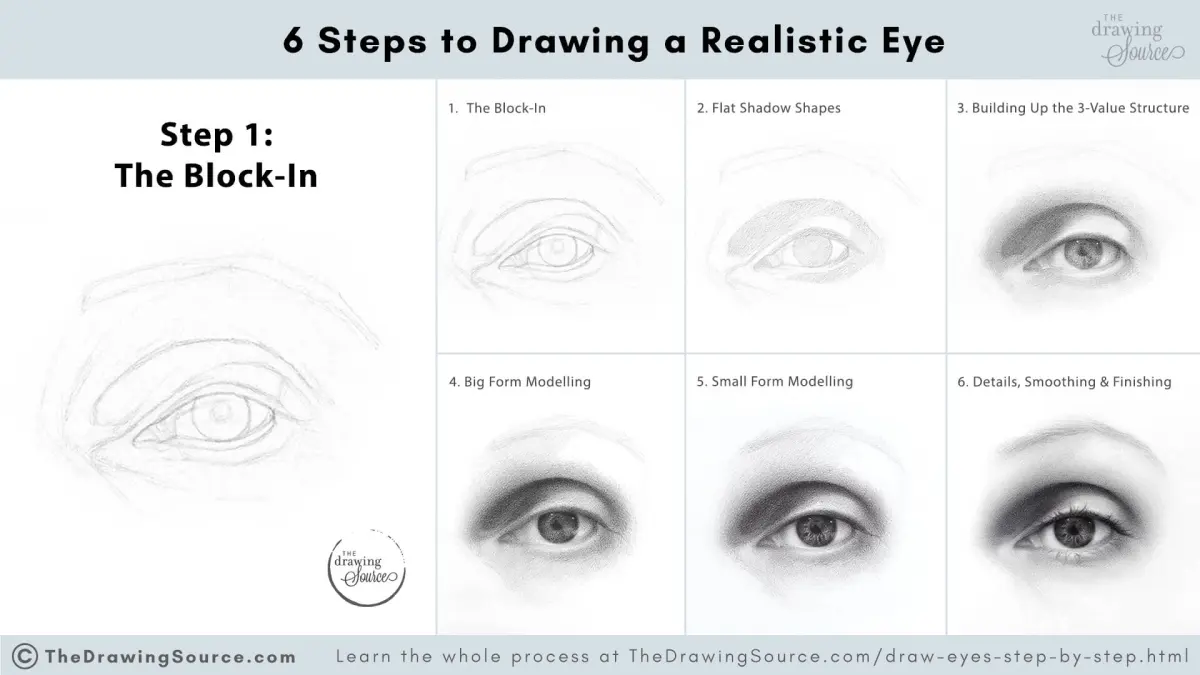
How do you draw eyes?
Short answer
Drawing eyes requires understanding the eyeball as a sphere resting within a bony socket. Start by sketching a simple almond shape, then place the circular iris and pupil centrally. By layering shadows around the eyelids and adding a sharp highlight to the pupil, you create depth, realism, and a sense of life.
![How To Draw Eyes In 7 Easy Steps [Video + ]](/img/8e/how-do-you-draw-eyes-1.webp)
On this page
How to draw an eye step by step
To begin, draw a horizontal guideline to ensure the eye is balanced. Sketch an almond shape, keeping in mind that the upper eyelid usually covers a portion of the iris. Place a perfect circle for the iris in the center, ensuring the pupil is positioned directly in the middle of that circle. Avoid drawing the iris as a floating shape; it must touch or slightly overlap the upper eyelid to look natural.
Once the basic structure is established, add the thickness of the eyelids by drawing a secondary line along the edges of the almond shape. This detail is crucial because eyelids have physical volume. Finally, add the tear duct at the inner corner and define the lash line. Use these steps to maintain accuracy:
- Sketch a light circle to represent the eyeball's placement.
- Draw the almond-shaped lid over the circle.
- Place the iris and pupil, ensuring they are centered.
- Add the upper and lower eyelid thickness.
- Include the caruncle, the small pinkish bump at the inner corner.
Why eyes look flat in drawings
Many beginners struggle with flatness because they treat the eye as a two-dimensional sticker on a flat surface. In reality, the eyeball is a sphere, and the eyelids wrap around that sphere like a blanket. If you fail to shade the corners of the eye or ignore the shadow cast by the upper eyelid, the eye will lack the necessary volume to look three-dimensional.
To fix this, observe how light hits the eyeball. The sclera, or the white part of the eye, is rarely pure white. It is curved, meaning one side is usually in shadow while the other catches the light. By applying subtle gradients across the sclera, you mimic the curvature of a sphere. Remember that the upper eyelid casts a soft shadow onto the iris and the sclera, which immediately pushes the eye back into the socket and creates a realistic sense of depth.
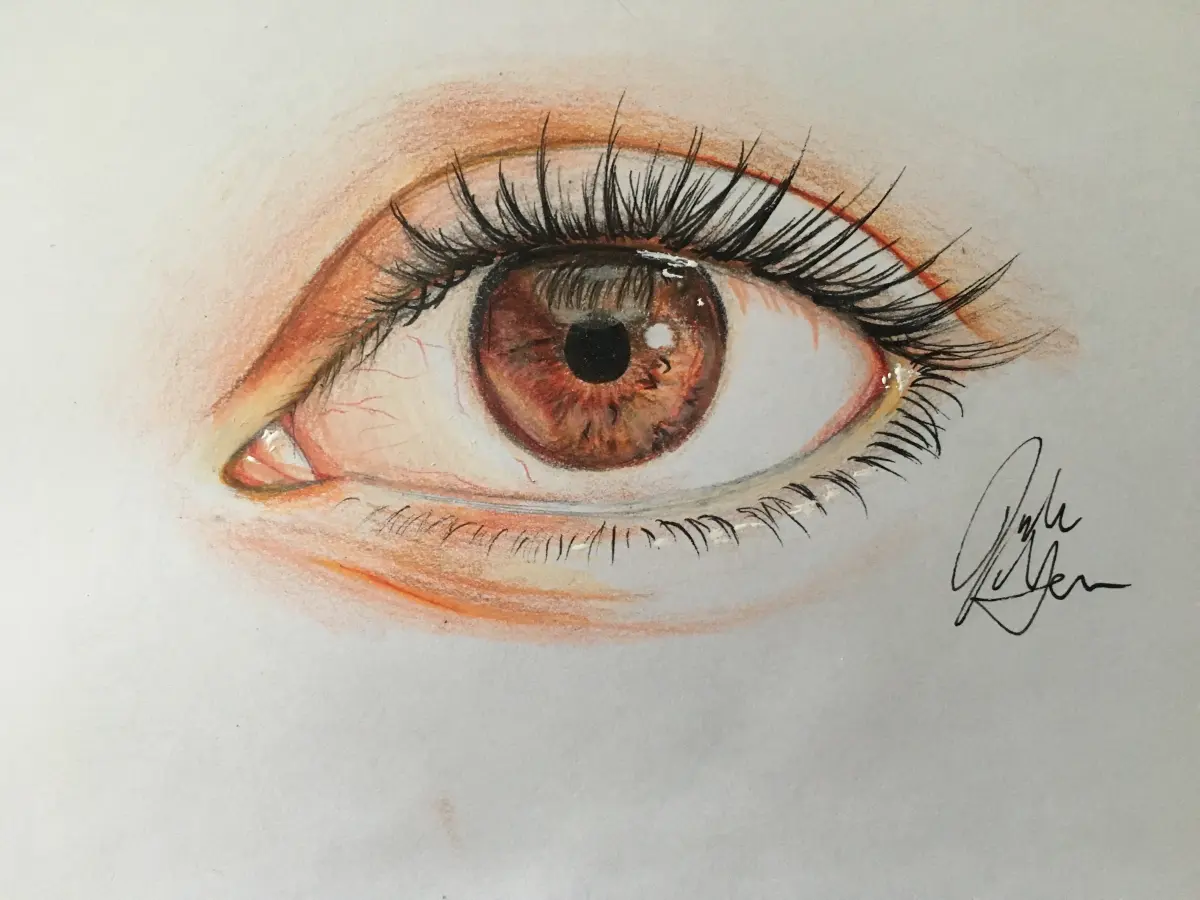
Best tools for drawing eyes
For beginners, a set of graphite pencils ranging from 2H to 6B is ideal. Use the harder 2H pencil for initial light sketches and guidelines, as these lines are easy to erase. The softer 6B pencil is perfect for the deep, dark values found in the pupil and the thickest parts of the eyelashes. A kneaded eraser is also essential, as it allows you to lift graphite gently to create the crisp highlights on the iris.
Paper choice also impacts the final result. A medium-tooth drawing paper provides enough texture to hold multiple layers of graphite, allowing for smooth transitions between light and shadow. Avoid overly smooth printer paper, as it can become "slick" after a few layers, making it difficult to add darker tones. When working on details like eyelashes, use a sharp lead or a mechanical pencil to achieve thin, tapered lines that mimic the natural growth pattern of hair.
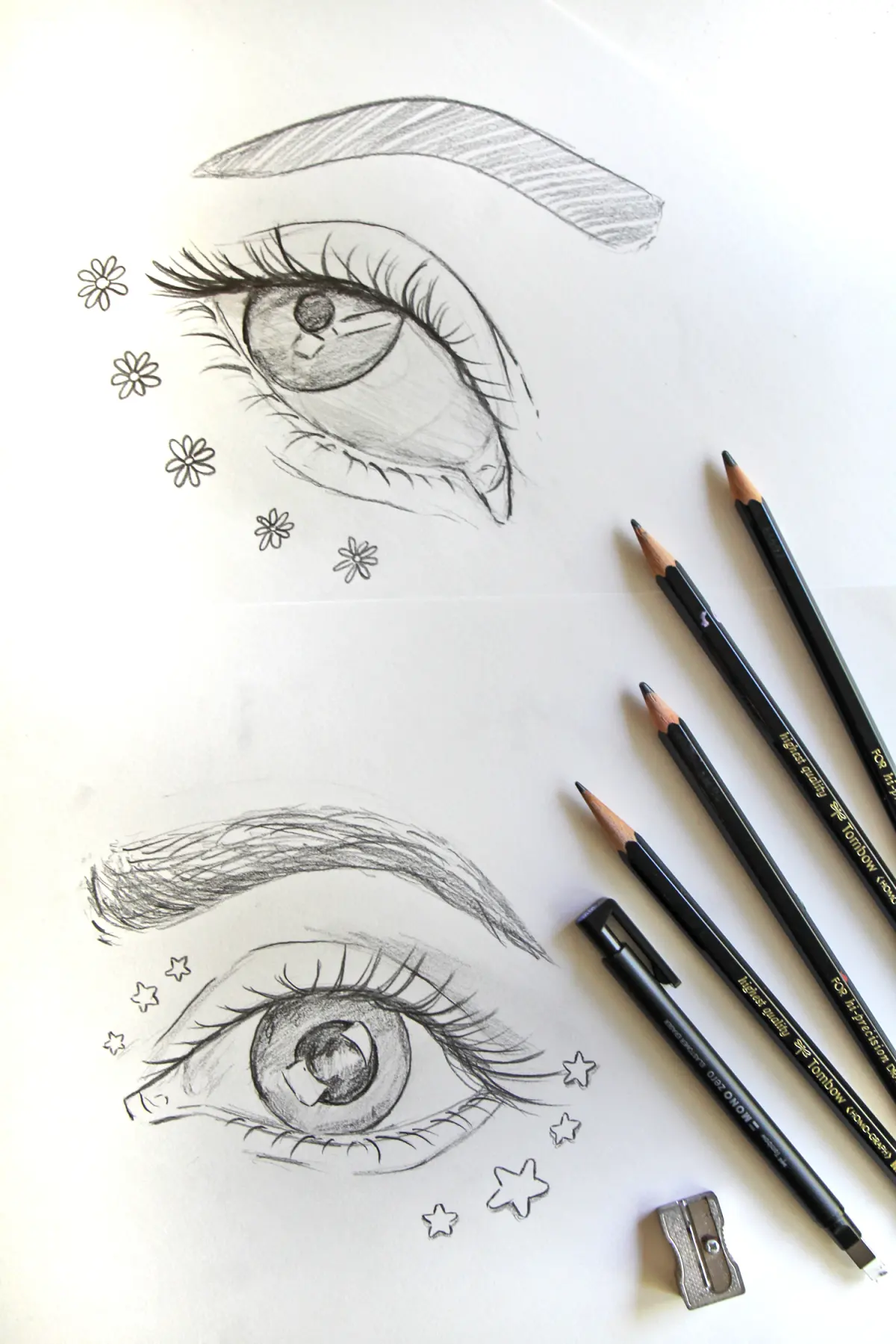
Common mistakes when drawing eyes
One of the most frequent errors is drawing the iris as a perfect, isolated circle that does not interact with the eyelids. This creates a "surprised" or "wide-eyed" look that feels unnatural. Another common mistake is placing the pupil off-center or making the eyelashes look like rigid, straight spikes growing out of the skin. Eyelashes should curve naturally and vary in length, often clumping together slightly rather than standing in a perfect, uniform row.
Additionally, many artists forget to include the "waterline," the thin strip of skin between the eye and the lower lashes. Neglecting this detail makes the eye appear as if it is missing a physical connection to the face. To avoid these pitfalls, keep these tips in mind:
- Avoid making the iris perfectly symmetrical; it should be partially obscured by the upper lid.
- Do not draw lashes as straight lines; curve them according to the eyelid's perspective.
- Always include a highlight in the pupil to represent the light source, which adds a "sparkle" or life to the gaze.
- Ensure the tear duct is placed correctly at the inner corner, as it provides the necessary anatomical anchor.
How to add realistic detail to eyes
Refining an eye involves focusing on the textures within the iris and the subtle skin folds around the lid. The iris is not a flat color; it is composed of intricate, radial fibers that extend from the pupil to the outer edge. Use short, flicking pencil strokes to mimic these fibers, varying the pressure to create light and dark variations. This texture prevents the iris from looking like a flat, colored disc.
Finally, pay attention to the skin surrounding the eye. The lower eyelid often has a small crease, and the upper eyelid has a fold that defines the eye socket. Lightly shading these areas helps the eye sit correctly within the skull. By adding these final, subtle details, you move beyond a simple diagram and create a portrait-quality eye. Observe real-life references to see how skin folds differently depending on whether the subject is looking up, down, or straight ahead, as these movements change the entire geometry of the eye.
Key facts
- The human eye is shaped like a sphere, meaning the eyelid must curve around a rounded eyeball rather than sitting flat.
- A standard eye is roughly one "eye-width" apart from the other, with the distance between them equal to the width of one eye.
- The iris is rarely a perfect circle; it is usually partially obscured by the upper eyelid, which creates a sense of natural expression.
- Highlights on the pupil should always be placed on the same side of both eyes to maintain a consistent light source.
- The tear duct is a small, triangular shape located at the inner corner of the eye, sitting slightly lower than the outer corner.
- Eyelashes grow from the outer edge of the eyelid rim, not from the waterline itself, and they typically curve upward on the top lid.
The bottom line
Drawing realistic eyes requires understanding the underlying spherical anatomy of the eyeball and the way eyelids drape over that curve. By mastering the placement of the iris, the consistency of light reflections, and the subtle shadows cast by the brow, you can create expressive portraits. Practice observing the negative space between the eyelids to capture the unique shape and character of the human gaze effectively.
People also ask
How do you draw eyes that look symmetrical?
Use light guidelines to mark the horizontal placement of both eyes before adding detail. By checking the distance between the inner corners, you can ensure they are properly aligned on the head.
Why do my eyes look flat when I draw them?
Flatness usually occurs because the eyelids are drawn as straight lines rather than curves. Remember to shade the eyeball itself, as the sphere creates shadows under the brow and toward the corners.
How much of the iris should be visible?
In a neutral expression, the upper lid covers the top portion of the iris, while the lower lid typically touches the bottom edge. If you show the entire iris, the subject will look surprised or startled.
What is the best way to draw the pupil?
Always use the darkest value for the pupil to create depth. Ensure it is perfectly centered within the iris unless the subject is looking in a specific direction.
How do I make eyes look realistic?
Focus on the reflection of light, known as the catchlight, which is usually a small white shape on the pupil or iris. Adding subtle shadows on the white of the eye, or sclera, also adds volume.
Should I draw every individual eyelash?
Avoid drawing each lash as a straight line, as this looks unnatural. Instead, group lashes into small clusters and vary their length and thickness to create a more organic, flowing appearance.
This answer was created with the help of AI research tools and reference sources. Spotted an error? Let us know — we correct mistakes quickly. See our editorial policy.