What is Salvador Dalí's most famous painting?
Short answer
The Persistence of Memory, painted in 1931, is Salvador Dalí’s most famous work. This iconic surrealist masterpiece features melting clocks draped over a barren landscape. Housed in the Museum of Modern Art in New York City, it remains the definitive symbol of Dalí’s exploration of time, dreams, and the subconscious mind.
On this page
What is The Persistence of Memory?
The Persistence of Memory is a small oil-on-canvas painting measuring only 9.5 by 13 inches. Despite its modest size, it is widely considered the quintessential image of the Surrealist movement. The composition depicts a desolate, dreamlike landscape featuring a strange, flesh-like creature in the center and several clocks that appear to be melting or drooping. These "soft watches" challenge the rigidity of time, suggesting that time is fluid and subjective rather than a fixed, mechanical constant.
Dalí claimed that the inspiration for the melting clocks came to him after observing a piece of Camembert cheese melting in the sun. This anecdote highlights his "paranoiac-critical method," a technique he used to access his subconscious by inducing a state of self-hallucination. By juxtaposing everyday objects with impossible, distorted forms, Dalí forces the viewer to question their perception of reality. The stark contrast between the warm, golden light of the background and the cool, dark foreground enhances the painting’s eerie, otherworldly atmosphere.
How to interpret Salvador Dalí’s symbolism
To understand the deeper meaning behind Dalí’s work, one must look at the recurring motifs he used throughout his career. The melting clocks represent the collapse of the cosmic order and the irrelevance of human-made time in the face of eternity. The central figure, often interpreted as a self-portrait, appears asleep or in a state of decay, reinforcing the idea that the painting is a dreamscape.
When analyzing the painting, consider these key elements:
- The Ants: Often symbols of decay and mortality in Dalí’s work.
- The Landscape: Based on the cliffs of Cap de Creus in his native Catalonia.
- The Mirror: Representing the reflection of the subconscious mind.
- The Dead Tree: Symbolizing the barrenness of the desert of the mind.
By breaking down these components, you can begin to see how Dalí constructed a visual language that bypasses logic to speak directly to the viewer's anxieties and desires.

Where can you see the painting today?
The Persistence of Memory has been part of the permanent collection at the Museum of Modern Art (MoMA) in New York City since 1934. It was donated by an anonymous benefactor and has since become one of the most visited objects in the museum. Because the painting is relatively small, it is often displayed in a prominent position within the gallery to ensure that visitors can appreciate the intricate brushwork and the subtle transitions of color.
If you are planning a trip to see the painting, follow these steps to maximize your experience:
- Check the MoMA website in advance to confirm the painting is not currently on loan.
- Arrive at the museum shortly after opening to avoid the largest crowds.
- Locate the painting in the fifth-floor galleries, which house the museum's core collection of modern art.
- Spend at least ten minutes observing the painting from different angles to appreciate the depth of the landscape.
Why did Dalí paint melting clocks?
Dalí’s obsession with time was deeply rooted in his interest in the theories of Albert Einstein and the new physics of the early 20th century. While Dalí famously denied that the painting was a direct illustration of the theory of relativity, he acknowledged that the concept of time as a flexible, relative dimension fascinated him. He wanted to depict the "softness" of the world as it exists in the mind, rather than the "hardness" of the physical reality we experience while awake.
This approach was a direct rebellion against the rationalism that had dominated art and science for centuries. By painting objects that defied the laws of physics, Dalí sought to liberate the human imagination from the constraints of logic. He believed that the subconscious was the only true source of creativity, and his work served as a window into that hidden, chaotic, and often unsettling world of dreams and repressed memories.
Common mistakes when studying surrealist art
Many people approach surrealism expecting to find a literal, coded message that can be solved like a math problem. A common mistake is assuming that every object in the painting has a specific, dictionary-defined meaning. In reality, Dalí intended for his work to be ambiguous and open to interpretation. He wanted the viewer to feel the discomfort of the dream, not just to analyze its components.
Another frequent error is ignoring the technical skill required to execute these works. Because the subject matter is so bizarre, viewers often overlook the fact that Dalí was a classically trained painter with incredible technical precision. He utilized Renaissance-era techniques, such as glazing and fine brushwork, to make his impossible visions appear as realistic as a photograph. To truly appreciate his genius, you must look past the strange imagery and observe how he used light, shadow, and perspective to anchor his surrealist visions in a convincing, tactile reality that feels as though it could exist.
Key facts
- The painting is officially titled The Persistence of Memory, created in 1931.
- It is a small work, measuring approximately 9.5 by 13 inches (24 by 33 cm).
- The iconic melting clocks symbolize the relativity of space and time.
- The painting has been part of the Museum of Modern Art (MoMA) collection in New York City since 1934.
- Dalí used his "paranoiac-critical method" to access his subconscious and create the dreamlike landscape.
- When viewing the work, look for the central, distorted creature, which is a self-portrait of the artist.
The bottom line
The Persistence of Memory remains the definitive masterpiece of Surrealism, capturing the movement’s obsession with dream logic and the subconscious. By distorting rigid objects like clocks against a desolate, timeless landscape, Dalí challenged the viewer's perception of reality. Whether viewed as a critique of scientific precision or a personal psychological exploration, the painting continues to define Dalí’s legacy as a visionary of the twentieth-century art world.
People also ask
Where can I see The Persistence of Memory in person?
The painting is housed at the Museum of Modern Art (MoMA) in Midtown Manhattan. It is frequently displayed in the museum’s permanent collection galleries on the fifth floor.
What inspired the melting clocks in the painting?
Dalí famously claimed the inspiration came from watching a piece of Camembert cheese melting in the sun. He used this observation to challenge the rigidity of mechanical time.
Are there other versions of this painting?
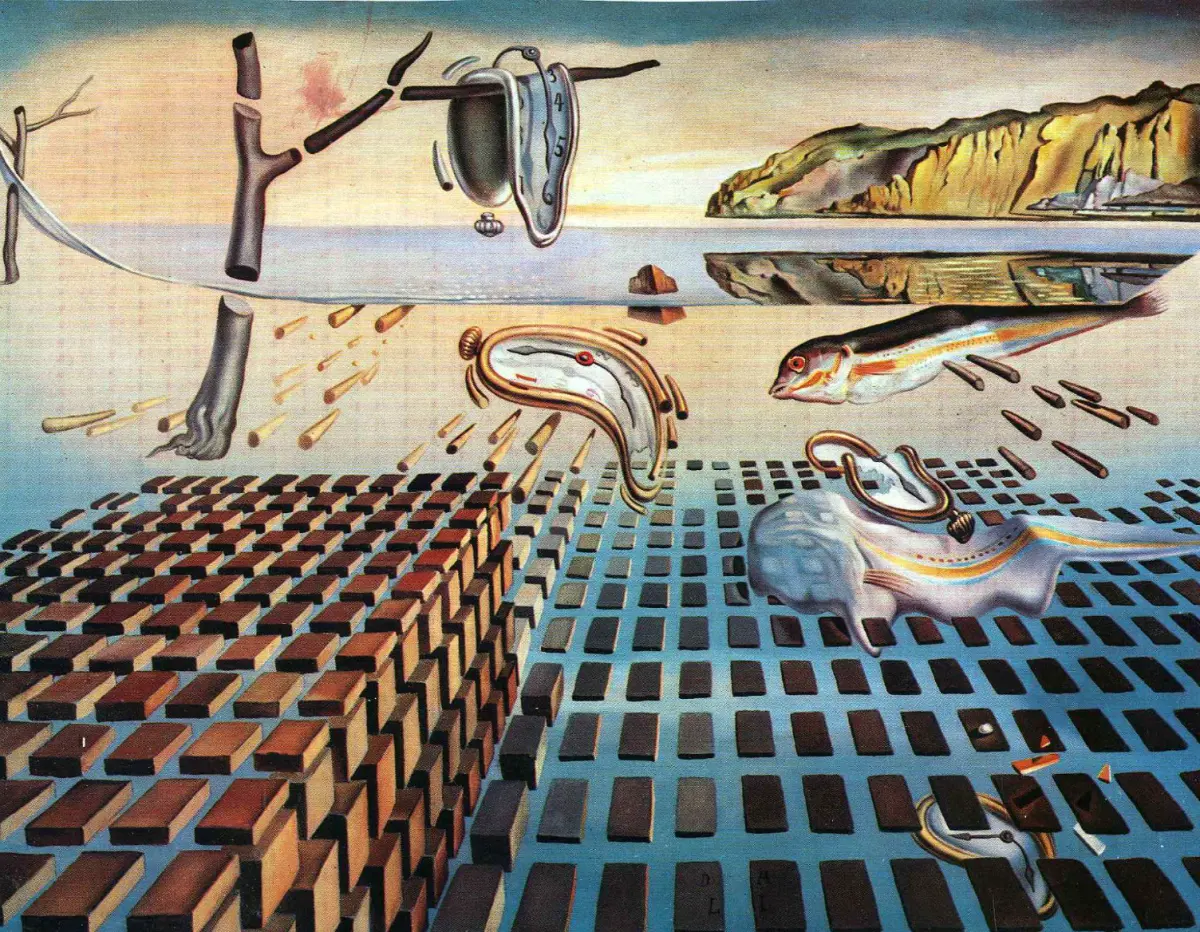
Yes, Dalí revisited the theme in 1954 with a work titled The Disintegration of the Persistence of Memory. This later version depicts the landscape submerged in water and fractured into geometric blocks.
What is the significance of the ants in the painting?
In Dalí’s iconography, ants represent decay, decomposition, and the transience of life. They appear on the orange clock in the bottom left of the composition.
Is the landscape based on a real place?
The background depicts the cliffs of Cape Creus in Catalonia, Spain. Dalí lived in this region for much of his life and often used its jagged coastline as a backdrop for his surrealist works.
How should I interpret the meaning of the painting?
Surrealists aimed to bypass rational thought, so there is no single "correct" interpretation. Most critics view it as a meditation on the fluidity of time and the subjective nature of human perception.
This answer was created with the help of AI research tools and reference sources. Spotted an error? Let us know — we correct mistakes quickly. See our editorial policy.