Why is The Elephants by Dalí so famous?
Short answer
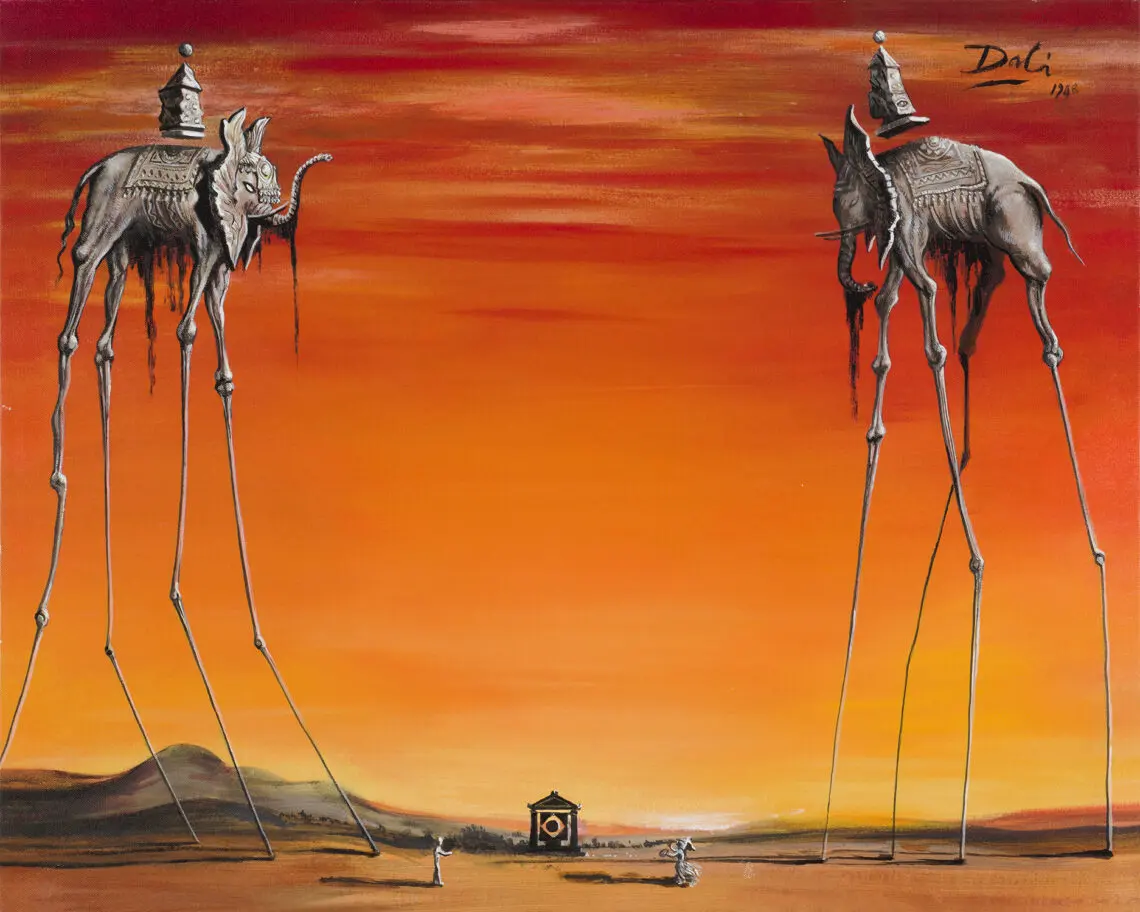
The Elephants, painted by Salvador Dalí in 1948, is famous for its iconic juxtaposition of fragile, spindly-legged creatures against a vast, desolate landscape. It exemplifies Surrealist dream logic, challenging perceptions of gravity and stability. The work remains a quintessential representation of Dalí’s obsession with metamorphosis, weight, and the subconscious mind.
On this page
Why is The Elephants so famous?
Salvador Dalí’s The Elephants is celebrated primarily because it masterfully distorts the physical laws of nature to evoke a sense of profound unease. By depicting massive, heavy beasts balanced on impossibly thin, insect-like legs, Dalí forces the viewer to confront the fragility of power and the absurdity of reality. This visual contradiction is a hallmark of Surrealist art, which seeks to bridge the gap between the waking world and the dream state.
The painting’s fame also stems from its technical execution and its place within Dalí’s broader body of work. The stark contrast between the warm, golden hues of the sunset and the deep, haunting shadows creates a cinematic atmosphere that draws the viewer into a barren, otherworldly expanse. It is frequently cited as one of the most recognizable images of the 20th century, serving as a primary reference point for how Surrealism uses scale and distortion to manipulate human emotion.
What is the symbolism in The Elephants?
In Dalí’s iconography, elephants represent strength and dominance, yet by placing them on spindly, elongated limbs, he subverts their traditional meaning. These creatures appear to be walking through a void, carrying heavy obelisks on their backs that signify the weight of human knowledge or religious tradition. The contrast between the immense burden and the delicate support system suggests that even the most powerful structures are inherently unstable and prone to collapse.
The painting also reflects Dalí’s fascination with the concept of "softness," a recurring theme in his work that often critiques the rigid structures of society. By transforming solid, heavy objects into something fluid or precarious, he invites viewers to question the permanence of their own reality. This symbolic layering encourages deep analysis, making the painting a perennial favorite for art historians and students of psychology alike.
- The elephant: Represents power, strength, and authority.
- The spindly legs: Symbolize fragility, vulnerability, and the illusion of stability.
- The obelisks: Often interpreted as symbols of religious or worldly weight.
- The barren landscape: Evokes a sense of isolation and the subconscious mind.
How to interpret Surrealist art like Dalí
Interpreting a painting like The Elephants requires moving beyond a literal understanding of the subject matter. Start by observing your immediate emotional response to the image rather than searching for a singular, "correct" meaning. Surrealism is intentionally ambiguous, designed to trigger the subconscious; therefore, your personal associations with the imagery are just as valid as academic critiques.
When analyzing such works, consider the following steps to deepen your engagement:
- Identify the primary visual contradiction, such as the scale or the physics of the objects.
- Examine the background and lighting to determine the mood or setting.
- Research the artist’s personal history or the historical context of the year the work was created.
- Reflect on how the juxtaposition of objects changes your perception of the subject’s inherent nature.
Avoid the common mistake of assuming that every element in a Surrealist painting has a specific, pre-defined meaning. Dalí often used symbols that were deeply personal or even nonsensical, intending for the viewer to participate in the creation of meaning rather than simply acting as a passive observer of a fixed narrative.
Where did the inspiration for The Elephants come from?
Dalí’s inspiration for The Elephants was rooted in his fascination with the works of Gian Lorenzo Bernini, specifically the Elephant and Obelisk sculpture in Rome. He was captivated by the idea of an elephant supporting a heavy structure, which he then adapted to fit his own Surrealist aesthetic. By exaggerating the proportions and placing the creatures in an empty, dreamlike desert, he transformed a classical motif into a modern psychological study.
The painting also draws from the artist’s interest in mathematics and the "golden ratio," which he often used to create a sense of harmony despite the chaotic subject matter. His ability to blend classical technique with radical, imaginative concepts allowed him to produce works that felt both grounded in history and completely revolutionary. This synthesis of tradition and rebellion is a key reason why his work continues to dominate the art world decades after his death.
Common mistakes when viewing Surrealist masterpieces
One frequent error visitors make in galleries is rushing past a painting like The Elephants without allowing enough time for the visual details to register. Because Surrealist works are dense with symbolic information and intricate brushwork, they require a slow, deliberate viewing process. Taking thirty seconds to scan the entire canvas before focusing on individual elements can significantly improve your understanding of the artist's intent.
Another common pitfall is ignoring the importance of the painting's title and historical context. While the visual impact is immediate, knowing that Dalí painted this in 1948—a time of post-war anxiety—provides essential clues about the themes of fragility and instability present in the work. To get the most out of your experience, consider these tips:
- Avoid viewing the painting on a small mobile screen; high-resolution prints or physical viewing are necessary to appreciate the depth.
- Do not look for a logical narrative; Surrealism is about the logic of dreams, not the logic of waking life.
- Research the artist’s other works from the same decade to see how his style evolved over time.
By avoiding these mistakes, you can appreciate The Elephants not just as a famous picture, but as a complex window into the mind of one of history’s most influential artists.
Key facts
- Salvador Dalí painted The Elephants in 1948, a period when he was deeply influenced by nuclear physics and the concept of weightlessness.
- The painting features two elephants with spindly, multi-jointed legs that defy the laws of gravity and biology.
- These creatures carry ornate obelisks on their backs, a recurring motif in Dalí’s work inspired by Gian Lorenzo Bernini’s Elephant and Obelisk sculpture in Rome.
- The composition uses a stark, desolate landscape to emphasize the contrast between the heavy, burdened animals and their fragile, elongated supports.
- A common mistake when interpreting the work is to view the elephants as literal animals; they are intended as dream-like symbols of power and fragility.
- To appreciate the painting, focus on the horizon line, which creates a sense of infinite, barren space that enhances the surrealist atmosphere.
The bottom line
The Elephants remains famous because it perfectly captures Salvador Dalí’s mastery of surrealist tension. By balancing massive, heavy bodies on impossibly thin, fragile legs, Dalí forces viewers to question the stability of their own reality. This iconic 1948 work serves as a visual metaphor for the precarious nature of human power, transforming a familiar animal into a haunting, dreamlike symbol of profound, unsettling artistic genius.
People also ask
What do the long legs of the elephants represent?
The spindly legs represent the contrast between strength and fragility, a common theme in Dalí’s work. By placing massive bodies on thin supports, he highlights the precarious nature of reality and the distortion of physical laws in dreams.
Are the elephants in the painting based on real animals?
While they resemble elephants, they are entirely products of Dalí’s imagination. He exaggerated their limbs to create a sense of weightlessness, moving away from naturalism toward surrealist symbolism.
Where is the original painting located today?
The painting is currently part of the private collection of the Dalí Foundation. It is frequently exhibited at the Dalí Theatre-Museum in Figueres, Spain.
Did Dalí paint other works featuring elephants?
Yes, elephants with long, spindly legs appear in several of his paintings, most notably Dream Caused by the Flight of a Bee Around a Pomegranate a Second Before Awakening. These figures consistently serve as icons of surrealist distortion.
What is the significance of the obelisks on the elephants' backs?
The obelisks symbolize the weight of knowledge or the burden of civilization. By balancing these heavy stone structures on spindly legs, Dalí suggests that human achievements are inherently unstable.
How should a viewer approach analyzing this painting?
Do not look for a logical narrative; instead, focus on the emotional reaction to the juxtaposition of elements. Observe how the vast, empty background forces the viewer to confront the absurdity of the central figures.
This answer was created with the help of AI research tools and reference sources. Spotted an error? Let us know — we correct mistakes quickly. See our editorial policy.