What is Edgar Degas's most famous painting?
Short answer
The Dance Class (c. 1874) is widely considered Edgar Degas’s most famous painting. Housed in the Musée d’Orsay in Paris, it epitomizes his fascination with ballet dancers. Degas produced several versions of this subject, but this specific composition is the definitive example of his mastery of movement, perspective, and candid observation.
On this page
Why is The Dance Class so famous?
The Dance Class is celebrated for its revolutionary approach to composition and its intimate portrayal of backstage ballet life. Unlike traditional portraiture of the 19th century, which often featured static, posed subjects, Degas captured the dancers in a moment of natural transition. The painting depicts a rehearsal led by the ballet master Jules Perrot, showing girls adjusting their straps, stretching, and waiting for their turn to perform.
This work is particularly famous because it showcases Degas’s unique "snapshot" aesthetic. By using an asymmetrical composition and cutting off figures at the edge of the frame, he created a sense of spontaneity that mirrored the emerging art of photography. The floorboards are tilted at a steep angle, drawing the viewer's eye deep into the room while emphasizing the vast, empty space that surrounds the dancers. This technical mastery solidified his reputation as a pioneer of Impressionism.
How to identify an authentic Degas painting
Identifying a Degas work requires looking for specific thematic and stylistic markers that distinguish him from his contemporaries. Most of his famous paintings focus on "modern life" subjects, specifically ballet dancers, laundresses, or women at their toilette. He rarely painted outdoor landscapes, preferring the artificial light of theaters and interior rooms. His technique often involved layering oil paint over pastel or using thin, translucent glazes to create a sense of texture.
When examining a potential Degas work or print, look for these key characteristics:
- Asymmetrical compositions that place the main action off-center.
- A high vantage point that flattens the perspective of the floor.
- Figures caught in awkward, unposed, or "ungraceful" movements.
- Muted color palettes punctuated by bright, vibrant accents on costumes.
- Visible, rapid brushwork that suggests motion rather than precise detail.
Where can you see Degas paintings in person?
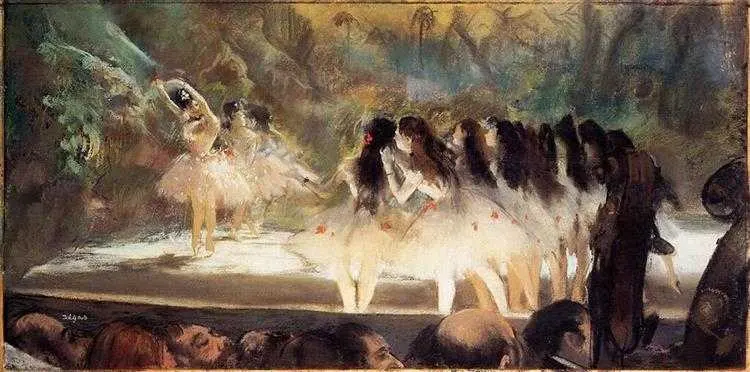
Because Degas was incredibly prolific, his works are spread across many major international museums. While The Dance Class resides in the Musée d’Orsay in Paris, other versions and related studies are held in prestigious collections globally. Seeing these works in person is the only way to appreciate the delicate layering of pastel and the subtle shifts in color that are often lost in digital reproductions.
If you are planning a trip to view his work, prioritize these institutions:
- The Musée d’Orsay, Paris: Home to the most extensive collection of his ballet scenes.
- The Metropolitan Museum of Art, New York: Holds a significant number of his later pastels and bronzes.
- The Art Institute of Chicago: Features excellent examples of his experimental techniques.
- The National Gallery of Art, Washington, D.C.: Offers a comprehensive look at his transition from classical training to Impressionism.
Common mistakes when studying Degas
A frequent mistake people make is assuming that Degas was a traditional Impressionist who painted exclusively outdoors. In reality, Degas famously disliked the practice of en plein air painting, preferring the controlled environment of his studio. He often mocked his peers for their obsession with capturing fleeting natural light, choosing instead to focus on the psychological depth of his subjects. Understanding this distinction is essential for correctly interpreting his artistic intent.
Another common error is viewing his dancers as idealized, romantic figures. Degas was a realist at heart; he frequently painted his dancers looking exhausted, bored, or physically strained. He was interested in the labor behind the performance rather than the glamour of the stage. When you view his work, look past the tutus and ribbons to notice the slumped shoulders and tired expressions. This focus on the "human" element is what truly separates his work from the decorative art of his time.
How to appreciate the technique of Degas
To truly appreciate the genius of Degas, you must look closely at how he manipulated his materials. He was an experimentalist who frequently mixed media, often combining oil paint with pastel to achieve a matte, chalky finish. This allowed him to add highlights and sharp lines over dried paint, creating a sense of depth that traditional oils could not replicate. His process was slow and methodical, often involving dozens of preparatory sketches.
- Observe the background: Notice how he uses negative space to make the subjects feel isolated.
- Follow the lines: Trace the diagonal floorboards to see how they guide your eyes to the ballet master.
- Check the edges: Look for figures that are cropped, which creates the feeling of a candid photograph.
- Examine the light: Note how he uses artificial, overhead light to create harsh shadows on the floor.
By following these steps, you can better understand why his work remains so influential in the history of art.
Key facts
- The Dance Class (c. 1874) is widely considered Edgar Degas’s most famous and iconic painting.
- The work is currently housed in the Musée d'Orsay in Paris, France.
- Degas painted approximately 1,500 works featuring ballet dancers throughout his career.
- He preferred the term "independent" over "Impressionist" to describe his artistic style.
- When viewing the painting, look for the "off-center" composition influenced by Japanese woodblock prints.
- Avoid assuming the dancers were professional stars; Degas often depicted them as young students in training.
The bottom line
While Edgar Degas produced a vast body of work, The Dance Class remains his most recognizable masterpiece. By focusing on the candid, behind-the-scenes reality of ballet students rather than the glamour of the stage, Degas revolutionized 19th-century art. His unique perspective, influenced by photography and Japanese prints, provides a window into the rigorous training and private moments of performers, cementing his legacy as a master observer.
People also ask
Did Degas only paint ballet dancers?
No, while he is famous for ballet scenes, Degas also produced many paintings of horse racing, laundresses, and intimate bathing scenes. He was deeply interested in capturing the human body in motion across various social settings.
Why did Degas paint from unusual angles?
Degas was fascinated by the rise of photography and the asymmetrical compositions found in Japanese ukiyo-e prints. He intentionally cropped his scenes to suggest a fleeting, candid moment rather than a posed portrait.
Was Degas considered a traditional Impressionist?
Degas participated in seven of the eight Impressionist exhibitions, but he rejected the label. He focused on studio work and precise drawing rather than painting en plein air (outdoors) like Monet or Renoir.
What medium did Degas use for his famous dance scenes?
He frequently experimented with a combination of oil paint, pastel, and gouache. His later works rely heavily on layered pastels to achieve vibrant, textured colors.
Are there multiple versions of "The Dance Class"?
Yes, Degas painted two major versions of The Dance Class. One is in the Musée d'Orsay, and another, titled The Dance Class (La Classe de danse), is part of the Metropolitan Museum of Art collection in New York.
How can I identify a Degas painting?
Look for dynamic, often awkward poses, high vantage points, and a focus on the labor behind the performance. His figures are rarely static and often appear caught in the middle of a gesture or adjustment.
This answer was created with the help of AI research tools and reference sources. Spotted an error? Let us know — we correct mistakes quickly. See our editorial policy.