Why is Black Square so famous?
Short answer
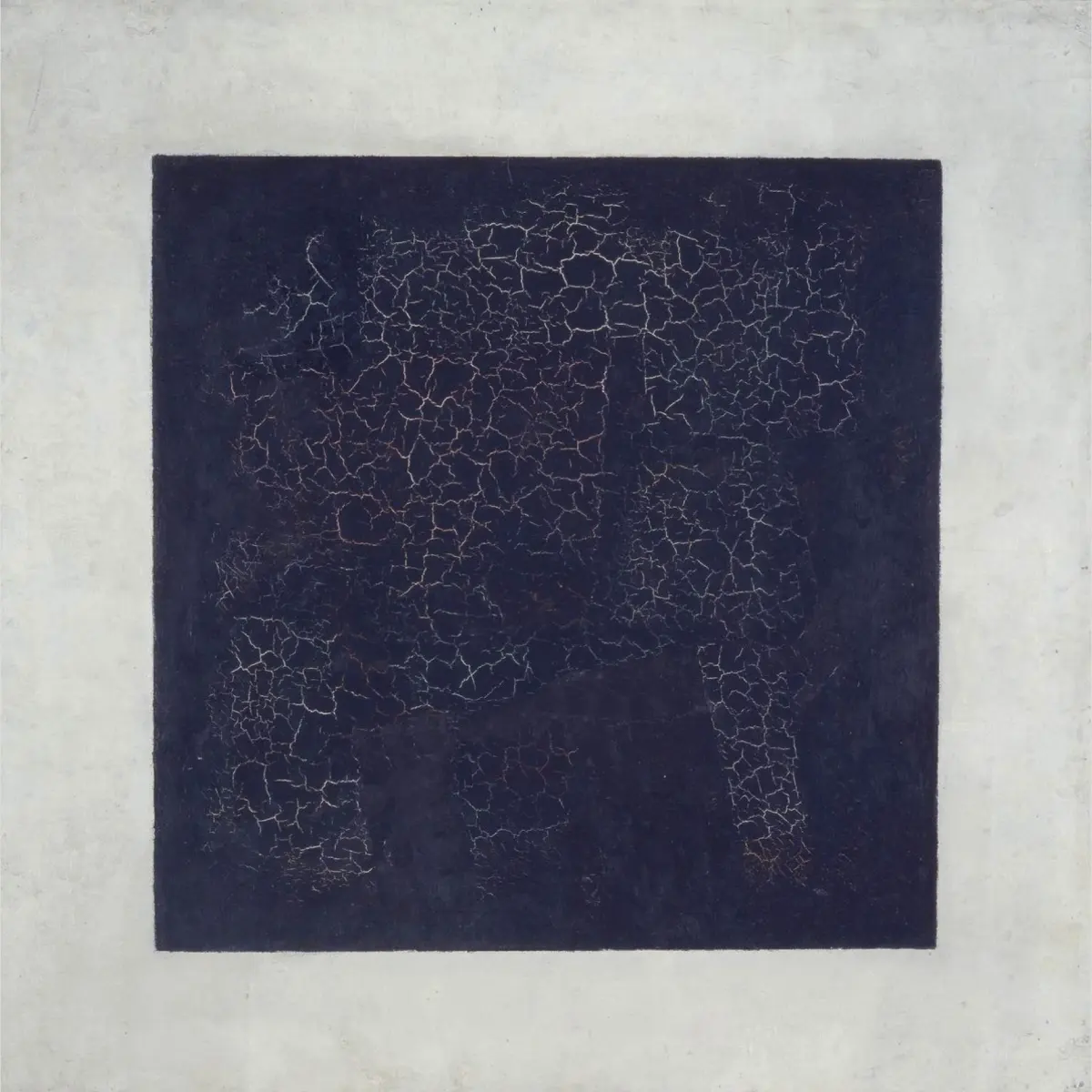
Kazimir Malevich’s Black Square is famous because it represents the definitive break from traditional representational art. Unveiled in 1915, it stripped painting down to its most basic, non-objective essence. By rejecting the depiction of reality, Malevich transformed the canvas into a radical space for pure feeling and philosophical inquiry, forever altering modern art.
On this page
Why did Malevich create Black Square?
Kazimir Malevich painted Black Square in 1915 as the centerpiece of the "0.10" exhibition in Petrograd. At the time, the Russian art world was dominated by Cubism and Futurism, both of which still relied on recognizable subjects. Malevich wanted to move beyond these limitations to create a new visual language he called Suprematism. He believed that art should not represent the physical world but instead express the "supremacy of pure feeling."
By painting a simple black square on a white background, Malevich sought to achieve a "zero point" of painting. He stripped away the clutter of narrative, portraiture, and landscape to find the absolute foundation of artistic expression. This act was not merely a technical choice but a spiritual and philosophical one. He viewed the black square as a portal to a realm where the artist could communicate directly with the viewer’s consciousness without the distraction of external objects.
What makes Black Square so revolutionary?
The revolutionary nature of Black Square lies in its total rejection of mimesis, or the imitation of reality. For centuries, Western art was judged by how well it captured the human form, nature, or historical events. Malevich shattered this expectation by presenting a work that contained no recognizable subject matter. He effectively declared that the act of painting itself—the application of pigment to a surface—was the only subject necessary.
This shift opened the door for the development of abstract art throughout the 20th century. By removing the "crutch" of the object, Malevich forced the viewer to confront the medium itself. The stark contrast between the black shape and the white field created a sense of depth and tension that challenged the viewer's perception. This radical minimalism paved the way for movements such as Minimalism, Conceptualism, and Color Field painting, proving that art could exist entirely as an idea.
How to appreciate abstract art like Black Square
Appreciating non-objective art requires a shift in mindset. Instead of asking "What is this a picture of?", you should focus on your own emotional and sensory response to the work. Follow these steps to engage with abstract paintings:
- Observe the physical properties: Note the texture, the brushwork, and the scale of the canvas.
- Identify your initial reaction: Pay attention to whether the work makes you feel calm, anxious, curious, or indifferent.
- Consider the context: Research the artist's goals and the historical environment in which the piece was created.
- Reflect on the space: Think about how the work interacts with the walls and the lighting of the gallery.
Avoid the common mistake of dismissing the work as "something a child could do." While the execution may appear simple, the intellectual labor required to arrive at such a reductionist conclusion is immense. Focus on the history and the intent behind the simplicity.
Common mistakes when interpreting Black Square
A frequent error when viewing Black Square is searching for hidden symbols or secret codes within the geometry. While some critics have attempted to link the square to religious icons or political statements, Malevich insisted that the work was purely about sensation. Over-analyzing the geometry often leads to missing the primary point: the work is an experience, not a puzzle to be solved.
Another mistake is ignoring the physical condition of the original 1915 painting. Over time, the pigments have cracked and faded, revealing layers of color beneath the black surface. These cracks are not just signs of age; they are part of the painting’s history and its physical reality. When you look at the work, acknowledge the following aspects:
- The intentionality of the brushstrokes visible beneath the black paint.
- The subtle variations in the white border that frame the square.
- The way the painting occupies the corner of the room, as Malevich originally intended.
Where can you see Black Square today?
The original 1915 version of Black Square is housed in the State Tretyakov Gallery in Moscow. Because the work is fragile and historically significant, it is rarely moved for international exhibitions. Malevich actually created four different versions of the Black Square throughout his life, with the last one painted in the early 1930s. These versions serve as a testament to his lifelong commitment to the Suprematist philosophy.
If you are planning to visit the Tretyakov Gallery, keep these practical tips in mind:
- Check the gallery schedule in advance, as the painting is sometimes rotated into storage for conservation.
- Arrive early in the morning to avoid the largest crowds in the main exhibition halls.
- Visit the surrounding galleries to see other Suprematist works by Malevich and his contemporaries to gain a broader understanding of the movement.
By viewing the painting in person, you can better appreciate its scale and the way it commands the space around it, confirming its status as one of the most influential works in the history of art.
Key facts
- Kazimir Malevich painted Black Square in 1915 as the centerpiece of the 0.10 Exhibition in Petrograd.
- The work measures approximately 79.5 by 79.5 centimeters and is painted in oil on linen.
- It is considered the foundational work of Suprematism, an art movement focused on basic geometric forms.
- Malevich intentionally placed the painting in the "beautiful corner," a spot traditionally reserved for religious icons in Russian homes.
- Scientific analysis reveals the black pigment is a mixture of various colors, including chalk, ivory black, and dark blue, rather than a single tube of black paint.
- The painting is currently housed in the State Tretyakov Gallery in Moscow, which holds several versions created by the artist.
The bottom line
Black Square remains famous because it represents a definitive break from centuries of representational art. By reducing painting to its most basic, non-objective form, Malevich challenged the definition of creativity itself. It serves as a historical marker for the birth of modern abstraction, proving that the concept behind an image can be just as powerful and enduring as the technical skill required to execute it.
People also ask
Did Malevich paint other versions of the Black Square?
Yes, Malevich painted at least four versions of the work between 1915 and the early 1930s. He created these replicas for various exhibitions and as a way to preserve the concept as the original canvas began to crack.
Is the painting actually a perfect square?
Despite its title, the sides of the shape are not perfectly parallel, and the corners do not meet at precise 90-degree angles. The hand-painted nature of the work introduces slight irregularities that distinguish it from a mechanical print.
What was the intention behind the painting?
Malevich intended to strip art of all representational content, such as landscapes or portraits, to reach "zero point." He believed that by removing the subject, he could force the viewer to confront pure feeling and the essence of non-objective art.
How did the public react when it was first shown?
The debut in 1915 was met with both intense confusion and hostility, as many viewers felt the work signaled the death of traditional art. However, it also galvanized a generation of avant-garde artists who saw it as a radical liberation from academic constraints.
Why are there cracks on the surface of the painting?
The cracks, known as craquelure, are the result of the paint drying unevenly over time due to the artist using multiple layers of different pigments. These cracks are now considered an authentic part of the work’s physical history.
Can anyone paint a black square and call it art?
While the act of painting a black square is simple, the fame of this specific work lies in its historical context and its role as a revolutionary manifesto. Art historians value the work for its timing and the philosophical shift it forced upon the 20th-century art world.
This answer was created with the help of AI research tools and reference sources. Spotted an error? Let us know — we correct mistakes quickly. See our editorial policy.