Who was Albert Einstein?
Short answer
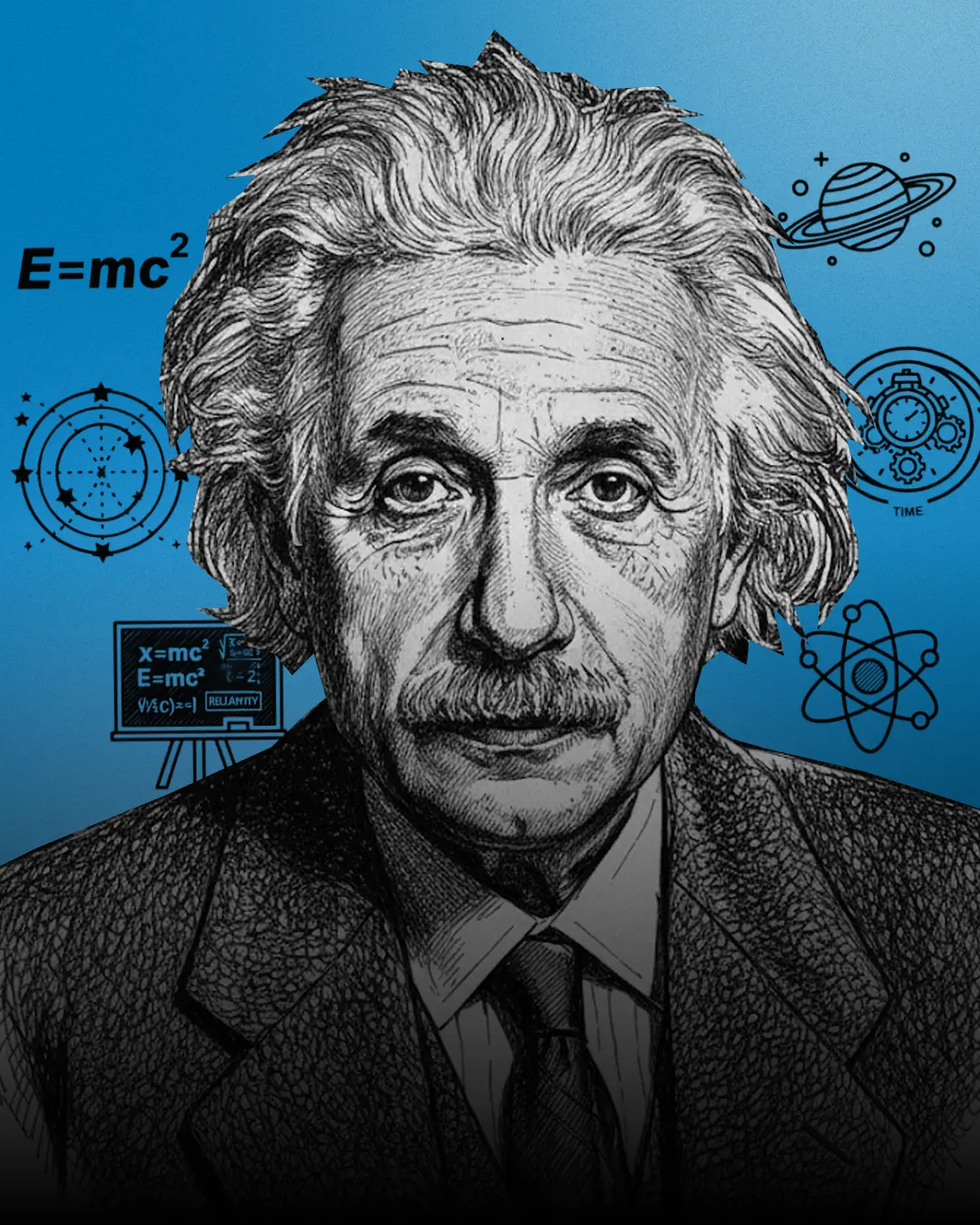
Albert Einstein was a German-born theoretical physicist who revolutionized our understanding of the universe. Best known for his theory of relativity and the mass-energy equivalence formula, E=mc², he fundamentally altered physics. His work reshaped concepts of space, time, and gravity, earning him the 1921 Nobel Prize in Physics for his discovery of the photoelectric effect.
On this page
What were Albert Einstein's major scientific contributions?
Einstein’s most significant achievement was the theory of relativity, which he developed in two distinct stages. In 1905, he published his special theory of relativity, which proposed that the laws of physics are the same for all non-accelerating observers and that the speed of light is constant. This work introduced the famous equation E=mc², showing that mass and energy are interchangeable. He later expanded this into general relativity in 1915, which redefined gravity not as a force, but as a curvature of spacetime caused by mass and energy.
These theories were not merely abstract calculations; they provided the foundation for modern cosmology and technology. His work explained phenomena that Newtonian physics could not, such as the orbit of Mercury and the bending of starlight by gravity. To understand the breadth of his contributions, consider these primary breakthroughs:
- Special Relativity: Established the constancy of the speed of light.
- Mass-Energy Equivalence: Proved that small amounts of mass can be converted into massive energy.
- General Relativity: Provided a new geometric description of gravity.
- Photoelectric Effect: Demonstrated that light acts as both a wave and a particle, or quantum.
- Brownian Motion: Offered empirical evidence for the existence of atoms.
How did Einstein change the world of physics?
Before Einstein, the scientific community largely relied on the mechanical worldview established by Isaac Newton. Einstein challenged these rigid structures by suggesting that time and space were not absolute, but relative to the observer's speed and gravitational environment. This radical shift allowed scientists to explain the behavior of stars, black holes, and the expansion of the universe. His work on the photoelectric effect was equally transformative, as it became a cornerstone of quantum mechanics, describing how light interacts with matter at the subatomic level.
The practical applications of his theories are integrated into many modern technologies. Without the corrections provided by general and special relativity, global positioning systems (GPS) would fail within minutes. The satellites orbiting Earth experience time differently due to their velocity and the weaker gravitational pull at their altitude. Engineers must account for these relativistic effects to ensure that the time signals sent to your device remain accurate. Without Einstein’s insights, the precise navigation systems used in aviation, shipping, and personal smartphones would simply not function with the necessary level of accuracy.
What was Albert Einstein's background and early life?
Born on March 14, 1879, in Ulm, Germany, Einstein grew up in a secular Jewish family in Munich. He showed an early interest in mathematics and physics, though he often clashed with the rigid, authoritarian structure of the German school system. After moving to Switzerland to complete his education, he graduated from the Zurich Polytechnic in 1900. Finding a permanent academic position proved difficult initially, leading him to accept a job as a technical assistant at the Swiss Patent Office in Bern.
The patent office environment proved unexpectedly beneficial for his intellectual development. While reviewing technical drawings and patent applications, Einstein had ample time to contemplate the nature of light and motion. It was during this period, in his "miracle year" of 1905, that he produced four groundbreaking papers that changed the course of physics. These documents addressed the photoelectric effect, Brownian motion, special relativity, and mass-energy equivalence. His rise from a quiet patent clerk to a world-renowned physicist remains one of the most remarkable trajectories in the history of science.
How to study Einstein's theories as a beginner
If you are interested in learning about Einstein’s work, you should start by focusing on conceptual understanding before attempting the complex mathematics. Many beginners make the mistake of diving directly into the tensor calculus required for general relativity, which often leads to frustration. Instead, prioritize reading high-quality popular science books that explain the physical implications of his theories. Focus on the thought experiments, such as his famous "elevator" analogy for gravity or the "train" analogy for relativity, which provide the best intuitive grasp of his ideas.
To effectively engage with these complex topics, follow these steps:
- Read Einstein’s own book, "Relativity: The Special and General Theory," which he wrote specifically for the general public.
- Watch educational documentaries that visualize spacetime curvature and time dilation to build a mental model.
- Learn the basic algebra behind E=mc² to understand the relationship between mass and energy.
- Explore the history of the 1919 solar eclipse, which provided the first experimental proof of his theory of gravity.
Common mistakes when learning about Einstein
A frequent error is the belief that Einstein’s theories were immediately accepted by the entire scientific community. In reality, his ideas were highly controversial and faced significant skepticism for years until empirical evidence, such as the 1919 solar eclipse observations, confirmed them. Another common misconception is that Einstein was a poor student in his youth. While he did struggle with the rote memorization required by his teachers, he was consistently excellent in mathematics and physics, often far ahead of his peers.
Additionally, avoid the mistake of viewing Einstein solely as a detached scientist. He was deeply involved in political and social issues, advocating for pacifism, civil rights, and international cooperation throughout his life. He famously declined the presidency of Israel in 1952, demonstrating his commitment to his intellectual pursuits over political power. When studying his life, it is important to remember that his scientific genius was matched by his humanitarian concerns. By keeping these distinctions in mind, you will gain a more accurate and nuanced understanding of who he was as both a scientist and a person.
Key facts
- Born on March 14, 1879, in Ulm, Germany, Albert Einstein became the most influential physicist of the 20th century.
- He published four groundbreaking papers in 1905, his "miracle year," which fundamentally changed our understanding of space, time, and energy.
- His most famous equation, E=mc², established the equivalence of mass and energy, laying the foundation for nuclear energy.
- Einstein received the 1921 Nobel Prize in Physics for his discovery of the law of the photoelectric effect, not for relativity.
- He fled Nazi Germany in 1933 and spent the remainder of his life at the Institute for Advanced Study in Princeton, New Jersey.
- To study his work effectively, focus on the conceptual logic of his thought experiments rather than trying to memorize complex mathematical derivations immediately.
The bottom line
Albert Einstein transformed modern science by challenging the rigid laws of classical physics. Through his theories of relativity, he reshaped our perception of the universe, proving that time and space are relative rather than absolute. Beyond his intellectual achievements, he remains a cultural icon whose commitment to pacifism and curiosity continues to inspire generations to question the status quo and seek deeper truths about reality.
People also ask
Did Albert Einstein fail math in school?
No, this is a common myth. Einstein excelled in mathematics and physics from a young age, mastering differential and integral calculus by the time he was 15 years old.
What is the theory of general relativity?
Published in 1915, this theory explains that gravity is not a force between masses but a curvature of spacetime caused by matter and energy. It predicted phenomena like the bending of light by stars, which was later confirmed by observation.
Why did Einstein move to the United States?
As a Jewish scientist, Einstein faced increasing antisemitism and political instability in Germany during the rise of the Nazi party. He accepted a position at Princeton in 1933 and eventually became a U.S. citizen in 1940.
Was Einstein involved in the creation of the atomic bomb?
Einstein did not work on the Manhattan Project, but he did sign a 1939 letter to President Franklin D. Roosevelt. The letter warned that Germany might develop nuclear weapons and urged the U.S. to accelerate its own research.
What was Einstein’s personality like in his later years?
He was known for his humanitarianism, his love of playing the violin, and his iconic, disheveled appearance. He became a global symbol of scientific genius and advocated for civil rights and international peace.
How can I understand Einstein’s theories without a physics degree?
Start by reading his own popular science book, Relativity: The Special and the General Theory. Avoid common mistakes like trying to visualize four-dimensional spacetime as a physical object; instead, treat it as a mathematical framework for how events relate to one another.
This answer was created with the help of AI research tools and reference sources. Spotted an error? Let us know — we correct mistakes quickly. See our editorial policy.