Who invented the printing press?
Short answer
Johannes Gutenberg, a German goldsmith, invented the movable-type printing press around 1440 in Mainz. While woodblock printing existed earlier in East Asia, Gutenberg’s innovation combined metal movable type, oil-based inks, and a wooden screw press. This mechanical system revolutionized communication by enabling the rapid, mass production of books across Europe.
On this page
Who was Johannes Gutenberg?
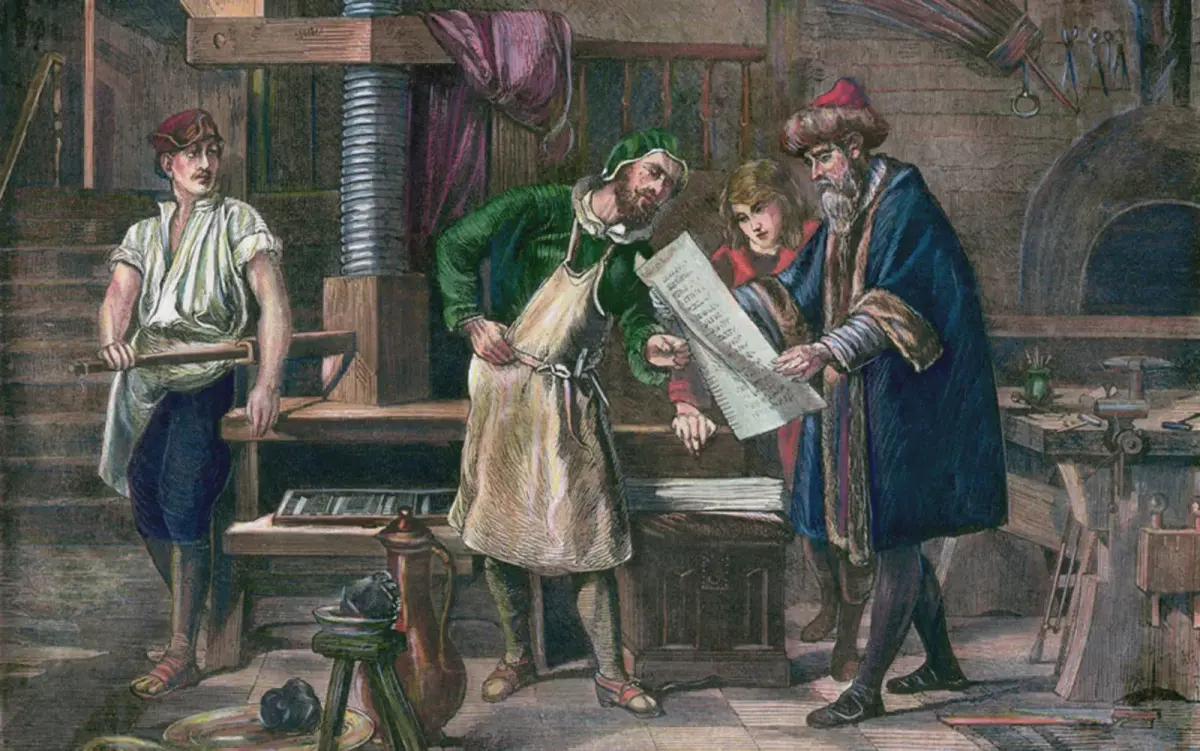
Johannes Gutenberg was a German inventor, goldsmith, and businessman who lived during the 15th century. Little is known about his early life, but historical records place him in Mainz, where he developed his mechanical printing system. He was not a scholar by trade, but his background in metallurgy allowed him to solve the technical challenges of casting precise metal letters.
Gutenberg faced significant financial hurdles throughout his career, often borrowing money from investors like Johann Fust to fund his experiments. Despite his monumental contribution to human history, he struggled to maintain control of his printing business and eventually lost his workshop due to legal disputes. He died in 1468, having fundamentally altered the trajectory of global literacy and the spread of information.
How did the printing press work?
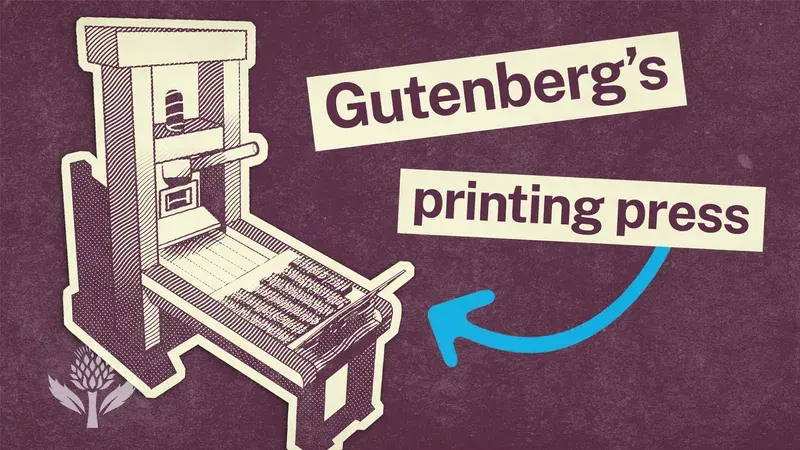
The printing press was a sophisticated assembly of several existing technologies adapted for a new purpose. Gutenberg’s primary innovation was the creation of a hand mold that allowed for the rapid casting of individual metal letters, known as movable type. These letters were made from a durable alloy of lead, tin, and antimony, which held up well under the pressure of the press.
- A compositor arranged individual metal letters into lines and pages within a wooden frame called a chase.
- The surface of the type was inked using leather-covered ink balls coated in a specialized oil-based ink.
- A sheet of dampened paper was placed onto the type and secured with a frame.
- The operator turned a heavy wooden screw mechanism to apply even, downward pressure, transferring the ink to the paper.
This process replaced the laborious method of hand-copying manuscripts, which had been the standard for centuries. By using oil-based ink rather than the water-based inks used in woodblock printing, Gutenberg ensured that the impressions were crisp and durable. The ability to rearrange type meant that printers could reuse the same letters for different texts, significantly reducing the cost of book production.
Why is it considered the most important invention?
The printing press acted as a catalyst for the Renaissance, the Reformation, and the Scientific Revolution. Before its invention, books were luxury items reserved for the elite and the clergy, as each copy required months of manual labor. The press enabled the mass production of texts, which drove down costs and allowed ideas to circulate among the broader population.
- Standardization of languages: Printing helped stabilize spelling and grammar across regional dialects.
- Democratization of knowledge: Scientific discoveries and philosophical ideas reached thinkers who were previously isolated.
- Religious reform: The ability to print Bibles in vernacular languages challenged the monopoly of the Catholic Church.
- Rise of literacy: As reading material became affordable, the incentive for the general public to learn to read increased dramatically.
This shift in information accessibility fundamentally changed how societies functioned. It broke the gatekeeping power of institutions that controlled information, allowing for a more informed and critical public discourse. Without the mechanical press, the rapid exchange of complex scientific and political concepts that defined the modern era would have been impossible.
Common mistakes when studying printing history
A frequent error is assuming that Gutenberg was the first person to use movable type. In reality, Bi Sheng in China developed ceramic movable type in the 11th century, and later, Korean inventors created metal movable type during the Goryeo Dynasty. Gutenberg’s unique contribution was the integration of these concepts into a cohesive, high-speed mechanical system tailored for the Latin alphabet.
Another common misconception is that the printing press immediately made everyone literate. In truth, literacy rates rose slowly over several centuries, as the availability of books was only one factor in a complex social transition. Additionally, one should avoid the mistake of thinking printing was an instant success for the inventor. Gutenberg’s business model was difficult to scale, and it took several decades for printing shops to proliferate across major European cities.
How to identify early printed books
If you are examining early printed material, look for specific physical characteristics that define the incunabula period, which refers to books printed before 1501. These volumes often lack title pages and page numbers, as early printers were still experimenting with the layout of a book. Instead, they often included a colophon at the end, which provided details about the printer, location, and date.
- Examine the paper quality: Early paper was made from linen rags, giving it a thick, textured feel compared to modern wood-pulp paper.
- Check for rubrication: Look for hand-drawn flourishes or colored initials added by artists after the text was printed.
- Observe the ink: Authentic early prints often show slight indentations where the metal type pressed into the damp paper.
- Verify the binding: Early bindings were typically heavy wooden boards covered in leather, often featuring metal clasps.
By paying attention to these details, historians can determine the authenticity and origin of rare texts. The study of these physical objects, known as bibliography, provides a tangible link to the era when the printing press first began to reshape the world. Understanding these markers helps preserve the legacy of a technology that defined the transition into the modern age.
Key facts
- Johannes Gutenberg, a German goldsmith, is credited with inventing the movable-type printing press around 1440.
- The innovation combined existing technologies like the olive press, oil-based inks, and durable metal alloy type.
- Gutenberg’s most famous production, the Gutenberg Bible, was completed in Mainz, Germany, around 1455.
- Movable type allowed individual metal letters to be rearranged and reused, significantly increasing printing speed.
- Before this invention, books were laboriously hand-copied by scribes or produced using labor-intensive woodblock printing.
- To avoid common historical misconceptions, note that woodblock printing existed in East Asia centuries before Gutenberg’s mechanical press.
The bottom line
Johannes Gutenberg transformed human history by perfecting the mechanical movable-type printing press in the mid-15th century. By integrating metal casting, oil-based inks, and a modified screw press, he enabled the mass production of books. This innovation dismantled the monopoly of the elite on information, catalyzed the spread of literacy, and laid the essential groundwork for the modern era of global communication and scientific inquiry.
People also ask
Did Gutenberg invent the first printing press in history?
No, he did not. Movable metal type was invented in Korea during the Goryeo Dynasty, specifically with the Jikji printed in 1377, decades before Gutenberg.
Why is Gutenberg’s press considered more significant than earlier Asian inventions?
Gutenberg’s system was highly efficient for the Latin alphabet, which uses fewer characters than East Asian languages. His combination of a screw press and durable metal alloys sparked a rapid, widespread communications revolution in Europe.
What materials were used to create the early printing type?
Gutenberg developed a special alloy consisting of lead, tin, and antimony. This mixture was soft enough to cast easily but hard enough to withstand the pressure of the printing process.
How long did it take to print a page with the new press?
While a scribe might take days to copy a single page, a printing press could produce hundreds of identical pages in a single day. This shift drastically reduced the cost and increased the availability of written materials.
What was the primary impact of the printing press on society?
It democratized knowledge by making books affordable for the middle class. This fueled the Renaissance, the Protestant Reformation, and the Scientific Revolution by allowing ideas to spread rapidly across borders.
Can you still see original Gutenberg Bibles today?
Yes, there are approximately 49 copies of the Gutenberg Bible known to exist today. They are held in various libraries and museums around the world, such as the British Library and the Library of Congress.
This answer was created with the help of AI research tools and reference sources. Spotted an error? Let us know — we correct mistakes quickly. See our editorial policy.