What is DNA?
Short answer
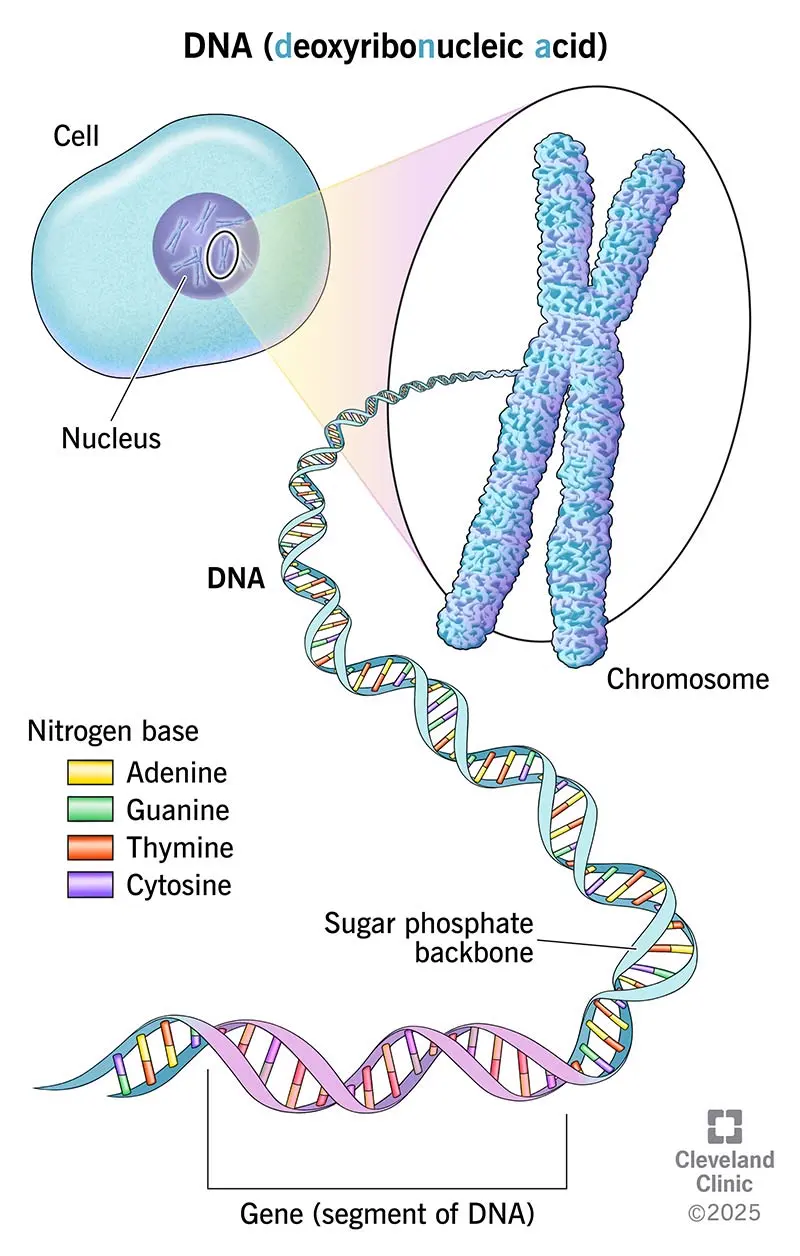
DNA, or deoxyribonucleic acid, is the hereditary material in humans and almost all other organisms. It functions as a biological instruction manual, storing the genetic code required for an organism to develop, survive, and reproduce. Located primarily within the cell nucleus, it consists of two long strands forming a double helix.
On this page
What is the structure of DNA?
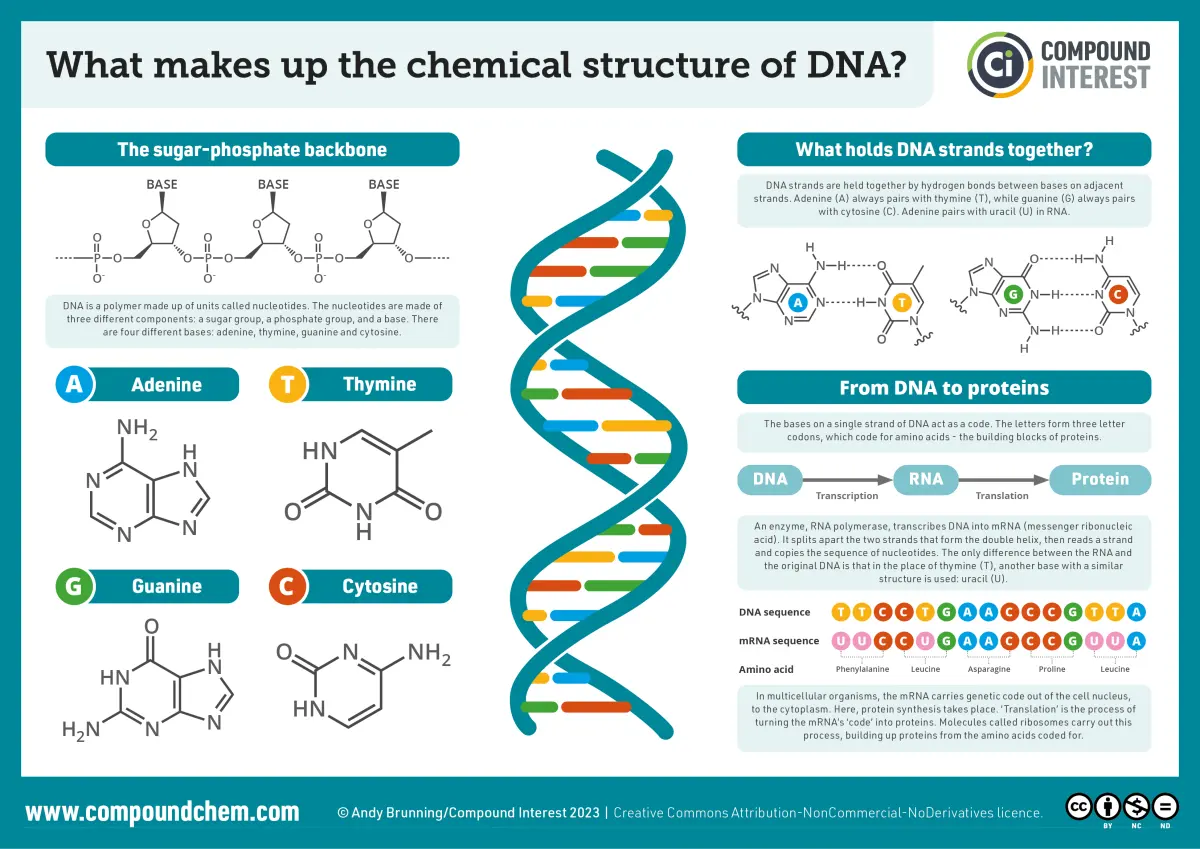
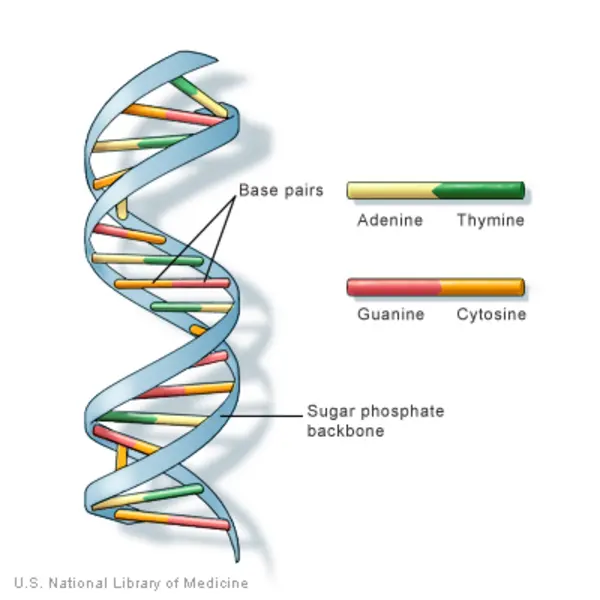
DNA is composed of two long strands that twist around each other to form a structure known as a double helix. These strands are made up of smaller units called nucleotides, which consist of a sugar molecule, a phosphate group, and a nitrogenous base. There are four distinct types of nitrogenous bases that act as the alphabet of life: adenine (A), thymine (T), cytosine (C), and guanine (G).
The specific pairing of these bases is what allows DNA to store information accurately. Adenine always pairs with thymine, while cytosine always pairs with guanine. This predictable pairing, discovered by James Watson and Francis Crick in 1953, is essential for the process of DNA replication. Because the bases fit together like puzzle pieces, the cell can easily copy its genetic information whenever it needs to divide. The sequence of these base pairs determines the unique genetic blueprint for every living thing, from bacteria to humans.
How does DNA work in the body?
DNA serves as the master blueprint for building proteins, which are the workhorses of the body. Through a process called gene expression, the cell reads the DNA sequence and translates it into instructions for creating specific proteins. These proteins then carry out almost every biological function, including building tissues, regulating hormones, and transporting oxygen through the blood.
The information is organized into segments called genes. While a human genome contains approximately 3 billion base pairs, only about 1 to 2 percent of that DNA actually codes for proteins. The rest of the DNA performs regulatory functions, acting like a control panel that determines when and where specific genes should be turned on or off. This ensures that a skin cell and a brain cell function differently, even though they contain the exact same genetic code.
How do scientists analyze DNA?
Scientists analyze DNA to understand ancestry, identify individuals, or diagnose genetic disorders. This process often involves extracting DNA from a sample, such as saliva or blood, and then using laboratory techniques to read the sequence of base pairs. Modern technology has made this process significantly faster and more affordable than it was during the initial Human Genome Project, which concluded in 2003.
Common methods for analyzing DNA include:
- Polymerase Chain Reaction (PCR): A technique used to amplify small segments of DNA so they can be studied in detail.
- DNA Sequencing: Determining the exact order of the four nitrogenous bases within a DNA molecule.
- Gel Electrophoresis: A method used to separate DNA fragments based on their size for identification purposes.
- Genotyping: Comparing specific markers in a person's DNA against known databases to identify variations or traits.
How to interpret DNA test results?
When you receive results from a consumer DNA test, you are looking at a report that highlights variations in your genetic code. These tests often focus on single nucleotide polymorphisms (SNPs), which are tiny differences in your DNA compared to a reference population. Interpreting these results requires understanding that genetics provides probabilities rather than absolute certainties.
If you are reviewing your own genetic data, follow these steps to avoid confusion:
- Identify the specific trait or condition being tested, as most tests only look at a small subset of your total genome.
- Check the confidence level of the result, as some genetic markers are strongly linked to traits while others are merely statistical associations.
- Consult with a qualified genetic counselor if you are concerned about health-related findings.
- Remember that environmental factors and lifestyle choices often play a larger role in health outcomes than your genetic predispositions alone.
Common mistakes when learning about genetics
A frequent error is assuming that DNA is the sole determinant of a person’s identity or health. While DNA provides the foundation, gene-environment interactions are complex and constantly evolving. Another common mistake is the misunderstanding of "junk DNA," which is an outdated term for non-coding regions. Scientists now know that this non-coding DNA is vital for regulating gene activity and maintaining the structural integrity of chromosomes.
Avoid these pitfalls to maintain an accurate understanding of the science:
- Do not assume that a "gene for" a specific disease means you will definitely develop that condition.
- Avoid equating genetic similarity with cultural or social identity, as these are distinct concepts.
- Do not overlook the role of epigenetics, which are chemical modifications that turn genes on or off without changing the underlying DNA sequence.
- Be wary of oversimplified media claims that suggest a single gene is responsible for complex human behaviors or personality traits.
Key facts
- DNA stands for deoxyribonucleic acid, a molecule that carries the genetic instructions for all living organisms.
- Its structure is a double helix, resembling a twisted ladder, discovered by James Watson and Francis Crick in 1953.
- The molecule is composed of four chemical bases: adenine (A), cytosine (C), guanine (G), and thymine (T).
- Human DNA contains approximately 3 billion base pairs, which are tightly packed into 23 pairs of chromosomes.
- Genetic information is stored in sequences of these bases, similar to how letters form words in a specific order.
- To preserve DNA samples, keep them away from direct sunlight, extreme heat, and moisture to prevent chemical degradation.
The bottom line
DNA serves as the fundamental biological blueprint for life, encoding the essential instructions for building and operating every living organism. By understanding this complex double-helix structure, scientists have unlocked breakthroughs in medicine, forensics, and evolutionary biology. While your genetic code is largely inherited, it functions as a dynamic system that dictates your unique physical traits and influences your long-term health throughout your entire life.
People also ask
How much DNA do humans share with each other?
Humans share approximately 99.9% of their DNA sequence with one another. The remaining 0.1% accounts for the individual differences in appearance, health, and susceptibility to certain diseases.
Can DNA be changed once it is formed?
While your base sequence is inherited, environmental factors and lifestyle choices can cause epigenetic changes. These modifications do not alter the DNA code itself but can influence how your body reads and expresses specific genes.
How is DNA used in criminal investigations?
Forensic scientists use DNA profiling to identify individuals by analyzing specific, highly variable regions of the genome. Even a tiny sample, such as a single hair follicle or a skin cell, can provide enough genetic material for a match.
What is the difference between DNA and RNA?
DNA is a double-stranded molecule that serves as the permanent storage for genetic information. RNA is typically single-stranded and acts as a messenger, translating the instructions from DNA into the proteins necessary for cell function.
Why do siblings have different traits if they have the same parents?
Although siblings share about 50% of their DNA with each parent, they inherit a unique combination of genes due to the random shuffling that occurs during reproduction. This genetic recombination ensures that every individual, except for identical twins, has a distinct genetic blueprint.
Is it possible to extract DNA at home?
Yes, you can extract DNA from fruits like strawberries using common household items such as dish soap, salt, and rubbing alcohol. The soap breaks down cell membranes, while the alcohol causes the DNA to precipitate out of the solution as a visible, cloudy mass.
This answer was created with the help of AI research tools and reference sources. Spotted an error? Let us know — we correct mistakes quickly. See our editorial policy.