What is Gustave Courbet known for?
Short answer
Gustave Courbet was a 19th-century French painter who founded the Realist movement. He rejected the idealized themes of Romanticism and Neoclassicism, choosing instead to depict the gritty, unvarnished realities of everyday life. His provocative subjects and bold, tactile brushwork challenged the artistic establishment and paved the way for modern art.
On this page
Why is Gustave Courbet important to art history?
Gustave Courbet is widely regarded as the father of Realism, a movement that emerged in France during the 1840s. While his contemporaries focused on historical, mythological, or exotic subjects, Courbet insisted that painting should be a living art form representing the visible world. He famously declared that he could not paint an angel because he had never seen one, cementing his commitment to empirical observation over imaginative fantasy.
His influence on the trajectory of Western art cannot be overstated. By elevating the status of common laborers and mundane scenes to the scale of traditional history paintings, he dismantled the rigid hierarchy of the French Academy. This shift forced the art world to reconsider what was considered "worthy" of depiction. His defiance against the establishment encouraged later generations, including the Impressionists, to prioritize personal vision and authentic experience over academic convention.
How to recognize a Gustave Courbet painting
Identifying a Courbet work involves looking for his signature heavy, impasto technique and his unflinching focus on physical reality. He often applied paint with a palette knife rather than a brush, creating a textured, almost sculptural surface that emphasized the materiality of the canvas. His color palette was frequently earthy and somber, dominated by deep greens, browns, and grays, which grounded his subjects in the physical landscape.
When analyzing his compositions, look for these specific characteristics:
- Large-scale canvases that treat working-class people with the gravity previously reserved for kings or saints.
- A lack of idealized lighting or dramatic theatricality, favoring naturalistic, often harsh, daylight.
- Compositions that feel candid, as if the viewer has stumbled upon a private or raw moment.
- A focus on the textures of nature, such as the dampness of rocks, the thickness of forest foliage, or the coarse fabric of peasant clothing.
What are his most famous works?
Courbet’s career was defined by several controversial masterpieces that drew both intense criticism and significant acclaim. His most ambitious work, A Burial at Ornans (1849–50), measures over 20 feet wide and depicts a provincial funeral with unflinching, life-sized detail. By portraying ordinary townspeople with such monumental scale, he directly challenged the Parisian elite’s perception of what constituted fine art.
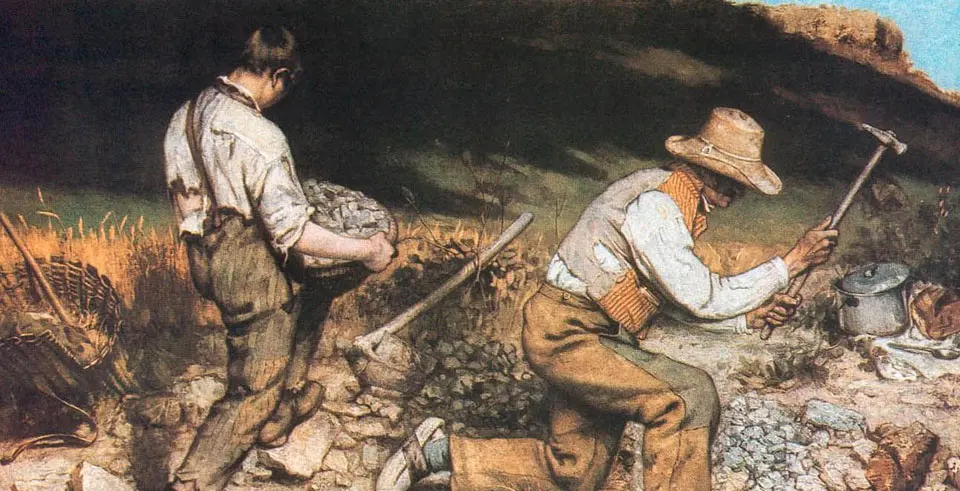
Another iconic piece is The Stone Breakers (1849), which portrays two laborers performing back-breaking manual labor. The painting is a stark social commentary on the poverty and exhaustion inherent in the working class. Other notable works include:
- The Painter's Studio (1855): A massive allegory of his life and artistic influences.
- Bonjour, Monsieur Courbet (1854): A self-portrait showing the artist as a traveler encountering his patron.
- The Origin of the World (1866): A provocative and highly realistic close-up of a female nude that remains a subject of intense academic and cultural debate.
Common mistakes when interpreting Courbet
A frequent error when studying Courbet is assuming his work was purely political propaganda. While he was deeply involved in radical politics—most notably his participation in the Paris Commune of 1871—his primary goal was artistic honesty. Viewers often mistake his choice of subjects for simple social protest, but his focus was equally on the technical challenges of capturing light, form, and the physical presence of his subjects on a flat surface.
Another common mistake is viewing his work through a modern lens without considering the 19th-century context. Critics at the time found his work "ugly" or "brutal" precisely because it lacked the refined polish expected of the era. To truly appreciate Courbet, one must understand that his "coarseness" was a deliberate aesthetic choice intended to shock the bourgeoisie out of their complacency. He was not failing to paint beautifully; he was intentionally redefining beauty to include the truth of human existence.
How to study his artistic technique
If you are interested in learning from Courbet’s methods, focus on the relationship between your materials and your subject matter. Start by observing your surroundings with a focus on texture rather than just form. Courbet did not smooth out his strokes; he built them up to create a sense of weight and volume. Practice using a palette knife to apply thick layers of paint, allowing the physical ridges to catch the light and create shadows across the surface of the work.
To emulate his approach, follow these foundational steps:
- Choose a subject from your daily life that is often overlooked or considered mundane.
- Limit your palette to natural, earth-toned pigments to maintain a sense of grounded realism.
- Apply paint thickly, focusing on the tactile quality of the objects rather than creating a perfectly blended finish.
- Avoid adding unnecessary narrative details or symbolic elements that distract from the raw reality of the scene.
By focusing on these elements, you can begin to see the world through the lens of a Realist, prioritizing the integrity of the subject over the desire for decorative appeal.
Key facts
- Gustave Courbet (1819–1877) was the leading figure of the 19th-century Realism movement in France.
- He famously rejected the idealized subjects of Romanticism and Neoclassicism, choosing instead to paint everyday life.
- His massive 1849 painting, A Burial at Ornans, shocked critics by treating a provincial funeral with the scale previously reserved for heroic history paintings.
- Courbet often used a palette knife to apply thick, textured paint directly onto the canvas, a technique that influenced later Impressionists.
- He was a political activist who participated in the 1871 Paris Commune, leading to his imprisonment and subsequent exile in Switzerland.
- To study his work, look for his signature dark, earthy tones and his refusal to retouch or "polish" his figures to meet academic standards.
The bottom line
Gustave Courbet transformed the landscape of Western art by championing the ordinary over the idealized. By elevating common people and provincial life to the scale of historical epics, he challenged the rigid standards of the 19th-century art establishment. His commitment to physical reality and his pioneering spirit of artistic independence laid the essential groundwork for modern art movements that would emerge later in the century.
People also ask
Why is Courbet considered a Realist?
He is defined as a Realist because he insisted on depicting only what he could see, famously stating, "Show me an angel, and I will paint one." He focused on the raw, unvarnished truth of rural life and common people.
What was the controversy surrounding his painting The Origin of the World?
This 1866 painting depicts a close-up view of female genitalia, which was considered highly scandalous and pornographic for its time. It remained in private collections for over a century before being displayed publicly at the Musée d'Orsay.
Did Courbet have formal art training?
Courbet was largely self-taught, having moved to Paris in 1839 to study law before shifting his focus to copying Old Masters at the Louvre. He rejected the rigid instruction of the official École des Beaux-Arts.
How did Courbet influence the Impressionists?
By breaking away from the state-sponsored Salon system, he paved the way for independent exhibitions. His emphasis on modern subjects and visible brushwork provided a foundation for artists like Claude Monet and Pierre-Auguste Renoir.
What is the significance of the Pavilion of Realism?
After his works were rejected from the 1855 Exposition Universelle, Courbet built his own temporary gallery nearby. This act was a historic turning point, marking the first time an artist staged a private, independent exhibition.
Was Courbet a successful artist during his lifetime?
He achieved significant fame and notoriety, but his confrontational personality and radical politics often alienated patrons. While he sold works to wealthy collectors, his career was frequently interrupted by legal troubles and public scandal.
This answer was created with the help of AI research tools and reference sources. Spotted an error? Let us know — we correct mistakes quickly. See our editorial policy.