What is Robert Rauschenberg known for?
Short answer
Robert Rauschenberg was a pivotal American artist known for bridging the gap between Abstract Expressionism and Pop Art. He is best recognized for his "Combines," which integrated three-dimensional objects into traditional paintings. His experimental approach to materials, printmaking, and performance art fundamentally altered the trajectory of 20th-century contemporary art and conceptual practice.
On this page
What are Robert Rauschenberg’s Combines?
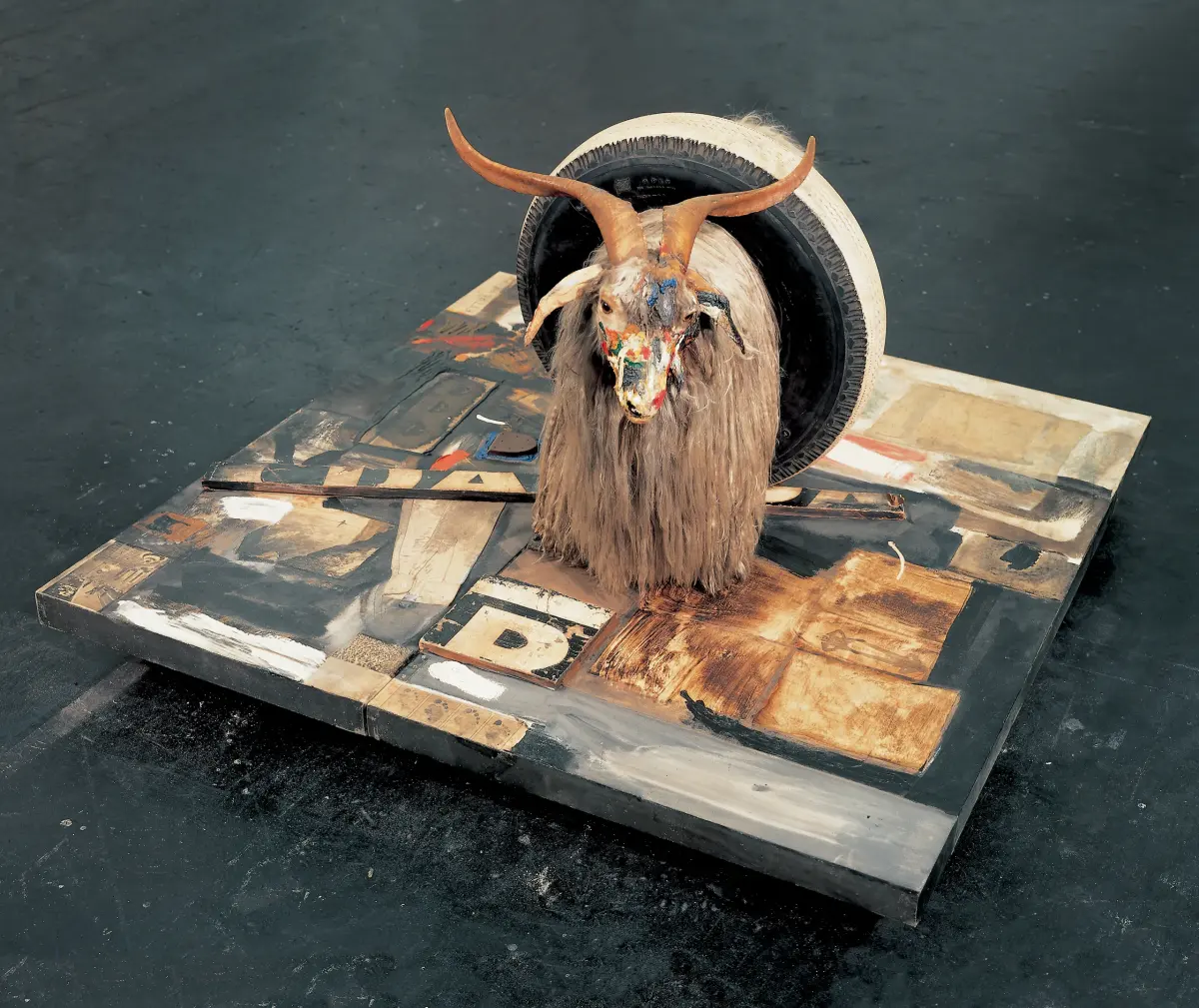
The defining contribution of Robert Rauschenberg’s career is the invention of the "Combine," a hybrid art form that blurred the distinction between painting and sculpture. Beginning in the mid-1950s, Rauschenberg began attaching found objects—such as tires, stuffed animals, pillows, and street signs—directly onto his canvases. By incorporating the physical debris of urban life, he rejected the elitism of high art and invited the chaotic, lived reality of the world into the gallery space.
These works challenged the prevailing dominance of Abstract Expressionism, which emphasized the artist’s internal emotional state. Instead, Rauschenberg sought to operate in the "gap between art and life." His most famous examples include Monogram, which features a taxidermied Angora goat encircled by a tire, and Bed, where he applied paint to a quilt and pillow. These pieces forced viewers to engage with art as a tactile, environmental experience rather than a static image.
How to understand Rauschenberg’s artistic process
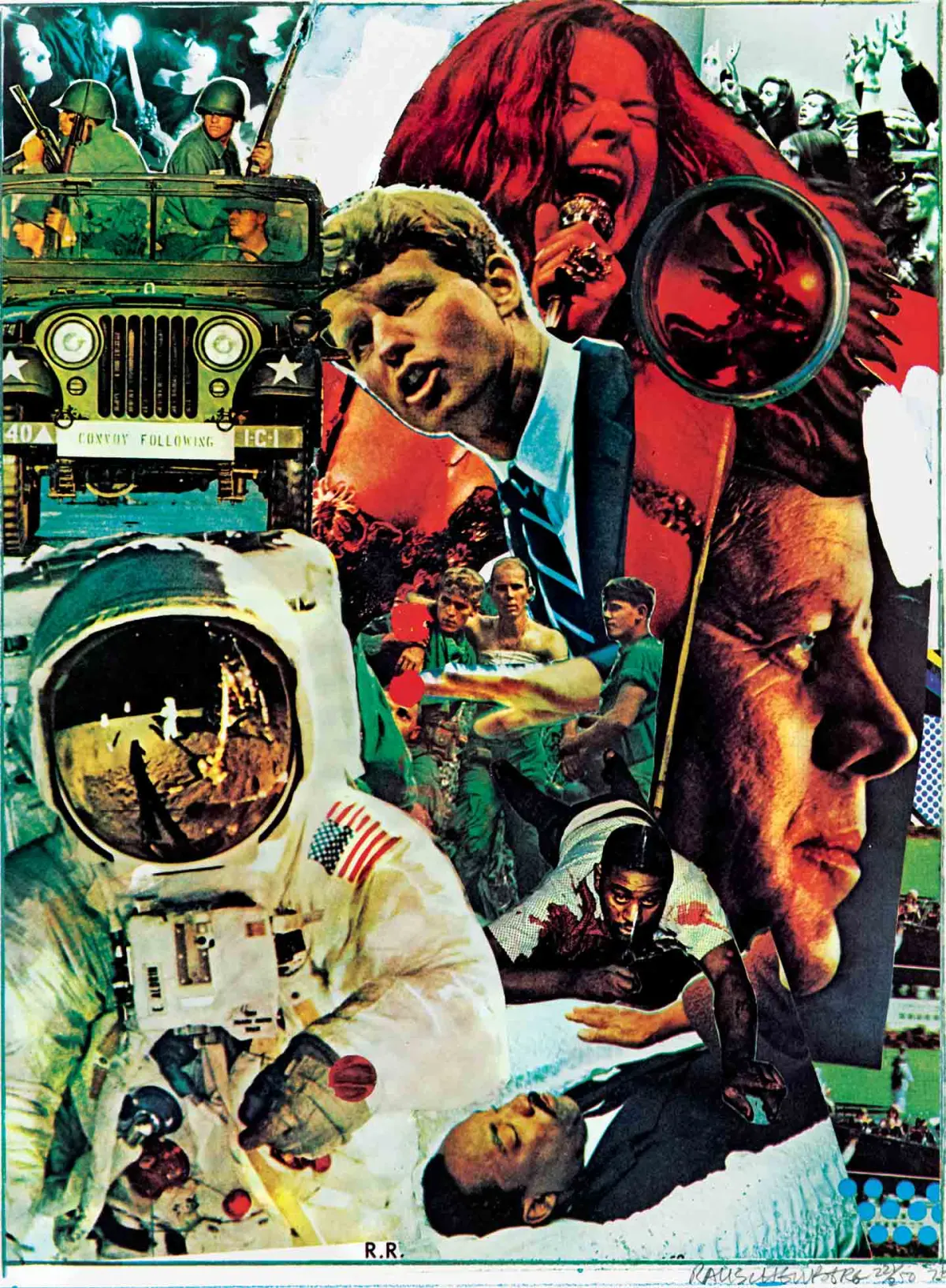
Rauschenberg’s creative methodology was rooted in curiosity and a refusal to be constrained by traditional media. He frequently utilized non-traditional materials, including silk screens, industrial solvents, and discarded newspaper clippings. His work often functioned as a visual archive of contemporary culture, reflecting the rapid pace of post-war American life through layers of images and textures.
To better appreciate his process, consider these key elements of his technical approach:
- Appropriation: He frequently used mass-media images, such as photographs of John F. Kennedy or NASA launches, to ground his work in current events.
- Layering: He utilized solvent transfers to move ink from printed magazines onto his own canvases, creating ghostly, fragmented compositions.
- Collaboration: He worked extensively with dancers, choreographers, and engineers to create multimedia performances that broke traditional boundaries between genres.
Why was Rauschenberg important to Pop Art?
While Rauschenberg is often categorized as a precursor to Pop Art, his work maintained a gestural, painterly quality that distinguished him from the more commercial, impersonal style of artists like Andy Warhol. He utilized the same imagery of consumer culture, but his application remained deeply personal and physically expressive. This unique position allowed him to influence a wide array of movements, including Minimalism, Conceptualism, and Fluxus.
His importance lies in his democratization of the art object. By proving that a discarded crate or a broken clock could be as significant as a brushstroke, he liberated subsequent generations of artists to use any material at their disposal. His work shifted the focus of art from the "originality" of the artist's hand to the "selection" and "recontextualization" of existing cultural artifacts. This shift remains a cornerstone of contemporary art theory and practice today.
Common mistakes when analyzing Rauschenberg’s work
Many viewers make the mistake of searching for a singular, hidden meaning within Rauschenberg’s complex compositions. Because his work is deliberately open-ended and non-narrative, attempting to decode his pieces like a puzzle often leads to frustration. Instead of looking for a specific message, it is more effective to view his works as visual poems that rely on the juxtaposition of disparate elements to evoke a mood or a historical moment.
Another common error is viewing his work as purely chaotic or random. While Rauschenberg embraced chance, his compositions were highly calculated and structured. He spent significant time balancing colors, weights, and spatial relationships within his Combines to ensure that the disparate objects functioned as a cohesive visual unit. When studying his work, focus on the following:
- Observe the balance between the painted areas and the attached objects.
- Identify how the artist uses repetition to guide the viewer’s eye across the canvas.
- Consider how the historical context of the 1950s and 60s informs the choice of specific found objects.
Best ways to explore Rauschenberg’s legacy
For those interested in exploring Rauschenberg’s work further, the best approach is to visit major museum collections that hold his key pieces, such as the Museum of Modern Art in New York or the Tate Modern in London. Because his work relies heavily on texture and scale, seeing the physical objects in person is essential to understanding their impact. His later work, particularly his large-scale silk screens and the Jammers series, also provides insight into his evolution toward more minimalist and colorful forms.
If you are a student or an artist, try experimenting with his techniques to understand his vision:
- Create a collage using only materials found in your immediate environment to practice the concept of "found art."
- Use a solvent transfer technique to move a printed image onto a piece of wood or fabric.
- Combine two unrelated objects into a single structure and observe how their meaning changes when they are placed together in a new context.
By engaging with these methods, you can gain a deeper appreciation for the technical and conceptual rigor that defined Rauschenberg’s storied career.
Key facts
- Robert Rauschenberg was a pioneer of the Neo-Dada movement, bridging the gap between Abstract Expressionism and Pop Art.
- He is most famous for his "Combines," a series of works from the 1950s that integrated everyday objects like pillows, tires, and clocks onto painted canvases.
- His 1955 work Bed is a defining example of a Combine, created by applying paint to a quilt, pillow, and sheet set mounted on a wooden support.
- In 1953, he famously created Erased de Kooning Drawing by obtaining a sketch from Willem de Kooning and painstakingly rubbing it out to explore the concept of art as subtraction.
- Rauschenberg was the first American artist to win the Golden Lion for painting at the Venice Biennale in 1964, signaling the shift of the art world center from Paris to New York.
- To practice Rauschenberg-style assemblage, start by collecting discarded household items and arranging them on a rigid surface before using acrylic medium to bind them to the canvas.
The bottom line
Robert Rauschenberg fundamentally altered the trajectory of 20th-century art by dismantling the boundaries between high art and everyday life. Through his innovative Combines and experimental use of mass media, he transformed discarded materials into profound cultural commentary. His legacy remains a testament to the power of curiosity and the belief that any object, no matter how mundane, holds the potential for artistic transformation.
People also ask
What is the main difference between Rauschenberg’s Combines and traditional sculpture?
Combines are hybrid works that blur the lines between painting and sculpture by hanging three-dimensional objects directly on a vertical surface. Unlike traditional sculpture, which is meant to be viewed from all sides, Combines are designed to be experienced primarily as a frontal, wall-mounted visual narrative.
Did Robert Rauschenberg work with other artists?
He was a highly collaborative artist who worked frequently with choreographer Merce Cunningham and composer John Cage. These partnerships often resulted in experimental performances and stage designs that incorporated live dance with visual art installations.
What was the significance of his "Silk Screen" paintings?
Starting in 1962, Rauschenberg used industrial silk-screening techniques to transfer photographic images from newspapers and magazines onto his canvases. This allowed him to comment on contemporary political events, such as the Vietnam War and the Space Race, by layering mass-produced imagery.
How did Rauschenberg influence the Pop Art movement?
By incorporating commercial products and celebrity imagery into fine art, he challenged the elitism of the art world. His willingness to use "junk" materials paved the way for artists like Andy Warhol and Roy Lichtenstein to embrace popular culture as a legitimate subject.
What common mistake should beginners avoid when making assemblage art?
A common error is failing to secure heavy objects properly, which can cause the piece to collapse or create an uneven weight distribution on the wall. Always use industrial-strength adhesives or mechanical fasteners like wire or screws to ensure that found objects are structurally sound.
Why did he erase a drawing by another artist?
The act was a conceptual gesture intended to question the definition of creativity and the value of an artist's mark. By removing the work of a master, Rauschenberg forced viewers to consider whether the act of destruction could be considered a creative process in its own right.
This answer was created with the help of AI research tools and reference sources. Spotted an error? Let us know — we correct mistakes quickly. See our editorial policy.