Why is Monet's Water Lilies so famous?
Short answer
Claude Monet’s Water Lilies series is famous for revolutionizing modern art through its radical departure from traditional perspective. By focusing on the ephemeral qualities of light and color rather than solid forms, Monet bridged the gap between Impressionism and abstraction, creating immersive, large-scale environments that fundamentally altered how viewers experience painting.
On this page
Why is Monet's Water Lilies so famous?
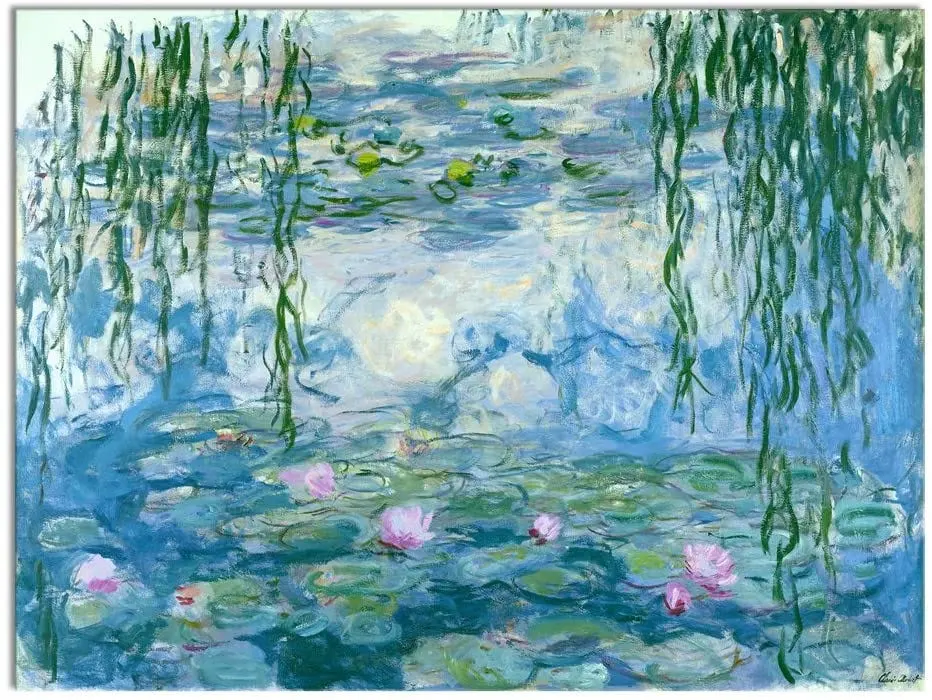
The fame of the Water Lilies series stems from Monet’s obsessive focus on his garden at Giverny during the final three decades of his life. Between 1899 and 1926, he produced approximately 250 oil paintings depicting his pond, capturing the shifting atmosphere of the water’s surface. Unlike his earlier works, these paintings often exclude the horizon line, forcing the viewer to look down into the water rather than across a landscape.
This shift in perspective was a deliberate artistic choice that challenged the conventions of the time. By removing the frame of reference, Monet transformed the canvas into a mirror of nature, where the sky and clouds are reflected alongside the lilies. This technique anticipated the development of Abstract Expressionism, as the brushwork became increasingly loose and the colors more expressive than descriptive. The series represents the culmination of a lifetime spent studying the mechanics of human vision.
How to appreciate the scale of the paintings
The Water Lilies are not merely individual canvases; they were conceived as massive, immersive installations. Monet designed the Grandes Décorations—a series of large, panoramic panels—to wrap around the walls of the Orangerie Museum in Paris. This architectural integration was intended to provide a meditative space where the viewer feels enveloped by the water and the flora, effectively erasing the boundary between the art and the spectator.
To fully appreciate this scale, consider these aspects of his installation design:
- The curved walls of the Orangerie were specifically built to accommodate the paintings, creating a continuous horizon.
- The lack of a defined focal point encourages the eye to wander across the surface, mimicking the experience of standing at the pond's edge.
- The varying sizes of the canvases, some reaching over six feet in height, force the viewer to physically move to take in the entire composition.
What techniques did Monet use?
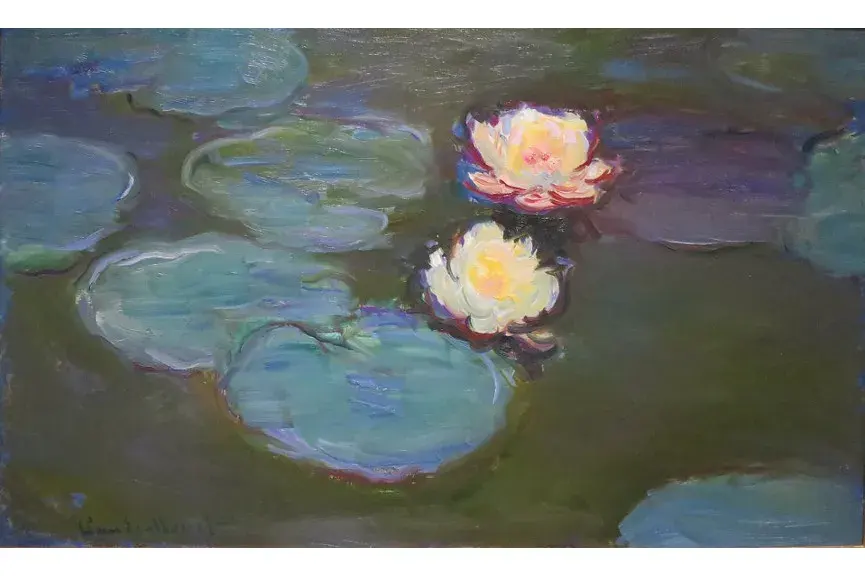
Monet’s technique evolved significantly as his eyesight began to fail due to cataracts. In his later years, he relied more on his memory and his deep familiarity with the garden, resulting in a more spontaneous and gestural application of paint. He used thick impasto, where paint is applied so heavily that it stands out from the surface, to catch the light and add a three-dimensional quality to the water.
His process involved several distinct steps:
- Observing the pond at different times of day to note how light altered the color of the water.
- Applying layers of color directly onto the canvas, often without preliminary sketches, to capture the fleeting moment.
- Using a limited palette of cool blues, violets, and greens, punctuated by vibrant bursts of yellow and red for the flowers.
- Refining the surface with short, rapid brushstrokes that blend in the viewer's eye from a distance.
Common mistakes when viewing Monet's work
Many visitors make the mistake of standing too close to the canvas, which prevents them from seeing the intended composition. Because Monet used thick, fragmented brushstrokes, the image can appear as a chaotic mess of color when viewed from inches away. To understand the depth and harmony of the work, you must step back several feet, allowing the individual strokes to coalesce into a coherent image of light and water.
Another common error is assuming that the paintings are meant to be literal representations of a garden. While they are based on reality, they are essentially studies in color theory and light. If you look for realistic detail, you will miss the emotional and atmospheric intent of the artist. The goal is to observe the interaction of light on the water's surface, not to identify individual plant species or specific pond features.
Where to see the Water Lilies today
While the Orangerie in Paris holds the most famous permanent installation, the Water Lilies are dispersed across major museums worldwide. Because Monet produced so many versions, you can find significant examples in the United States, Japan, and across Europe. Each museum offers a different context, but the experience remains consistent: a quiet, contemplative encounter with one of the most influential bodies of work in the history of art.
If you are planning to visit a collection, keep these tips in mind:
- Check the museum’s website for specific lighting conditions, as these paintings are sensitive to environmental factors.
- Visit during off-peak hours to ensure you have the quiet space necessary to properly engage with the expansive, meditative nature of the pieces.
- Look for the "bridge" paintings, which provide a rare structural anchor in the otherwise fluid and abstract compositions of the later years.
By following these suggestions, you will gain a deeper understanding of why Monet’s final masterwork remains a pinnacle of modern artistic achievement.
Key facts
- Claude Monet painted approximately 250 oil paintings in his Water Lilies series between 1899 and 1926.
- The works were created at his home in Giverny, France, where he diverted a local river to create his famous lily pond.
- These paintings are celebrated for abandoning traditional perspective, focusing instead on the play of light and color on water.
- Many of the largest panels, known as the Grandes Décorations, were designed to wrap around oval rooms to immerse the viewer.
- To view these works effectively, stand at various distances to appreciate how the thick, textured brushstrokes resolve into cohesive forms.
- Avoid viewing the paintings under direct, harsh lighting, as this can wash out the subtle color gradients Monet meticulously layered.
The bottom line
Monet’s Water Lilies remain iconic because they revolutionized modern art by prioritizing subjective perception over realistic detail. By capturing the ephemeral nature of light on water, Monet transformed a private garden into a universal experience of color and space. These masterpieces invite viewers to lose themselves in the canvas, marking a pivotal shift toward the abstract styles that would define the art of the 20th century.
People also ask
Where can I see the largest collection of Monet's Water Lilies?
The Musée de l'Orangerie in Paris houses the most famous large-scale installations in two custom-built oval rooms. Other significant collections are held at the Musée d'Orsay, the Art Institute of Chicago, and the Museum of Modern Art in New York.
Did Monet paint these works while he was losing his sight?
Yes, Monet suffered from severe cataracts during his later years, which influenced his shift toward more abstract, vibrant, and blurry compositions. He underwent surgery in 1923, which restored some of his vision, allowing him to refine his final works.
What is the significance of the Japanese bridge in his paintings?
The wooden Japanese-style footbridge was a central feature of Monet’s Giverny garden and a recurring subject in his early series. It represents his fascination with Japonisme, a trend of Japanese art influence that swept through 19th-century European painting.
Why are there no horizons in many of the Water Lilies paintings?
Monet intentionally removed the horizon line to emphasize the surface of the pond and the reflections of the sky. By doing so, he eliminated the distinction between the water and the atmosphere, creating a sense of infinite space.
How long did it take Monet to complete the entire series?
Monet worked on the Water Lilies theme for nearly 30 years, from 1897 until his death in 1926. He considered the project his life's work, constantly refining the canvases to capture the shifting light of different seasons.
Why are these paintings considered the precursor to Abstract Expressionism?
Later 20th-century artists viewed Monet’s move away from realistic representation as the birth of modern abstraction. His focus on pure color and gestural brushwork paved the way for painters like Jackson Pollock to prioritize emotion over literal subject matter.
This answer was created with the help of AI research tools and reference sources. Spotted an error? Let us know — we correct mistakes quickly. See our editorial policy.