Why is Impression, Sunrise so famous?
Short answer
Claude Monet’s Impression, Sunrise is famous because it provided the name for the Impressionist movement. Painted in 1872, its loose brushwork and focus on light over detail challenged the rigid standards of the French Academy. By capturing a fleeting moment in Le Havre, it fundamentally changed how artists perceive and represent reality.
On this page
Why is Impression, Sunrise considered a masterpiece?
Impression, Sunrise is celebrated primarily for its role as the catalyst for the Impressionist movement. When Monet exhibited the work in 1874, the critic Louis Leroy used the title of the painting to mock the artists, calling them "Impressionists" because he felt the work looked like a mere sketch rather than a finished piece. Instead of being insulted, the artists embraced the term, and it became the defining label for one of the most influential periods in art history.
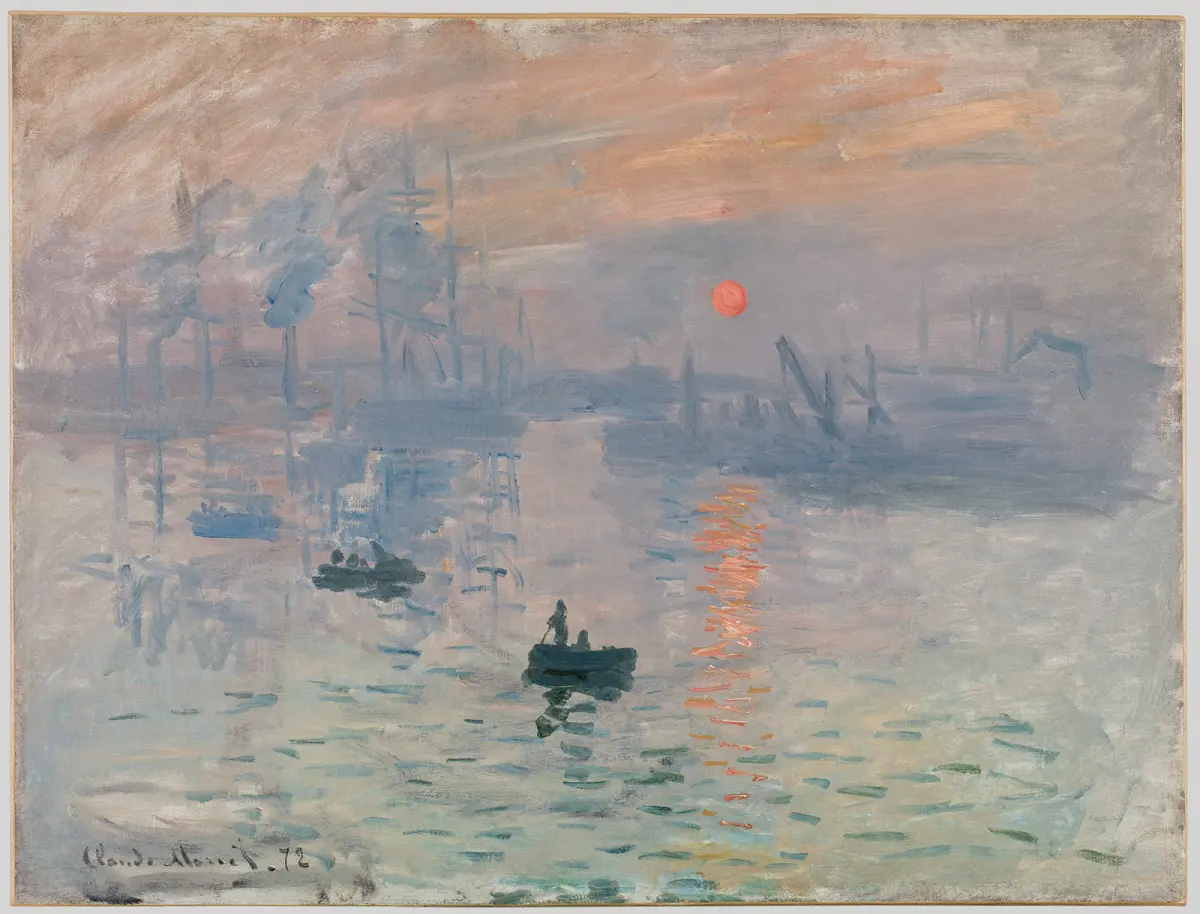
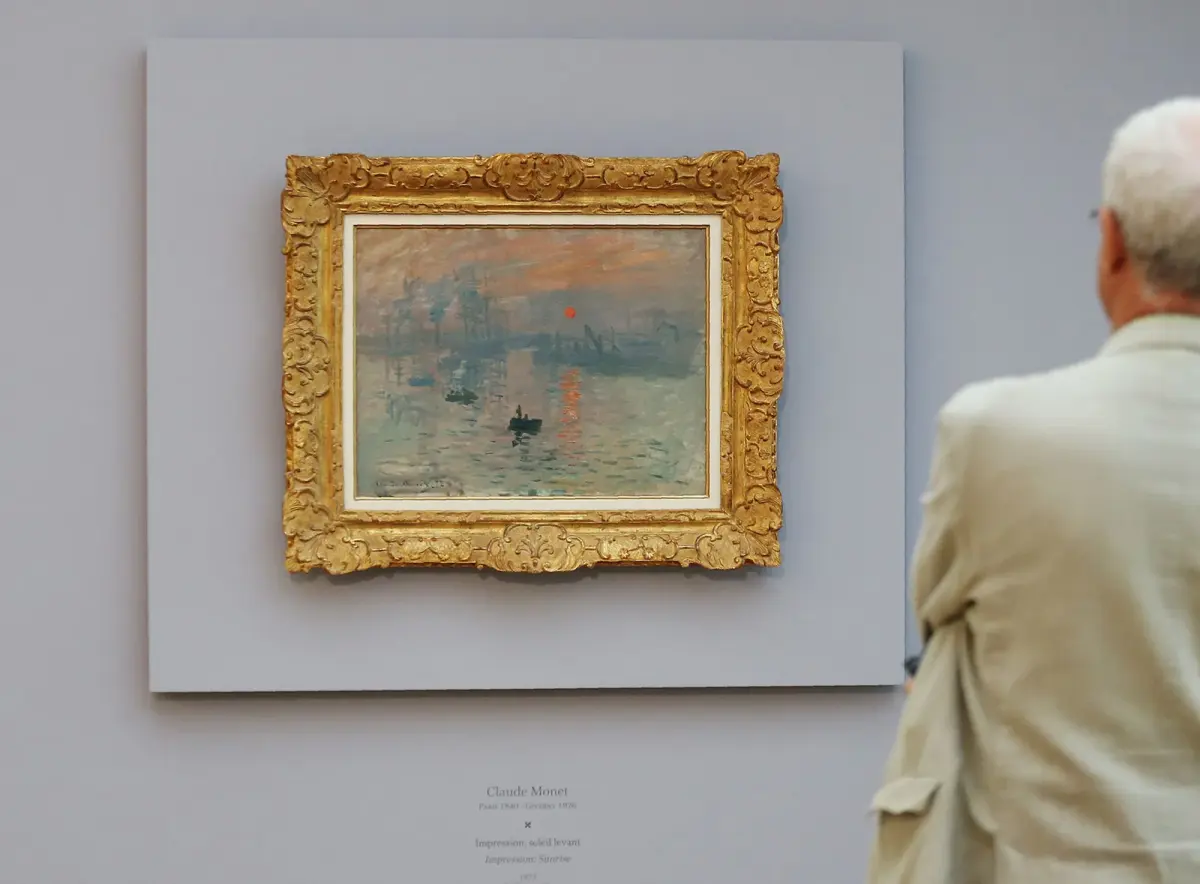
Beyond its historical significance, the painting is a masterpiece of atmospheric perspective. Monet used a limited palette of cool blues and grays contrasted with the vibrant, warm orange of the rising sun to create a sense of depth and movement. By focusing on the interplay of light and water rather than precise outlines, he captured the essence of a harbor at dawn. This approach shifted the focus of painting from historical or mythological subjects to the subjective experience of the modern world.
How did Monet paint Impression, Sunrise?
Monet created this work in 1872 while visiting his hometown of Le Havre, France. He painted the view from his hotel window, looking out over the harbor at dawn. Rather than attempting to document the scene with photographic accuracy, he used rapid, short brushstrokes to record the immediate visual sensation of the light hitting the water. This technique allowed him to capture the fleeting nature of time, a core goal of the Impressionist philosophy.
To achieve this effect, Monet employed specific artistic strategies that were revolutionary at the time:
- He applied paint in thin, visible layers to create a sense of vibration and light.
- He ignored traditional perspective rules, allowing the orange sun to appear as a focal point that sits on the surface of the canvas.
- He used a "broken color" technique, placing complementary colors side by side to make the light appear more intense to the human eye.
What makes the technique unique?
The technique used in Impression, Sunrise represents a radical departure from the academic painting styles of the 19th century. Traditionally, artists were expected to hide their brushstrokes and create smooth, polished surfaces that mimicked reality. Monet, however, celebrated the physical act of painting. By leaving his brushwork visible, he invited the viewer to participate in the construction of the image, as the eye must blend the individual strokes of color from a distance.
This emphasis on "the impression" rather than the "object" itself allowed for greater emotional expression. The painting functions as a record of a specific, transient moment in time, rather than a timeless, static representation. This shift was essential for the development of modern art, as it paved the way for later movements like Fauvism and Abstract Expressionism. By prioritizing the artist's perception over the subject's objective reality, Monet granted future generations the freedom to experiment with color and form in entirely new ways.
Common mistakes when analyzing Impressionist art
When viewing a work like Impression, Sunrise, many people make the mistake of looking for photographic detail. Because the painting is not meant to be a literal map of the harbor, judging it by the standards of realism will lead to confusion. Instead of looking for clear edges or defined structures, focus on the overall mood and the way the light interacts with the atmosphere. If you stand too close, the image may appear chaotic, but stepping back allows the colors to harmonize.
Another common error is assuming that the loose style was a result of a lack of skill. Monet was a highly trained artist who could paint with extreme precision when he chose to do so. The "unfinished" look was a deliberate, intellectual choice aimed at capturing the speed of modern life. To better appreciate the work, consider these steps:
- Observe the painting from several different distances to see how the image changes.
- Identify the primary light source and note how it affects the surrounding colors.
- Compare the painting to a photograph of the same location to see what details Monet chose to omit.
Where can you see Impression, Sunrise today?
The painting is currently housed at the Musée Marmottan Monet in Paris, France. It has a storied history, having been stolen in 1985 by armed robbers who entered the museum during daylight hours. The painting was missing for five years before being recovered by police in a villa in Corsica in 1990. Its recovery and return to the museum solidified its status as a cultural icon and a symbol of the resilience of French heritage.
If you are planning to visit the museum to see the work in person, keep in mind that the painting is relatively small, measuring only about 19 by 25 inches. This intimate size contributes to its impact, as it feels more like a personal observation than a grand, staged production. Viewing the original allows you to see the texture of the oil paint and the specific direction of the strokes, which are often lost in digital reproductions. It remains a must-see piece for anyone interested in the origins of modern artistic expression.
Key facts
- Claude Monet painted Impression, Sunrise in 1872 while visiting his hometown of Le Havre, France.
- The painting depicts the port of Le Havre at dawn, featuring orange sunlight contrasting against a dark, hazy blue background.
- It was first exhibited in April 1874 at a show organized by the Anonymous Society of Painters, Sculptors, and Engravers.
- The term "Impressionist" was coined by critic Louis Leroy in a satirical review, intended to mock the work as an unfinished "impression" rather than a painting.
- The artwork measures 48 centimeters by 63 centimeters and is currently housed in the Musée Marmottan Monet in Paris.
- To view the painting effectively, stand at a distance to allow the loose, rapid brushstrokes to coalesce into a cohesive scene of industrial harbor life.
The bottom line
Impression, Sunrise is famous because it inadvertently provided the name for one of history’s most influential art movements. By prioritizing the artist's immediate sensory experience over academic perfection, Monet challenged the artistic standards of the 19th century. Today, it serves as a foundational masterpiece that marks the transition toward modern art, reminding viewers that the essence of a scene often lies in its fleeting atmosphere.
People also ask
Why did critics initially dislike the painting?
Critics were accustomed to the polished, realistic style of the French Academy. They viewed Monet’s loose brushwork and lack of clear outlines as evidence of incompetence or laziness.
What is the significance of the orange sun in the painting?
The sun serves as the focal point and is the only element with high color saturation. It demonstrates Monet’s interest in capturing the fleeting effects of light rather than precise architectural detail.
Was the painting stolen?
Yes, Impression, Sunrise was stolen from the Musée Marmottan Monet in 1985. It was recovered five years later in 1990 and returned to the museum.
How does this painting differ from traditional landscape art?
Traditional landscapes prioritized deep perspective and realistic textures. Monet prioritized the subjective experience of a moment, using color to convey atmosphere rather than physical form.
Did Monet intend for the painting to be controversial?
Monet was committed to his personal style, but he did not set out to start a revolution. He simply wanted to capture the specific quality of light he observed in the harbor.
Can I see the original painting in person today?
Yes, the painting remains a permanent part of the collection at the Musée Marmottan Monet in Paris. It is displayed in a dedicated space that highlights its historical importance.
This answer was created with the help of AI research tools and reference sources. Spotted an error? Let us know — we correct mistakes quickly. See our editorial policy.