Who invented the smartphone?
Short answer
The smartphone was not invented by a single individual but emerged from the convergence of mobile telephony and personal computing. IBM is widely credited with creating the first true smartphone, the Simon Personal Communicator, which was unveiled in 1992 and released commercially in 1994, establishing the foundation for the modern mobile industry.
On this page
Who actually created the first smartphone?
The IBM Simon Personal Communicator is recognized by historians as the world's first smartphone. Developed under the codename "Angler," it was first demonstrated as a prototype at the COMDEX computer trade show in Las Vegas in 1992. It featured a monochrome LCD touchscreen and allowed users to send and receive faxes, emails, and cellular pages.
While it lacked the high-speed internet connectivity of today's devices, it integrated a calendar, address book, calculator, and notepad. The device weighed about 1.1 pounds and cost $899 with a two-year contract. Although it was only sold for six months, it proved that a handheld device could function as more than just a telephone, setting a precedent for future mobile innovation.
How did smartphones evolve over time?
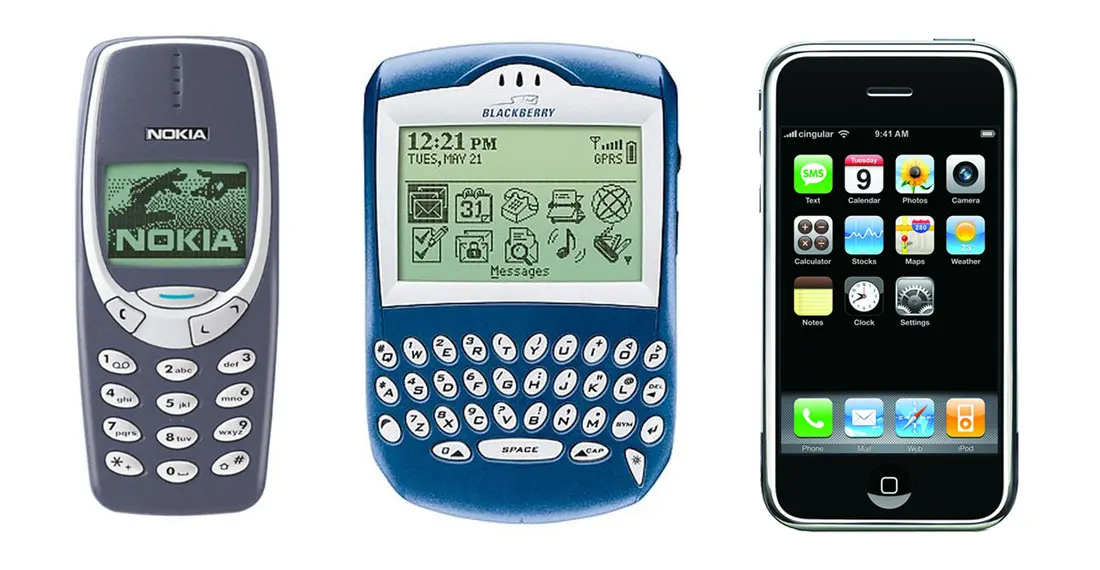
Following the IBM Simon, other companies attempted to merge computing with telephony throughout the late 1990s. Nokia introduced the Communicator series in 1996, which featured a physical QWERTY keyboard and a wider screen. BlackBerry, then known as Research In Motion, later dominated the enterprise market by focusing on secure email delivery and physical keyboards.
The industry underwent a massive shift in 2007 with the release of the Apple iPhone. By removing the physical keyboard in favor of a multi-touch interface, Apple redefined how users interacted with mobile software. This era marked the transition from niche business tools to essential consumer devices. Key milestones in this evolution include:
- 1994: IBM Simon released as the first commercial smartphone.
- 1996: Nokia 9000 Communicator integrates internet and email.
- 2002: BlackBerry 5810 introduces integrated wireless email.
- 2007: Apple iPhone launches with a full web browser and touch interface.
- 2008: T-Mobile G1 becomes the first device to run the Android operating system.
Which features define a modern smartphone?
A device is classified as a smartphone if it combines the functions of a mobile phone with an advanced operating system. Unlike feature phones, which are limited to basic calling and texting, smartphones support third-party applications. These apps allow users to customize their devices for navigation, photography, banking, and entertainment.
Modern smartphones rely on high-capacity processors, high-resolution cameras, and constant internet connectivity via Wi-Fi or cellular networks. They also incorporate sensors like accelerometers, gyroscopes, and GPS chips to provide context-aware services. To be considered a contemporary smartphone, a device typically requires:
- An operating system capable of running diverse applications.
- A high-speed mobile data connection.
- Advanced multimedia capabilities, including high-definition video recording.
- A touch-sensitive screen for intuitive user navigation.
Why do people confuse the inventor?
The confusion regarding the "inventor" of the smartphone stems from the fact that the technology resulted from decades of incremental improvements. Many people associate the invention with the iPhone because it brought smartphones into the mainstream consciousness. However, the iPhone was the culmination of existing technologies rather than the creation of a new category.
Early pioneers like IBM, Nokia, and Palm laid the groundwork for mobile computing long before the touchscreen revolution. Because these early devices were expensive and primarily targeted at corporate executives, they remained largely invisible to the general public. This lack of widespread adoption makes it easy for consumers to overlook the foundational work done in the 1990s and early 2000s.
Common mistakes when researching smartphone history
When studying the history of mobile technology, many learners make the mistake of focusing only on the most famous brands. It is important to look at the patent filings and trade show archives from the early 1990s to understand the true origins. Another common error is assuming that a "mobile phone" and a "smartphone" are the same thing; the latter specifically requires an operating system.
To conduct accurate research, avoid relying on marketing materials from a single manufacturer, as they often claim to have "invented" features that were actually industry standards for years. Instead, verify technical specifications and release dates through independent technology journals. By following these steps, you can avoid common pitfalls:
- Check the release dates of operating systems rather than just hardware.
- Distinguish between a device with a touchscreen and a true smartphone.
- Research the history of Personal Digital Assistants (PDAs) to see how they merged with cellular radios.
- Verify if a device supported third-party software installation, which is a core requirement for the smartphone definition.
Key facts
- IBM released the Simon Personal Communicator in 1994, widely considered the world’s first smartphone.
- The device featured a touchscreen, email capabilities, a calendar, and a calculator.
- It sold for $899 with a two-year contract or $1,099 without one, targeting business professionals.
- Apple’s iPhone, launched in 2007, revolutionized the industry by introducing a multi-touch interface and a full web browser.
- Modern smartphones rely on operating systems like Android or iOS to manage hardware and third-party applications.
- Avoid treating your smartphone like a desktop computer; regularly clear your cache and update software to maintain security and speed.
The bottom line
The smartphone was not invented by a single person but evolved through decades of engineering. IBM’s 1994 Simon introduced the concept, while Apple’s 2007 iPhone refined the user experience for the masses. Today, these devices act as essential pocket computers. Understanding this history helps users appreciate the rapid technological progress that has transformed how we communicate, work, and access information in our daily lives.
People also ask
What was the first phone to have an app store?
The T-Mobile G1, released in 2008, was the first device to feature the Android Market. This allowed users to download software directly to their phones rather than installing it via a computer.
Did BlackBerry invent the smartphone?
BlackBerry did not invent the smartphone, but they popularized mobile email and secure messaging in the early 2000s. Their physical QWERTY keyboards became the industry standard for business communication before touchscreens took over.
When did smartphones become mainstream?
Smartphones entered the mainstream between 2007 and 2010. The release of the iPhone and the subsequent rise of Android devices made high-speed internet and mobile applications accessible to the general public.
What is the difference between a feature phone and a smartphone?
A feature phone is primarily designed for calls and text messages with limited extra functions. A smartphone runs a robust operating system that supports advanced computing, high-speed internet, and complex software applications.
Why are modern smartphones so expensive?
High costs reflect the integration of advanced components like high-resolution OLED screens, sophisticated camera arrays, and powerful processors. Research and development for new hardware and software also contribute significantly to the retail price.
How long should a smartphone last?
Most smartphones are designed to perform optimally for three to five years. Battery degradation and software incompatibility with newer apps are the primary reasons users eventually upgrade their devices.
This answer was created with the help of AI research tools and reference sources. Spotted an error? Let us know — we correct mistakes quickly. See our editorial policy.