Who invented the internet?
Short answer
The internet was not invented by a single person but emerged from collaborative research funded by the U.S. Department of Defense. Vint Cerf and Bob Kahn are widely recognized for creating the TCP/IP protocols, while Tim Berners-Lee later invented the World Wide Web, the application that made the internet accessible to the public.
On this page
Who actually created the internet?
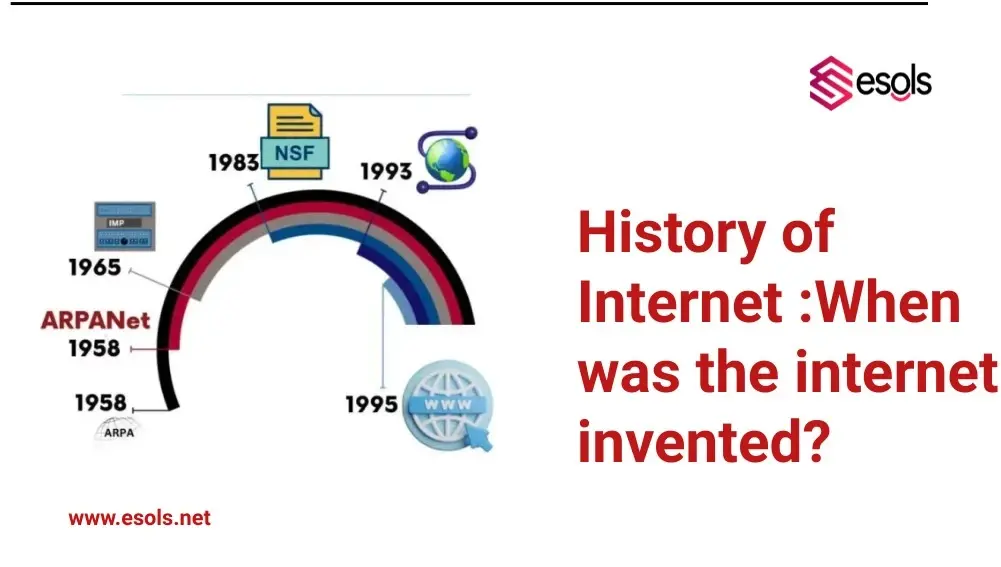
The internet began as ARPANET, a project commissioned by the Advanced Research Projects Agency (ARPA) in the 1960s. Researchers sought a way to connect disparate computer systems to share processing power and data across long distances. This required a method of breaking information into small "packets" that could travel independently across a network and reassemble at their destination.
Key figures in this early development included J.C.R. Licklider, who envisioned a "Galactic Network," and Leonard Kleinrock, who developed the mathematical theory of packet switching. By 1969, the first successful message was sent between computers at UCLA and Stanford. These foundational efforts established the hardware and basic connectivity standards that would eventually grow into the global infrastructure we use today.
How do TCP/IP protocols work?
In the 1970s, the challenge shifted to connecting different types of networks. Vint Cerf and Bob Kahn developed the Transmission Control Protocol and Internet Protocol (TCP/IP), which acted as a universal language for computers. This allowed diverse networks to communicate seamlessly, effectively creating a "network of networks."
The adoption of these protocols on January 1, 1983, is often considered the official birthday of the modern internet. Without these rules, data would have no reliable way to navigate the complex web of global infrastructure. Today, every device connected to the internet uses these protocols to ensure that emails, videos, and websites reach the correct destination without errors or data loss.
- Data is broken down into small, manageable packets.
- Each packet is labeled with the sender's and receiver's IP address.
- Routers direct these packets across the most efficient path available.
- The receiving computer reassembles the packets in the correct order.
What is the difference between the internet and the web?
Many people mistakenly use the terms "internet" and "World Wide Web" interchangeably, but they are distinct technologies. The internet is the underlying physical and logical infrastructure—the cables, routers, and protocols that connect computers globally. The World Wide Web is an application that runs on top of the internet, using browsers to display pages.
Tim Berners-Lee, a British scientist at CERN, invented the web in 1989. He created HTML (HyperText Markup Language), HTTP (HyperText Transfer Protocol), and the first web browser to make information sharing easier for researchers. His invention transformed the internet from a technical tool for academics and the military into a user-friendly space for the general public.
- Internet: The infrastructure of connected networks.
- Web: The system of linked documents accessed via the internet.
- Browser: The software used to view web pages.
- Server: The computer that hosts website data.
Why do people confuse the inventors?
The confusion regarding the internet's invention stems from the project's massive scale and long timeline. Because it evolved over decades through the work of thousands of engineers, scientists, and government officials, it lacks a single "Eureka" moment. Early media reports often focused on political figures or high-profile agency heads, further obscuring the technical contributions of the actual researchers.
Public perception is also influenced by the rapid commercialization of the web in the 1990s. When companies like Netscape and AOL brought the internet into homes, the public associated the technology with the entrepreneurs of that era rather than the government-funded researchers of the 1960s. Understanding this history requires distinguishing between the foundational network architecture and the later software applications that popularized the medium.
Common mistakes when researching internet history
A common error is assuming the internet was designed to survive a nuclear attack. While researchers did prioritize robust, decentralized communication, the primary goal was resource sharing among research institutions. Another frequent mistake is ignoring the global nature of the development process; while American funding was central, international contributions to hardware, fiber optics, and software standards were equally vital to the network's success.
When researching this topic, avoid relying on singular narratives that credit one individual with the entire invention. Instead, look for the distinction between packet switching, protocol development, and the creation of the user interface. By separating these layers, you can better appreciate how a complex, decentralized system was built through decades of incremental innovation and international cooperation. Always verify dates against established technical milestones rather than anecdotal accounts to ensure accuracy.
Key facts
- Vint Cerf and Bob Kahn are widely considered the "fathers of the internet" for developing the TCP/IP protocols in the 1970s.
- ARPANET, funded by the U.S. Department of Defense, sent the first host-to-host message between UCLA and SRI International on October 29, 1969.
- Tim Berners-Lee invented the World Wide Web in 1989, which is the system of interlinked hypertext documents accessed via the internet.
- The internet is a global network of networks, while the web is an application that runs on top of that infrastructure.
- Packet switching, a method of grouping data into small chunks for transmission, was independently developed by Paul Baran and Donald Davies.
- To understand internet architecture, distinguish between physical infrastructure like fiber-optic cables and logical protocols like HTTP and IP.
The bottom line
The internet was not the invention of a single person but the result of decades of collaborative research by scientists, engineers, and government agencies. While figures like Cerf, Kahn, and Berners-Lee provided critical foundations, the modern internet evolved through a decentralized process. Understanding this history clarifies that the network is a shared, global utility built upon open standards rather than a proprietary product owned by one entity.
People also ask
What is the difference between the internet and the World Wide Web?
The internet is the underlying hardware and software infrastructure that connects computers globally. The World Wide Web is a service that uses the internet to display linked pages through browsers.
Did Al Gore invent the internet?
No, Al Gore did not invent the internet, though he was a key political supporter who helped pass legislation to fund and expand its development. He famously stated he took the initiative in creating the internet, referring to his legislative work.
When did the public start using the internet?
Public access began to grow rapidly in the early 1990s after the release of the Mosaic web browser. Before this, the internet was primarily used by academic, military, and research institutions.
What was the first message ever sent on the internet?
The first message was intended to be "LOGIN," but the system crashed after the first two letters. Therefore, the first successful transmission between two computers was simply "LO."
Is there a single person who owns the internet?
No individual, government, or corporation owns the internet. It is a decentralized collection of thousands of independent networks that agree to communicate using shared protocols.
Why was the internet originally created?
The internet originated as a military project called ARPANET to create a communication network that could survive a partial outage. Researchers wanted a way to share computing resources across geographically distant locations.
This answer was created with the help of AI research tools and reference sources. Spotted an error? Let us know — we correct mistakes quickly. See our editorial policy.