Who invented the Rubik's Cube?
Short answer
Ernő Rubik, a Hungarian architecture professor, invented the Rubik’s Cube in 1974. He originally designed the device, known as the "Magic Cube," as a teaching tool to help his students understand three-dimensional movement. It was later licensed to the Ideal Toy Corporation and became a global phenomenon in the early 1980s.
On this page
Who was the inventor of the Rubik's Cube?
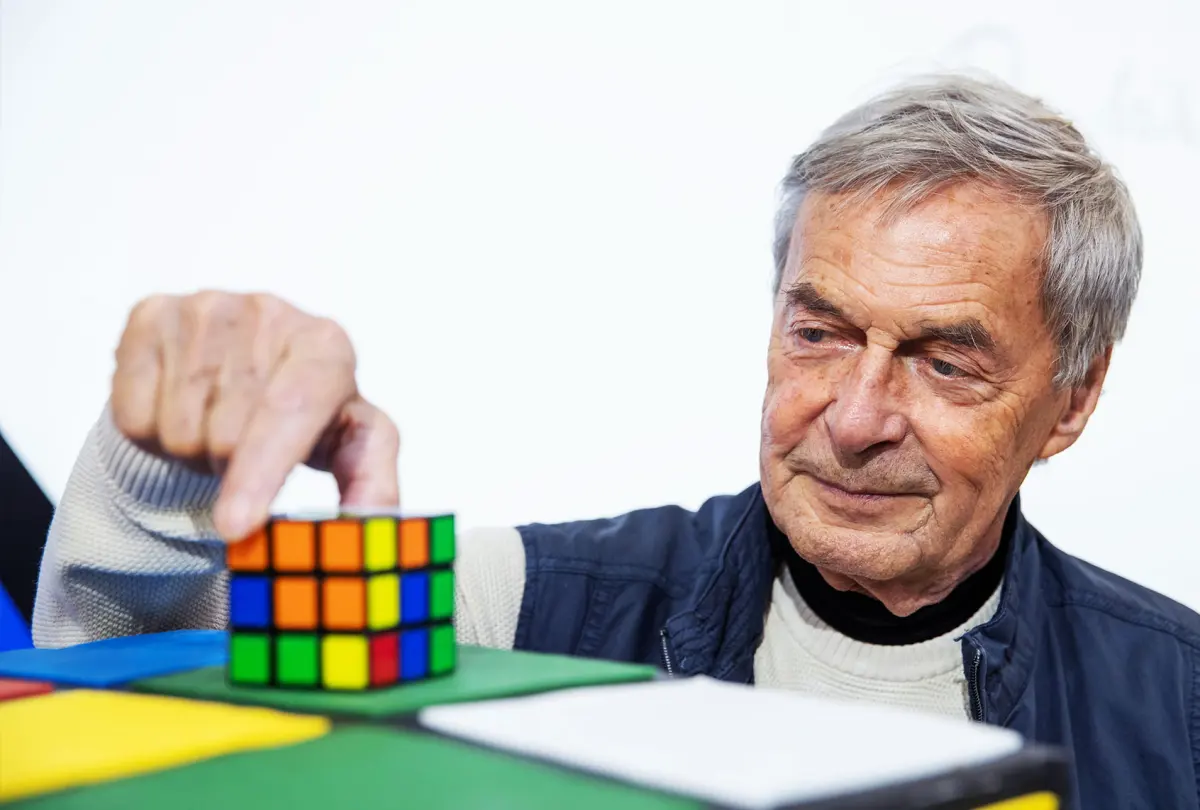
Ernő Rubik was born in Budapest, Hungary, in 1944. As a professor at the Academy of Applied Arts and Crafts, he was fascinated by the concept of spatial relationships and the structural integrity of objects. He wanted to create a model that could move independently without the entire mechanism falling apart, which led to his experimental work with wood and paper blocks.
The prototype was constructed in 1974 using wooden blocks held together by rubber bands and paper clips. Rubik spent an entire month trying to solve his own invention after scrambling the colors for the first time. He realized that the puzzle was not just a structural experiment but a challenging game that required logical thinking. His invention was patented in Hungary in 1975 and officially launched as the "Bűvös Kocka," or Magic Cube, in local toy shops by 1977.
How does the Rubik's Cube mechanism work?
The internal structure of a standard 3x3x3 cube is a sophisticated system of plastic parts. At the center of the cube is a "core" shaped like a cross, which allows the six center pieces to remain fixed in their relative positions. Each face of the cube rotates around this central mechanism, held in place by tension springs and screws that ensure smooth movement.
The pieces that make up the cube are categorized into three distinct types based on their position and movement:
- Center pieces: These are fixed to the core and do not move relative to one another.
- Edge pieces: These have two colors and sit between the center pieces.
- Corner pieces: These have three colors and occupy the eight corners of the cube.
When a layer is turned, the edge and corner pieces slide along tracks carved into the internal core, allowing the cube to change configuration while maintaining its overall shape.
How to solve a Rubik's Cube for beginners
Solving the cube for the first time can seem daunting, but it relies on a series of repeatable algorithms. Most beginners use the "layer-by-layer" method, which focuses on solving the bottom layer first, then the middle, and finally the top. Consistency and patience are more important than speed when learning these initial sequences.
Follow these fundamental steps to complete your first solve:
- Create a "white cross" on the top face, ensuring the side colors match the center pieces.
- Place the white corner pieces to complete the first layer.
- Use specific algorithms to insert the middle layer edge pieces without disturbing the first layer.
- Orient the top layer to form a yellow cross and then position the final corner pieces.
- Apply the final sequence of moves to permute the corners into their correct locations.
Common mistakes when learning to solve the cube
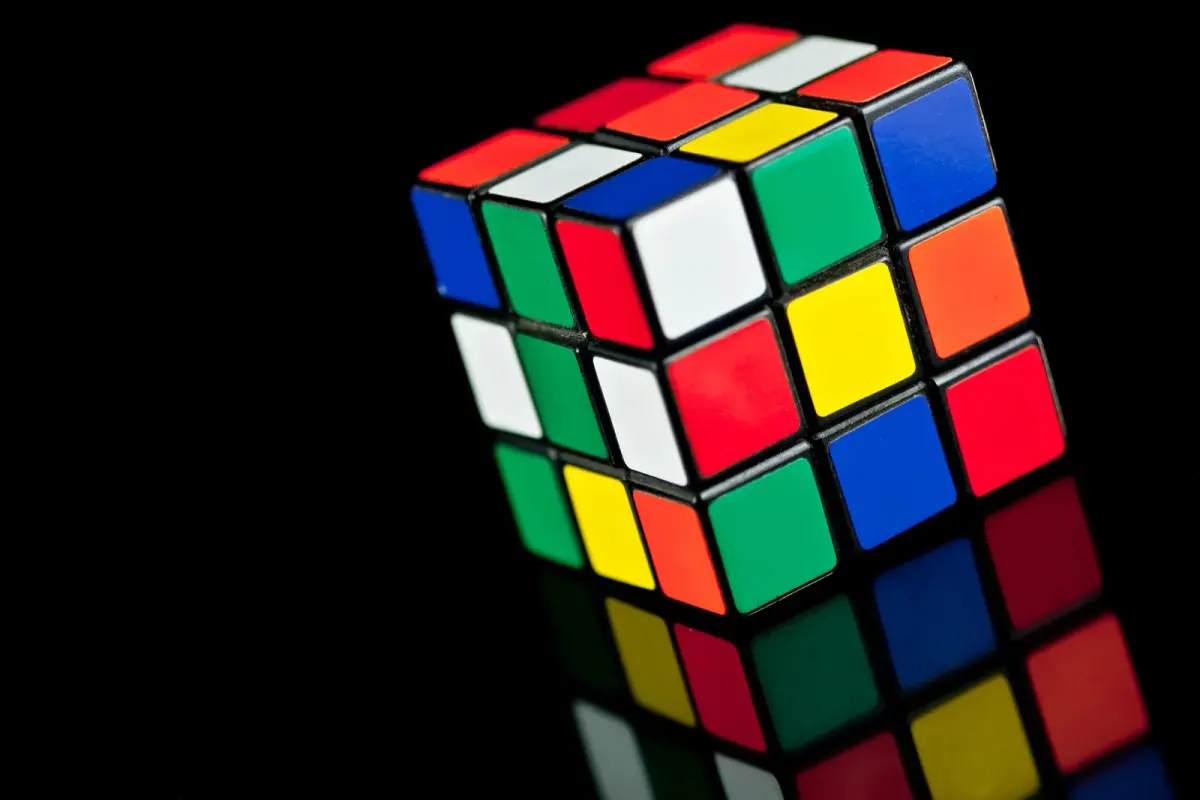
One of the most frequent errors beginners make is attempting to solve the cube one face at a time. While this seems intuitive, it is mathematically impossible to complete the puzzle this way because the pieces are interconnected. Trying to finish one color completely usually results in a scrambled state for the rest of the cube, making it impossible to finish the final face.
Another common mistake involves losing track of the orientation of the cube. If you rotate the entire cube in your hands while performing an algorithm, you will lose your place and disrupt the sequence. Always keep the same face pointing toward you throughout a specific set of moves. Additionally, beginners often force the cube to turn when it is slightly misaligned. This can cause the internal pieces to pop out or the mechanism to jam, which may damage the plastic parts over time.
Why did the Rubik's Cube become so popular?
The Rubik's Cube became a cultural icon because it provided a universal challenge that transcended language and age. When it was licensed for international distribution in 1980, it coincided with a growing interest in logic puzzles and brain teasers. Its simple design, combined with the extreme difficulty of solving it without instructions, created a sense of accomplishment that appealed to millions of people worldwide.
The toy's popularity was further cemented by the first world championship held in Budapest in 1982. This event sparked a competitive culture that continues to thrive today through "speedcubing," where participants compete to solve the cube in mere seconds. The cube remains a staple in classrooms and homes alike, serving as a testament to the enduring appeal of mechanical puzzles. Its legacy is not just in its sales, which number in the hundreds of millions, but in its ability to inspire generations of people to engage with geometry and problem-solving through play.
Key facts
- The Rubik's Cube was invented in 1974 by Ernő Rubik, a Hungarian professor of architecture.
- It was originally created as a teaching tool to help students understand three-dimensional objects and spatial relationships.
- The puzzle was first marketed in Hungary as the "Magic Cube" before being renamed for international distribution in 1980.
- A standard 3x3x3 cube features 26 individual "cubies" that rotate around a central core mechanism.
- Solving the cube requires memorizing algorithms, which are specific sequences of moves that reposition pieces without disturbing others.
- Beginners should avoid "peeling" stickers to rearrange the cube, as this damages the toy and prevents learning the logic of the puzzle.
The bottom line
Ernő Rubik’s invention remains one of the world’s most iconic puzzles, evolving from a classroom aid into a global phenomenon. While its 43 quintillion combinations seem daunting, mastering the cube is a logical process of learning specific algorithms. By focusing on the fixed center pieces and practicing the layer-by-layer method, anyone can move beyond frustration and eventually solve the puzzle with speed and confidence.
People also ask
How many possible combinations does a standard 3x3x3 Rubik’s Cube have?
A standard cube has approximately 43 quintillion possible configurations. Despite this massive number, every position can be solved in 20 moves or fewer.
What is the fastest time to solve a Rubik’s Cube?
The world record for the fastest single solve is 3.13 seconds, set by Max Park in 2023. Most casual solvers take several minutes to complete the puzzle using beginner methods.
Are there different sizes of Rubik’s Cubes?
Yes, there are many variations ranging from the 2x2x2 "Pocket Cube" to the complex 17x17x17 version. The internal mechanics vary by size, but the fundamental logic of grouping colors remains consistent.
What is the best way for a beginner to start solving the cube?
Beginners should learn the "layer-by-layer" method. This involves solving the bottom layer, then the middle, and finally the top, which simplifies the process into manageable stages.
Why do some people use "speedcubes" instead of standard cubes?
Speedcubes are designed with specialized internal magnets and lubricants to reduce friction and allow for faster, smoother rotations. They are essential for competitive cubing but can be too loose for beginners.
Does the center piece of a Rubik’s Cube move?
No, the center piece of each face is fixed to the internal core and does not change position. The color of the center piece defines the color of the entire side.
This answer was created with the help of AI research tools and reference sources. Spotted an error? Let us know — we correct mistakes quickly. See our editorial policy.