Who invented the sticky note?
Short answer
Dr. Spencer Silver, a chemist at 3M, invented the unique low-tack adhesive in 1968. However, it was his colleague Art Fry who conceived the practical application of using the adhesive on paper bookmarks in 1974. Together, they developed the iconic Post-it Note, which 3M officially launched to the public in 1980.
On this page
Who invented the sticky note?
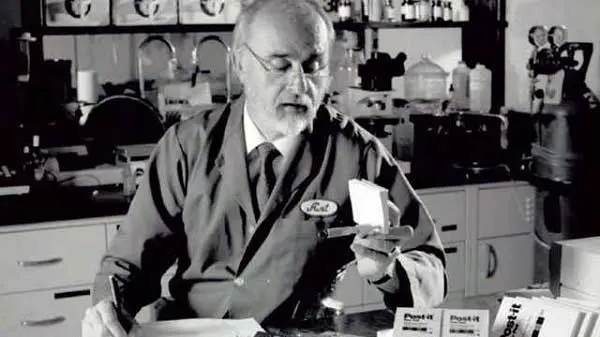
The invention of the sticky note was a collaborative process spanning several years at the 3M company. In 1968, Dr. Spencer Silver was working to develop a super-strong adhesive for the aerospace industry. Instead, he accidentally created a "low-tack," pressure-sensitive adhesive. This substance was unique because it could stick to surfaces repeatedly without leaving a residue or damaging the underlying material.
For several years, Silver struggled to find a practical use for his invention. He promoted the adhesive within 3M, but colleagues were initially skeptical of a glue that did not hold things together permanently. It was not until 1974 that Art Fry, a fellow 3M scientist, realized the potential for the adhesive. Fry sang in his church choir and grew frustrated when his paper bookmarks kept falling out of his hymnal. He realized that Silver’s adhesive could keep his markers in place without damaging the book pages.
How the sticky note was developed
Once Art Fry identified the need for a removable bookmark, he and Spencer Silver began prototyping. They coated pieces of paper with the adhesive, testing various levels of tackiness to ensure the notes would stay put but peel away easily. This period of development required significant internal advocacy, as 3M management was initially hesitant to invest in a product that seemed to contradict the purpose of traditional glue.
The team eventually moved from the laboratory to internal testing. They distributed the notes to 3M employees, who quickly discovered that the pads were useful for far more than just bookmarks. The notes became essential for office communication, reminders, and organization. This internal "bootlegging" of the product proved its market viability. The development process highlights how innovation often stems from solving a small, specific problem and then observing how users adapt the solution for broader, unforeseen purposes.

When were sticky notes released?
The path to a successful commercial launch was not immediate. After the internal success of the notes, 3M launched a test market in Boise, Idaho, in 1977 under the name "Press 'n Peel." The results were disappointing, as consumers did not immediately understand the value of the product. Many people were accustomed to traditional tape or scraps of paper and did not see the benefit of paying for a specialized adhesive note.
3M decided to try a different strategy, known as the "Boise Blitz," in 1978. They sent free samples directly to office managers and administrative assistants in the area. Once people began using the notes in their daily workflows, demand skyrocketed. This direct-to-user approach proved that the product needed to be experienced to be appreciated. Following the success of the Boise campaign, the product was officially rebranded as the Post-it Note and launched across the United States in 1980.

How to use sticky notes effectively
To get the most out of sticky notes in a professional or personal setting, users should follow a few best practices. The adhesive is designed to work best when peeled from the side rather than the bottom. Pulling the note upward from the bottom often causes the paper to curl, which prevents it from lying flat against the surface.
- Peel the note from the side of the pad.
- Apply the note to a clean, dry surface.
- Smooth the adhesive strip down with your finger.
- Remove the note by pulling it parallel to the surface to maintain the adhesive's integrity.
Common mistakes include applying notes to dusty or oily surfaces, which weakens the bond significantly. Additionally, users often attempt to write on the note while it is still attached to the pad, which can cause the ink to bleed through to the page below. It is always better to write your message before sticking the note to your monitor or document.
Why sticky notes are still popular
Despite the rise of digital task managers and smartphone applications, the physical sticky note remains a staple in offices and homes worldwide. Their popularity endures because they provide a tactile, visual reminder that is impossible to ignore. Unlike a digital notification that can be swiped away or buried in a menu, a physical note occupies space in the real world, serving as a persistent prompt until the task is completed.
- They require no power or software updates to function.
- They are highly portable and can be moved between surfaces.
- They provide a sense of accomplishment when physically removed and discarded.
- They are excellent for brainstorming sessions and collaborative group work.
The simplicity of the design is its greatest strength. By providing a low-friction way to organize thoughts and communicate quick messages, the sticky note remains one of the most successful office inventions of the 20th century. It serves as a reminder that the most effective tools are often those that integrate seamlessly into our existing habits rather than forcing us to change them.
Key facts
- Spencer Silver, a 3M scientist, accidentally created a low-tack, reusable adhesive in 1968.
- Arthur Fry, a colleague of Silver, conceived the idea of using the adhesive to keep bookmarks in his hymnal in 1974.
- The product was officially launched as "Post-it Notes" in 1980 after a successful test market in Boise, Idaho.
- The iconic canary yellow color was chosen by chance because the lab next door only had yellow scrap paper available.
- To maximize stickiness, apply the note to a clean, dry, and flat surface to prevent dust from compromising the adhesive.
- Avoid peeling a note from the bottom up, as this causes the paper to curl; instead, peel it from the side to keep it flat.
The bottom line
The invention of the sticky note stands as a testament to the power of serendipity in scientific research. By combining Spencer Silver’s unique, low-tack adhesive with Arthur Fry’s practical need for a bookmark, 3M transformed a "failed" experiment into a global office staple. Today, these simple yellow squares remain an essential tool for organization, proving that even minor innovations can fundamentally change how we communicate and work.
People also ask
Why are Post-it Notes traditionally yellow?
The signature yellow color was the result of a happy accident during the initial development phase. The team needed scrap paper for testing and the only available supply in the laboratory happened to be yellow.
Can you recycle sticky notes?
Yes, most sticky notes are recyclable because the adhesive is specifically designed to be removed during the paper pulping process. You should check with your local recycling facility to confirm their specific policies regarding adhesive-backed paper.
How do you keep sticky notes from curling?
The most common mistake is pulling the note upward from the bottom of the pad. To prevent curling, peel the note off from the side, moving horizontally across the adhesive strip.
What was the original name of the product?
When 3M first test-marketed the product in 1977, it was called "Press 'n Peel." It was later rebranded to "Post-it Notes" for its national launch in 1980.
Are all sticky notes made by 3M?
No, while 3M owns the trademark for "Post-it," many other companies manufacture similar repositionable notes. These generic versions often use different adhesive formulas and paper qualities.
How long does the adhesive on a sticky note last?
The adhesive is designed for temporary use and can be repositioned many times. Its lifespan depends on the surface texture and the amount of dust or oil it collects over time.
This answer was created with the help of AI research tools and reference sources. Spotted an error? Let us know — we correct mistakes quickly. See our editorial policy.